Classic form
Near miss report form that asks for no blame
A near miss report form records something that could have hurt someone but did not: when and where it happened, what nearly happened, how bad it could have been and what was done straight away. This civil contractor version makes the reporter's name optional, because the report matters more than who sent it.
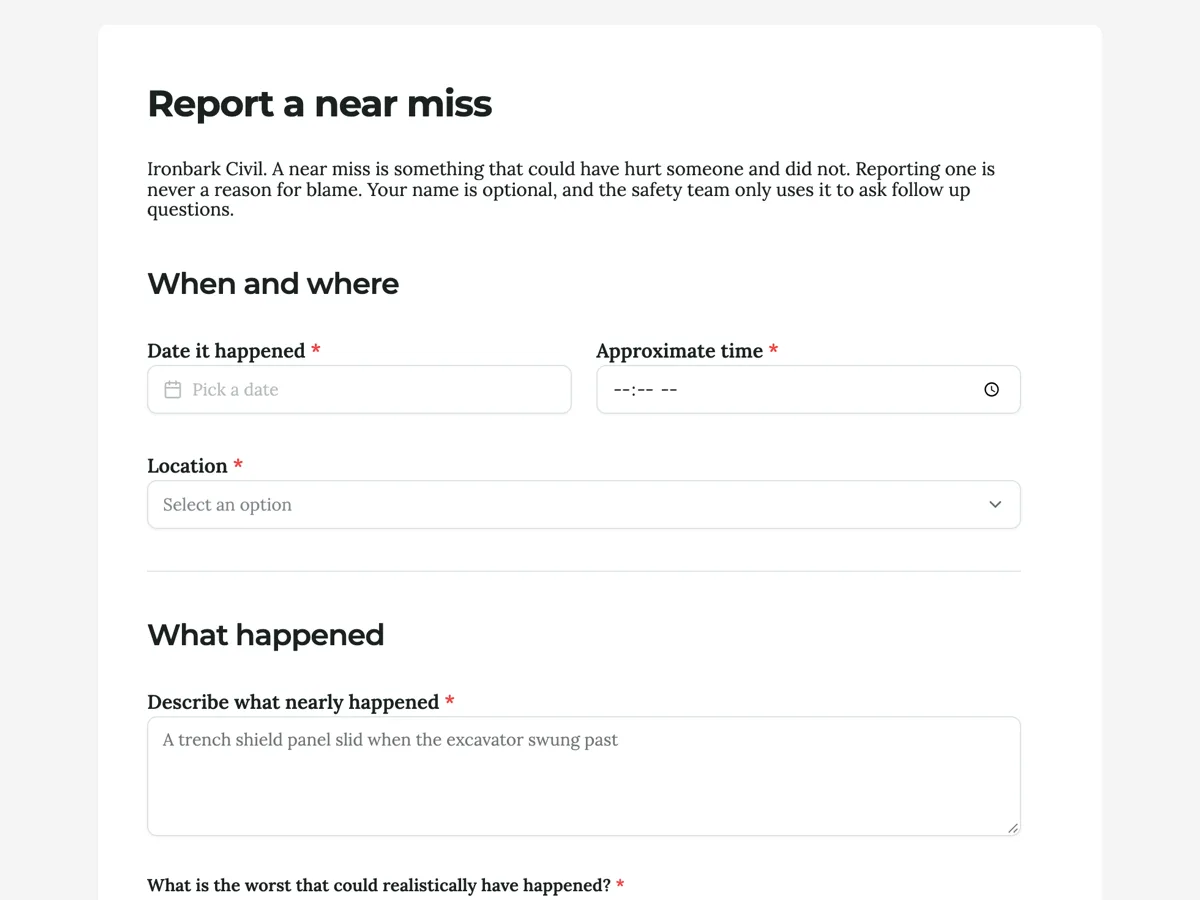
The form itself
A static copy of the finished form, exactly as it renders. Nothing here can be filled in or submitted, so read it as a reference and build your own from the button above.
Every field, and what it collects
The complete field list, in the order respondents meet it.
- Date it happenedDateRequired
- Approximate timeTimeRequired
- LocationDropdownRequired
- Options: Pipeline trench, stage 3 · Bridge abutment works · Site compound and laydown · Haul road · Office and amenities · Somewhere else on site
- Describe what nearly happenedLong textRequired
- What is the worst that could realistically have happened?Single choiceRequired
- Options: Minor injury, first aid at most · Injury needing a doctor or time off · Serious injury or a death · Damage to plant or property only
- What did you or others do straight away?Long text
- Photo of the hazardPhoto upload
- Only if it is safe to take one. Do not go back into danger for a photo.
- Your name, optionalShort text
- Does your supervisor know?Single choiceRequired
- Options: Yes, told them already · No, please let them know
When and where
What happened
What each field on this form collects
Date and approximate time sit side by side, then the location comes from a list of six work areas on the project, including somewhere else on site. A long text box takes what nearly happened. A single choice asks for the worst realistic outcome, from first aid to a death, with a separate answer for damage only. A second long text records the immediate action. A photo field is optional and its description warns against going back into danger. The reporter's name is optional, and a final required question asks whether the supervisor already knows.
Why a near miss deserves its own form
Most serious incidents are preceded by near misses that nobody wrote down. The trench shield that slid on Monday and stopped against the batter is the same shield that falls on Thursday. WorkSafe Victoria publishes near miss safety alerts for that reason: a near miss is a free lesson. A near miss form has to be quick, ask nothing that sounds like an investigation, and never feel like a confession. That is why this one has no field asking who was at fault, makes the name optional, and opens with a sentence saying reporting is never a reason for blame.
The worst realistic outcome
The single most useful answer on a near miss report is how bad it could have been. A dropped spanner on a ground floor and a dropped spanner from a bridge deck are the same event with very different outcomes, and the safety team triages them by potential, not by what actually happened. The radio question gives four plain answers that a worker can choose in seconds. A report marked serious injury or a death goes to the top of the pile even though nobody was touched, and that is the point of collecting them.
How to adapt this form
A warehouse replaces the work areas with aisles, docks and the yard and adds a question about forklifts involved. A hospital adds the ward and a choice for patient, staff or visitor at risk. A school adds the building and asks whether students were present, then routes reports to the business manager.
What makes this form work
Potential, not outcome
The worst realistic outcome question lets the safety team rank reports by what could have happened. A near miss with a fatal potential gets attention even though the form records no injury.
Name is optional, supervisor is not
The reporter can stay anonymous, but the form still asks whether the supervisor knows. A hazard reported anonymously can still be made safe today.
No photo at any cost
The photo description says not to go back into danger for a picture. A form that seems to demand evidence can push people toward the hazard it is meant to remove.
Questions people ask
What counts as a near miss?
An unplanned event that could have caused injury, illness or damage but did not, often by luck or a split second. A load swinging close to a worker, a slip caught on a handrail and a vehicle reversing past someone unseen are all near misses. If you are asking whether it counts, report it.
Does a near miss have to be reported to the regulator?
Most near misses do not, but some dangerous incidents must be notified even when nobody is hurt, such as certain collapses, uncontrolled releases and electric shocks. Check your state regulator's list of notifiable incidents. This form is for internal reporting and does not notify anyone outside the business.
Can near miss reports be anonymous?
This one can: the name field is optional. A public form records no account details unless you restrict it to signed in users. Anonymity helps people report, though it makes follow up questions impossible, which is why the form explains what the name is used for.
Who reads the reports?
Whoever owns the form, usually a safety advisor, sees every submission in the responses table. An email alert add-on can send each report to one address as it arrives. Share the lessons back at toolbox talks so workers see that reporting changes something.
Should a near miss lead to an investigation?
A near miss with serious potential deserves the same look as an incident: what failed, why, and what control would stop it. Low potential near misses are usually logged and trended. The worst realistic outcome answer on this form is what decides which path a report takes.
Build your own in about a minute
The button below opens the generator with this use case already described. Change the wording to match your own, generate, then edit anything you like.
Make one like thisOther form examples
Data breach report form for the NDB scheme
A data breach report form lets staff report a suspected breach quickly: when it was found, what information and how many people, how it happened, whether it is contained and whether it could cause serious harm. This Australian version explains the Notifiable Data Breaches test in plain words and leaves the assessment to the privacy officer.
Site safety inspection checklist by area
A site safety inspection checklist walks the whole site by area, from the entry and fencing to traffic, excavations, plant zones, heights, electrics, chemicals, amenities, first aid and services, and turns every problem into an action with an owner. This civil contractor version rates each area and records an overall condition.
Toolbox talk form that records what the crew said
A toolbox talk form records the date, topic and presenter, the points covered, who attended, what the crew raised and the actions agreed. This electrical contractor version gives the crew's issues their own box, because that is the part of a toolbox talk that changes anything.
Want the steps in the builder? Read Build a reporting form from a description, then Decide who can submit reports. For everything this generator can do, see the form maker.
Written and checked by the OneCraft team. Last checked .