Conversational form
Product return form with separate faulty and change of mind paths
A product return form must treat a faulty item as a consumer guarantee claim, not as a change of mind, because the Australian Consumer Law gives faults remedies that a store's returns policy cannot take away. This conversational version for an outdoor gear store sends each reason down its own path, and only applies the 30 day window to change of mind.
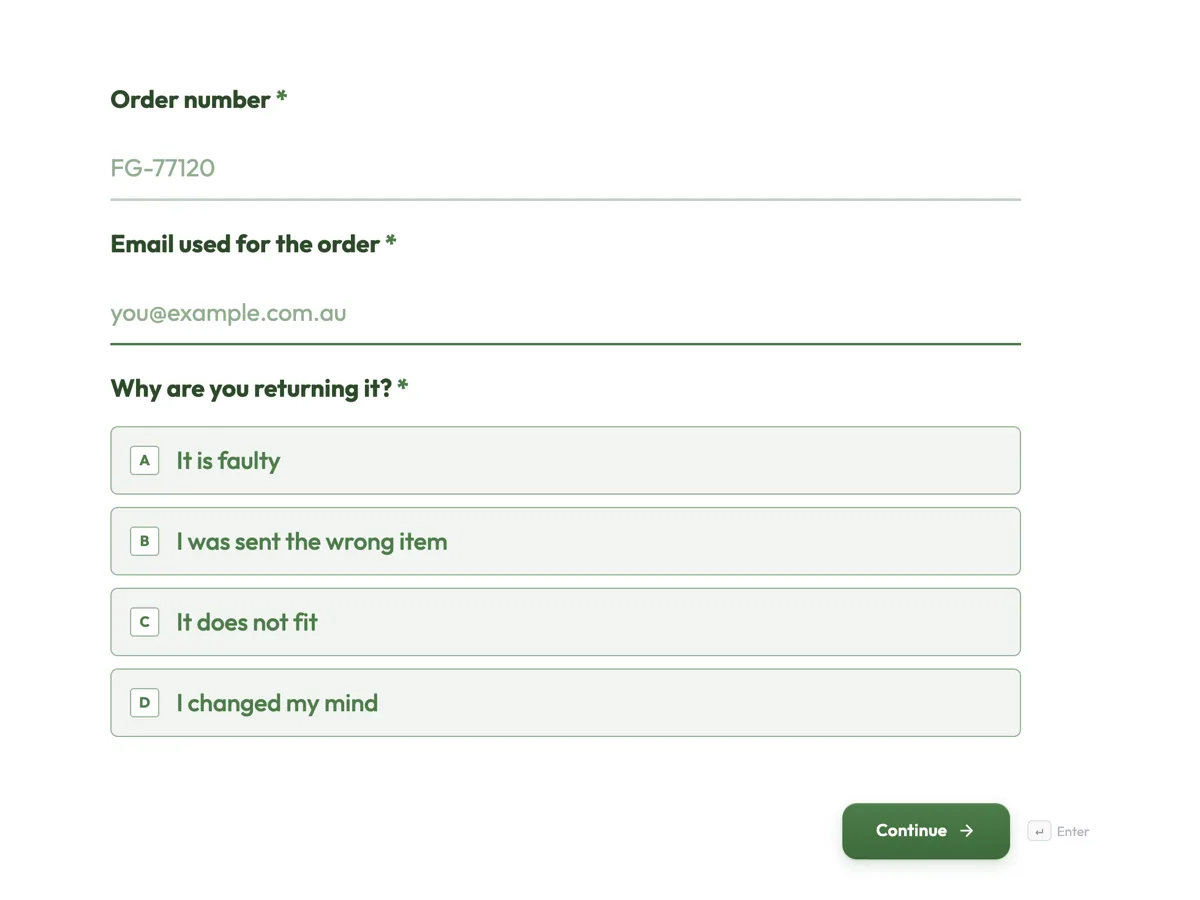
The form itself
The first screen of the form. A conversational form shows one question per screen, so the remaining screens are listed in the field table below. Nothing here can be filled in or submitted, so read it as a reference and build your own from the button above.
Every field, and what it collects
The complete field list, in the order respondents meet it.
- Order numberShort textRequired
- Email used for the orderEmailRequired
- Why are you returning it?Single choiceRequired
- Options: It is faulty · I was sent the wrong item · It does not fit · I changed my mind
- What happened?Long text
- Up to 3 photos of the faultFile upload
- What would you like?Single choice
- Options: A refund · A repair · A replacement
- What arrived instead?Short text
- Which size would you like instead?Dropdown
- Options: XS · S · M · L · XL · Shoe size, in the notes
- Did it arrive within the last 30 days, and is it unused?Single choice
- Options: Yes, unused with tags · No, more than 30 days ago
- How will you send it back?Single choice
- Options: Prepaid post label · Drop off at the Katoomba store
- Anything else?Long text
What each field on this form collects
Screen 1 takes the order number, email and reason. Screens 2 to 4 belong to faults: what happened, up to three photos and the remedy wanted. Screen 5 asks what arrived instead of the right item. Screen 6 asks the size for an exchange. Screen 7 asks a change of mind return whether it arrived within 30 days unused. Screen 8 is the policy stop screen. Screen 9 asks how the item will come back and screen 10 leaves room for anything else.
The rules, as the Logic tab shows them
On screen 1: if Why are you returning it is It is faulty, go to screen 2; I was sent the wrong item, screen 5; It does not fit, screen 6; I changed my mind, screen 7. On screen 7: if Did it arrive within the last 30 days is No, more than 30 days ago, go to screen 8. Screen 8 is set to End and submit. Screens 4, 5, 6 and 7 are each set to go to screen 9, so every accepted return reaches the method question without passing through other reasons' screens.
Faulty is not change of mind under the Australian Consumer Law
Under the consumer guarantees, a product must be of acceptable quality, match its description and be fit for purpose. A faulty product gets a remedy, refund, repair or replacement depending on whether the fault is major or minor, and a store's returns policy cannot remove that right or put a 30 day limit on it. Change of mind is different: a store does not have to accept it, and can set its own conditions. Consumer Affairs Victoria explains both. That is why the 30 day question only appears on the change of mind path, and the policy screen reminds anyone with a faulty item to go back and choose faulty. Law checked on 21 October 2026; this page is general information, not legal advice.
How to adapt this form
A store with a longer change of mind window changes the threshold in the question and the stop screen together. A business selling online to the UK adds a path for the 14 day cancellation right under the Consumer Contracts Regulations. A brand that offers lifetime warranties on some products adds a warranty path that asks for proof of purchase.
What makes this form work
The window only applies to change of mind
Only the change of mind path asks about 30 days. A faulty tent never meets the window, because consumer guarantees do not have one.
The stop screen points back to faulty
The policy screen tells anyone outside 30 days that a fault is a different claim with no time limit. A customer with a faulty item who chose the wrong reason is told how to fix it.
Remedies only for faults
Refund, repair or replacement is asked only after a fault is described and photographed. Exchanges by size and wrong items have their own simpler paths.
Questions people ask
Do I have to accept returns for change of mind in Australia?
No. Under the Australian Consumer Law, a business does not have to give a refund or exchange for change of mind, although many do as a policy. If it offers change of mind returns, it should honour the conditions it sets, such as this store's 30 days for unused items.
What remedy does a faulty item get?
If the fault is major, the customer can usually choose a refund or replacement, or keep the item with compensation for the drop in value. If it is minor, the business can choose to repair, replace or refund. Consumer Affairs Victoria and the ACCC explain the details.
Can a store ask for photos of a faulty product?
Yes, asking for evidence is reasonable and speeds up the claim. A store cannot refuse a valid fault claim just because the customer has no photo, though it can ask to inspect the item. The photo upload on this form is optional.
Is there a time limit on faulty item claims?
There is no fixed time limit. Consumer guarantees last for a reasonable time, which depends on the product, its price and how it was used. A store's returns policy or warranty period does not shorten that. Expensive outdoor gear can reasonably be expected to last for years.
Why does the form use a jump instead of hiding questions?
Conversational forms move between screens with jump rules; they cannot hide or show individual questions. Each reason jumps to its own screens and then joins the shared ending, which gives the same effect for the customer: each person sees only the questions for their reason.
Why are most questions optional?
Some customers end at the policy screen, and the server checks every required question when the form is sent, even on screens a jump skipped. Only screen 1, which everyone answers, is required, so every path can be submitted, including the one that ends at the policy screen.
Build your own in about a minute
The button below opens the generator with this use case already described. Change the wording to match your own, generate, then edit anything you like.
Make one like thisOther form examples
Customer support form for an online store
A customer support form that sorts by problem answers many orders without a reply, because a customer whose parcel is not late yet is told so on the spot. This conversational version for a homewares store asks for photos only when something arrived damaged, and never asks a product question for an order number.
Product recommendation quiz built from jump rules
A product recommendation quiz works when each answer narrows the shelf, and four questions are enough to point most people at one product. This coffee roaster quiz uses three jump rules, with no scoring, to land every path on one of four blend screens.
RMA form for industrial parts with every serial
An RMA form is where a return becomes a traceable record, so every serial number goes in before anything ships. This conversational version for an industrial electronics maker branches on the reason: excess stock sees the restocking fee and can cancel, and only failures in service are asked how long the units ran.
Want the steps in the builder? Read Create a returns form with branches, then Work through returns by reason. For everything this generator can do, see the form maker.
Sources
Written and checked by the OneCraft team. Last checked .