Contract clause
Alterations clause in a UK commercial lease
An alterations clause controls what changes a tenant may make to leased premises, such as building works, partitions or new services, and whether the landlord's consent is needed. It usually bans structural works, allows others with consent, and requires the tenant to reinstate the premises at the end of the lease.
Tenants want to fit a space to their business; landlords want the building back in a lettable state. The alterations clause draws the line between what a tenant can do freely, what needs consent, and what is banned altogether.
Nuwan Madhusanka · Co-founder
3 min read · Published
Sample clause
Written for a lease of the second floor of a fictional Leeds office building to Headrow Digital, a fictional digital agency.
Alterations. (a) The Tenant must not make any alteration to the structure or exterior of the Building, or to the Premises' load bearing elements. (b) The Tenant must not make any other alteration to the Premises without the Landlord's prior written consent, which must not be unreasonably withheld or delayed. (c) The Tenant may install, alter and remove demountable partitioning, floor and ceiling finishes and data cabling without consent, if it gives the Landlord drawings within 10 business days after completing the work and the work does not affect the Building's services or fire safety systems. (d) At the end of the Term the Tenant must remove any alterations if the Landlord gives notice at least 6 months before the end of the Term requiring it, and make good any damage caused by removal.
Sample wording, not legal advice.
Variants
Absolute ban on structural works
Multi let buildings where the landlord must protect the structure for all tenants.
The Tenant must not make any structural alteration or addition to the Premises, or cut into, remove or alter any load bearing wall, floor, column or beam.
Qualified consent
Most internal works, where the landlord wants control but should not block reasonable changes.
The Tenant must not make any internal non structural alteration without the Landlord's consent, such consent not to be unreasonably withheld or delayed. The Landlord may require the Tenant to enter into a licence for alterations setting out conditions for the works.
Free internal partitioning
Office tenants who reconfigure layouts often and need flexibility without seeking consent each time.
The Tenant may install and remove internal demountable partitions without the Landlord's consent, provided it notifies the Landlord with plans within 10 business days and complies with building regulations and fire safety requirements.
What to negotiate
Section 19(2) of the Landlord and Tenant Act 1927
Where a lease prohibits improvements without the landlord's consent, section 19(2) of the Landlord and Tenant Act 1927 implies that consent is not to be unreasonably withheld, though the landlord may require reasonable payments and an undertaking to reinstate in some cases. It applies to improvements, not to every alteration, and it cannot convert an absolute ban into a qualified one. Tenants should still ask for express not unreasonably withheld wording.
Reinstatement
Leases often require the tenant to remove its alterations and reinstate the premises at the end, which can be expensive. Tenants should negotiate that reinstatement applies only if the landlord gives notice in good time, as in the sample, and that works the landlord approved as improvements need not be removed. Landlords should record the original condition so reinstatement can be measured.
Licence for alterations
For significant works, landlords usually grant consent in a formal licence for alterations, a deed setting out the approved plans, the standards, insurance, the timetable and reinstatement obligations. Tenants should expect to pay the landlord's reasonable legal and surveyor's costs. Agreeing the form of licence early avoids delaying the fit out.
The risk of leaving it out
A lease silent on alterations leaves the position to the general law, which can allow a tenant to make changes the landlord never expected, or leave both sides unsure whether consent was needed. A clause that bans every alteration may prevent a tenant fitting out the space at all. Clear categories of what is free, what needs consent and what is banned avoid both problems.
Absolute, qualified and fully qualified covenants
An absolute covenant bans the alteration outright: the landlord can refuse for any reason or none, and section 19(2) does not apply. A qualified covenant bans it without the landlord's consent, so the landlord can decide, subject to section 19(2) for improvements. A fully qualified covenant bans it without consent, which must not be unreasonably withheld, expressly giving the tenant the protection. Most office leases use an absolute covenant for structural works and a fully qualified one for internal works, with some works allowed freely. Law checked on 21 October 2026. This page explains how the clause works and is not legal advice.
What counts as reasonable refusal
A landlord can reasonably refuse consent where the works would damage the structure, affect other tenants or the building's services, reduce the value of the landlord's interest, or breach planning or building regulations. Refusal for a reason unconnected with the works, such as to extract a higher rent, is likely to be unreasonable. A landlord should respond within a reasonable time and give reasons in writing.
Alterations and dilapidations
At the end of a lease, the tenant's repair and reinstatement obligations together form the dilapidations claim. Alterations that were not reinstated as required are a common head of claim. Keeping drawings, licences and the landlord's consents throughout the lease makes it much easier to show which works were approved and which must be removed.
Australia
Australian commercial leases use similar structures, with consent not to be unreasonably withheld for internal works and make good obligations at the end. The make good clause page covers the Australian end of lease obligations, which serve the same purpose as reinstatement and dilapidations in the UK.
Documents that carry this clause
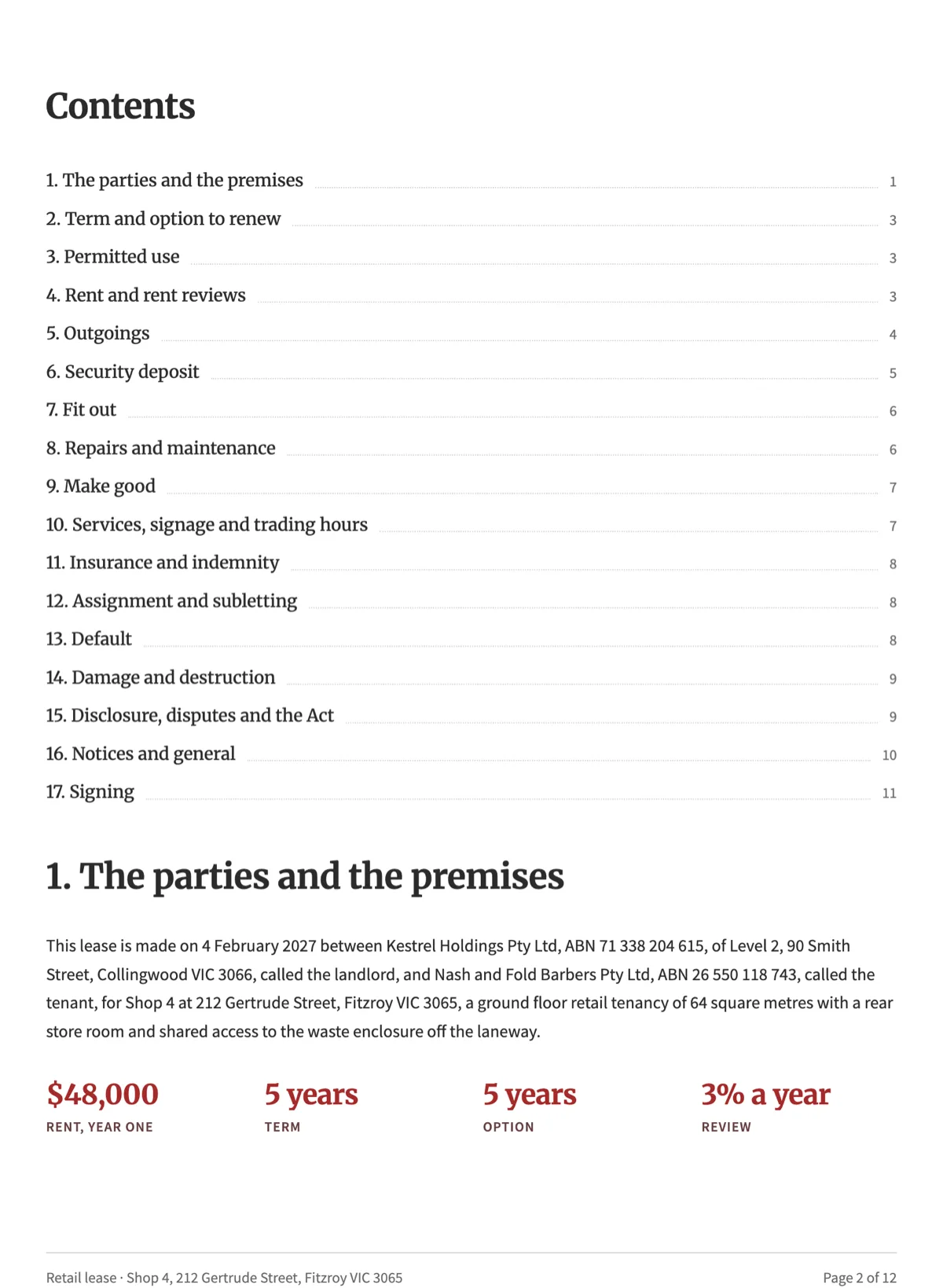 Commercial lease agreement template with outgoings and fit out termsA retail lease is decided by three numbers and two clauses: the rent, the review, the outgoings, the fit out contribution and the make good. This 12 page Victorian lease sets all five out in the open, including the outgoings the landlord is not allowed to recover at all.
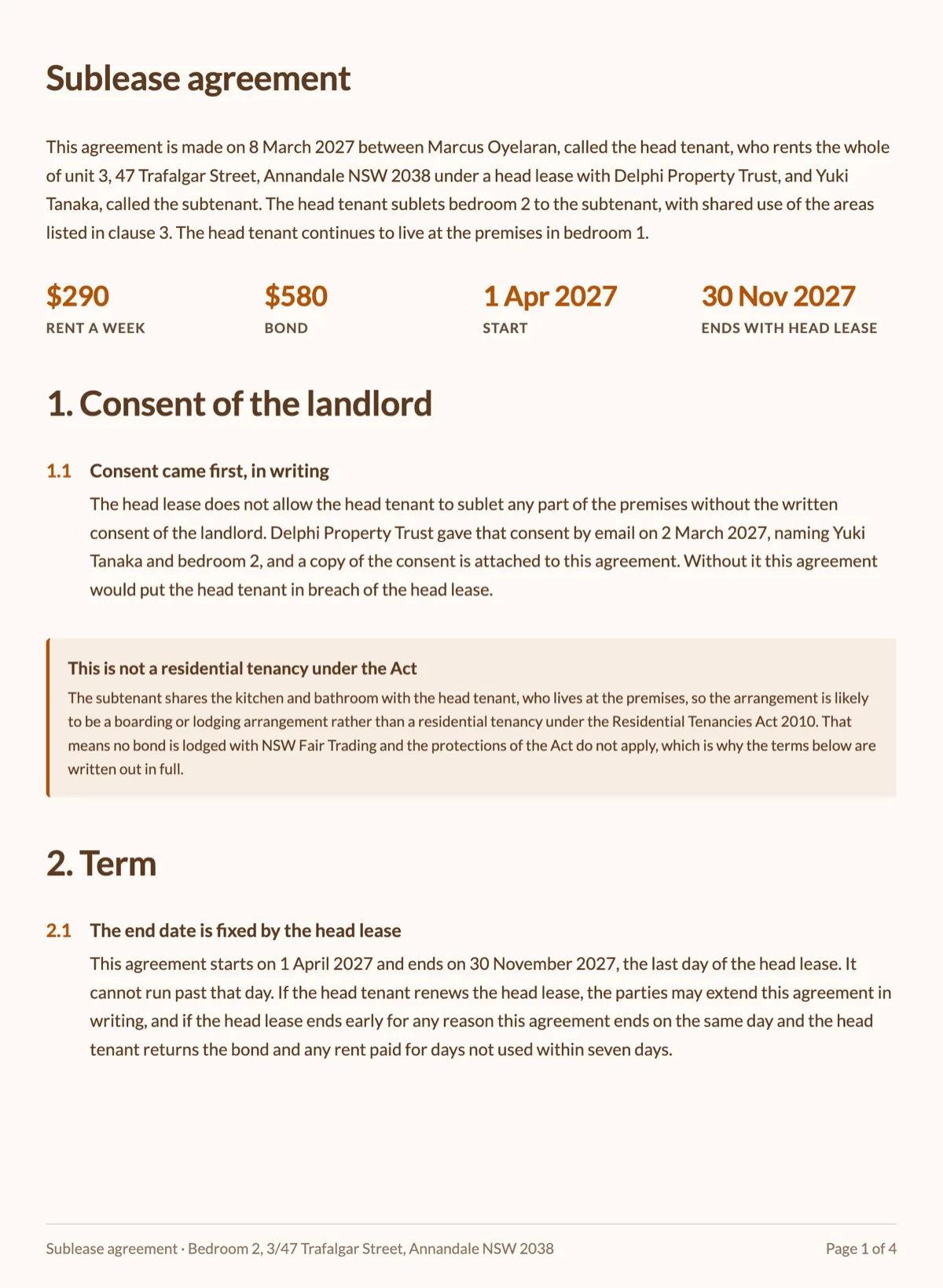 Sublease agreement template with the head lease consent recordedSubletting a room goes wrong in two places: the landlord never consented, and nobody wrote down what the occupant is actually renting. This agreement fixes the consent on the first page with a date and an email, then sets out the room, the shared areas and who keeps each one in order.
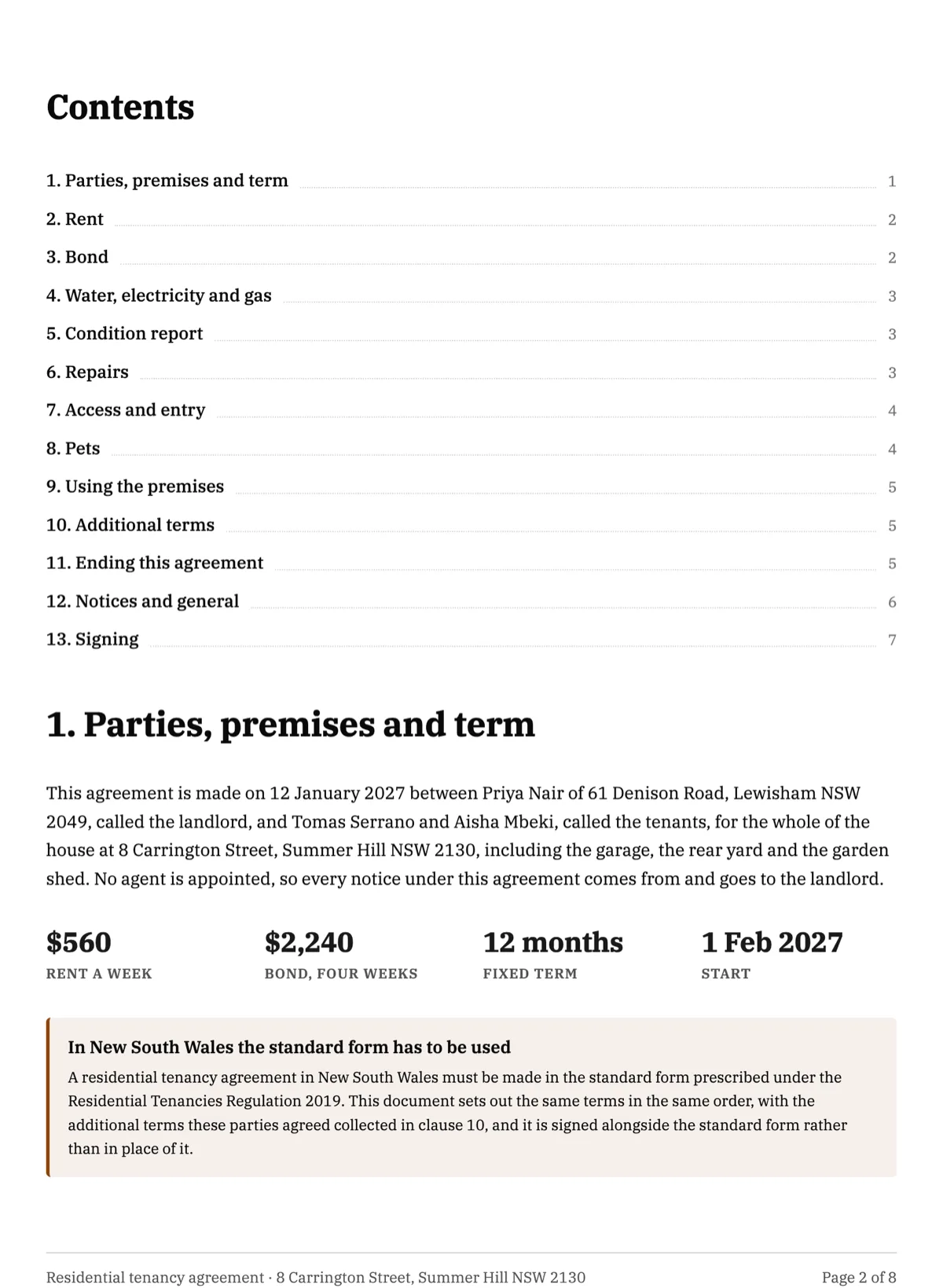 Residential lease agreement template for a New South Wales fixed termA residential tenancy is the one agreement where most of the terms are set by statute rather than by the parties, so the useful part of a template is the additional terms and the numbers. This one is a 12 month New South Wales fixed term at $560 a week, with the bond, the entry notice periods and the break fee written out exactly as the Act sets them.
Questions people ask
Can my landlord refuse consent to alterations?
If the lease bans the alteration absolutely, yes, for any reason. If it requires consent, a landlord can refuse only on reasonable grounds where the lease says consent is not to be unreasonably withheld, or where section 19(2) of the Landlord and Tenant Act 1927 applies to an improvement. Ask for reasons in writing.
Do I have to reinstate alterations at the end of the lease?
If the lease requires it, yes, and often only if the landlord gives notice. Some leases require reinstatement of all alterations; others only of those the landlord specifies. Check the licences for alterations, which may contain their own reinstatement terms.
What is a licence for alterations?
It is a formal document, usually a deed, in which the landlord gives consent to specific works on conditions such as approved plans, quality standards, insurance and reinstatement. Landlords usually ask for one for significant works, and the tenant usually pays the landlord's reasonable costs of preparing it.
Do I need consent to put up partitions?
It depends on the lease. Many office leases allow demountable partitions without consent if the landlord is notified and the work does not affect services or fire safety. Others require consent for any alteration. Check before starting work, because unauthorised alterations are a breach.
Does section 19(2) apply to every change I make?
No. It applies to improvements, which are judged from the tenant's point of view, and only where the lease prohibits them without consent. It does not apply where the lease bans works absolutely, and it does not stop a landlord requiring reasonable payments or reinstatement in some cases.
Put the clause in a finished document
The button opens the document generator with a starting description already filled in. Change it to match your own agreement before you run it.
Create a document with OneCraftRelated clauses
- Make good clause: what a tenant leaves behindA make good clause sets the condition a tenant leaves the premises in at the end of a lease. Victorian retail sample wording, scope checklist and variants.
- Repairs and maintenance clause: who fixes what in a leaseA repairs and maintenance clause splits who fixes what in a lease. Victorian retail sample wording, residential urgent repairs rules and a tenant heavy variant.
- Permitted use clause: what the premises may be used forA permitted use clause limits what leased premises may be used for. Victorian retail lease sample wording, narrow and broad variants, and what to negotiate.
- Service charge clause in a UK commercial leaseA service charge clause for a Bristol office lease: share by floor area, scheduled services, annual budget, reconciliation in 4 months, a cap and exclusions.
For everything the document generator can do, see the document maker.
Step by step in the builder: Create a document with AI, then Document builder components.
Written and checked by the OneCraft team. Last checked .