Contract clause
Bank guarantee clause: construction and lease security
A bank guarantee clause requires one party to give the other a bank's written promise to pay a set amount on demand, as security for performing a contract or a lease. The clause sets the amount, when the holder may call on it, when it must be returned and what happens if it is due to expire.
In Australian construction and commercial leasing, an unconditional bank guarantee is the usual form of security. It is as good as cash to the holder, so the clause's real job is to control when that cash can be taken.
Indunil Asanka · Co-founder
4 min read · Published
Sample clause
Written for a fit out contract between a building owner and Swanbourne Fitouts, a fictional Perth contractor, with a lease version for a tenant of the same building.
Security. (a) Within 10 business days after the Contract Date, the Contractor must give the Owner an unconditional and irrevocable bank guarantee from an Australian bank for 5% of the Contract Sum. (b) The Owner may call on the bank guarantee only for an amount the Contractor owes under this contract that remains unpaid 5 business days after the Owner has given the Contractor written notice of its intention to call, stating the amount and the reason. (c) The Owner must return half of the bank guarantee within 10 business days after Practical Completion and the balance within 10 business days after the end of the Defects Liability Period. (d) If the bank guarantee has an expiry date earlier than the date for its return, the Contractor must provide a replacement at least 15 business days before expiry.
Sample wording, not legal advice.
Variants
Construction security
Building and fit out contracts, where the guarantee secures completion, defects and amounts owing.
The Contractor must provide unconditional bank guarantees totalling 5% of the Contract Sum as security for its performance. The Principal may convert them to cash for any amount owing to it under the Contract after giving 5 business days' notice.
Lease security
Commercial and retail leases, where a guarantee replaces a cash bond and secures rent and the tenant's other obligations.
The Tenant must give the Landlord an unconditional bank guarantee equal to 3 months' rent and outgoings, including GST, to secure the Tenant's obligations under this Lease. The Landlord must return it within 30 days after the Tenant has vacated and met its obligations.
Reducing guarantee
Long projects where security should step down as the risk reduces.
On Practical Completion the security will reduce to 2.5% of the Contract Sum, and the Principal must return the excess guarantee within 10 business days. The remaining guarantee is returned at the end of the Defects Liability Period.
What to negotiate
When a call can be made
An unconditional guarantee lets the holder call without proving anything to the bank, so the contract must set the limits: only for amounts owing under the contract, and only after written notice. Australian courts will usually restrain a call only where it breaches such a contractual limit or involves unconscionable conduct, so the wording of the limit matters more than anything else.
Notice before calling
A notice period, typically 3 to 5 business days, gives the party providing security a chance to pay the amount or dispute it before the guarantee is cashed. Without notice, the first sign of a call may be a reduced bank facility. Holders sometimes resist notice for fear the other party will rush to court; a short notice period is the usual compromise.
Replacement on expiry
Many bank guarantees carry an expiry date. If the guarantee would expire before the date it is due to be returned, the clause should require a replacement in good time, and allow the holder to call and hold cash if it is not provided. Parties providing security should diarise expiry dates, because a call for failure to replace is hard to undo.
The risk of leaving it out
Without security, a principal or landlord has only a contractual claim against a party that may be insolvent when the claim arises. Without clear limits on calling, the party providing the guarantee faces the risk that it is cashed in a dispute, leaving it to sue to get the money back. A precise clause protects both.
Call and return timeline
In the sample, the timeline runs like this. Contract signed: guarantee due within 10 business days. During the works: a call only for an unpaid amount owing, after 5 business days' written notice. Practical completion: half returned within 10 business days. End of the 12 month defects liability period: the rest returned within 10 business days. Any time the guarantee approaches expiry: replacement due 15 business days before. Each step has a deadline, so neither side has to argue about what a reasonable time means. Law checked on 21 October 2026. This page explains how the clause works and is not legal advice.
Bank guarantees in leases
Commercial leases often ask for a bank guarantee of three to six months' rent. For retail premises, state retail leases laws, such as Victoria's Retail Leases Act 2003, set rules for leases of retail shops, and small business commissioners, such as the Victorian Small Business Commission, help with disputes about security and its return. The Australian Small Business and Family Enterprise Ombudsman provides guidance for small business tenants. A landlord should state in the lease when the guarantee will be returned, and a tenant should ask for return to be tied to vacating and meeting its obligations, not to a separate landlord sign off.
Bank guarantee or cash bond
A bank guarantee keeps the money in the provider's hands until a call, which suits contractors and tenants, though it uses up bank facilities and carries fees. A cash bond is simpler for the holder but ties up the provider's cash, and the holder may have to keep it in a trust or separate account. For residential tenancies, bonds are lodged with a state authority rather than held as guarantees.
Getting the form right
Banks issue guarantees on their own forms, which differ in expiry, how demands are made, and whether partial calls are allowed. The clause should state the essential terms, such as unconditional, irrevocable, from an Australian bank, no expiry or an agreed expiry, and allowing partial calls, so the holder can refuse a guarantee that does not match.
Documents that carry this clause
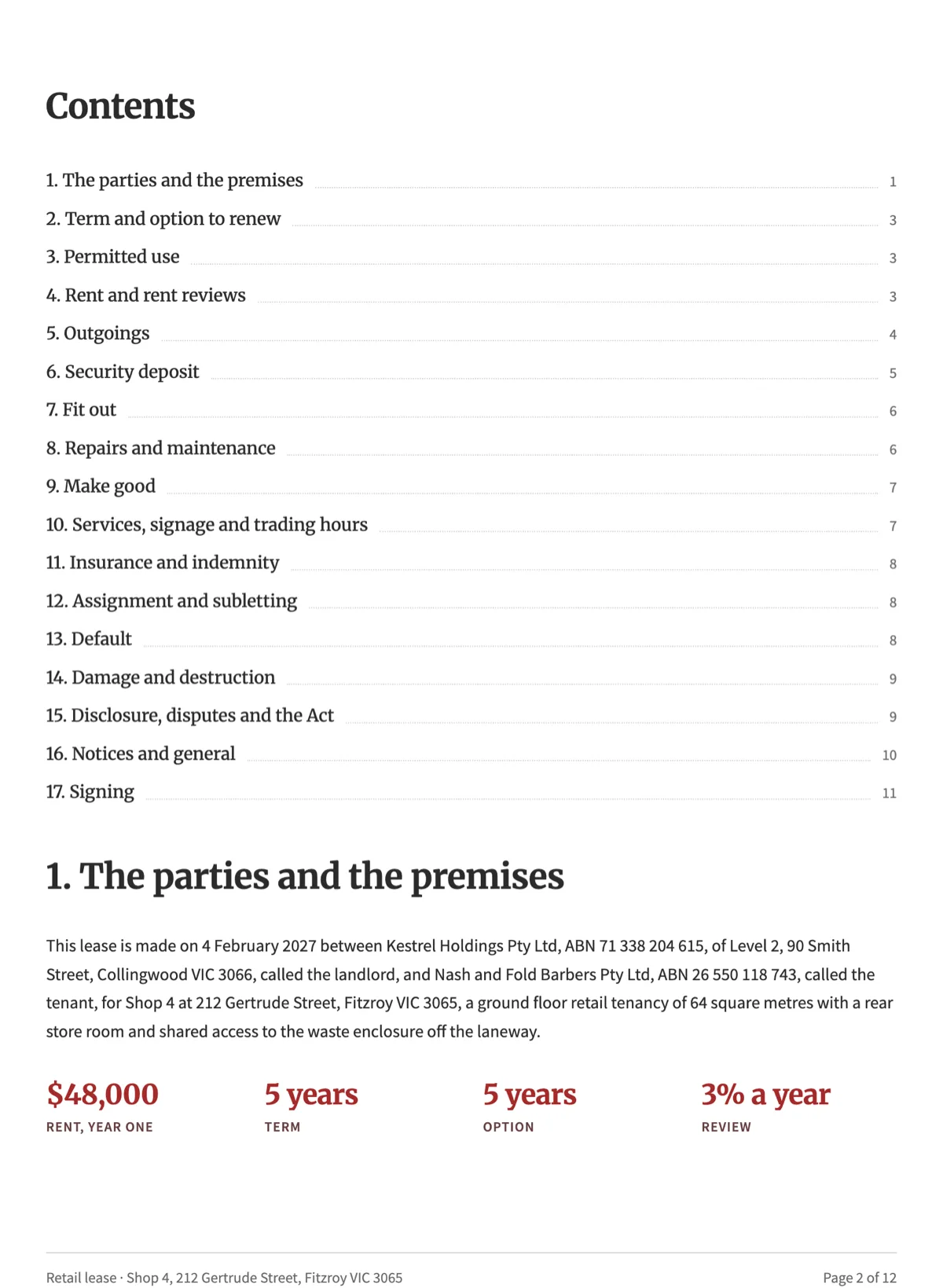 Commercial lease agreement template with outgoings and fit out termsA retail lease is decided by three numbers and two clauses: the rent, the review, the outgoings, the fit out contribution and the make good. This 12 page Victorian lease sets all five out in the open, including the outgoings the landlord is not allowed to recover at all.
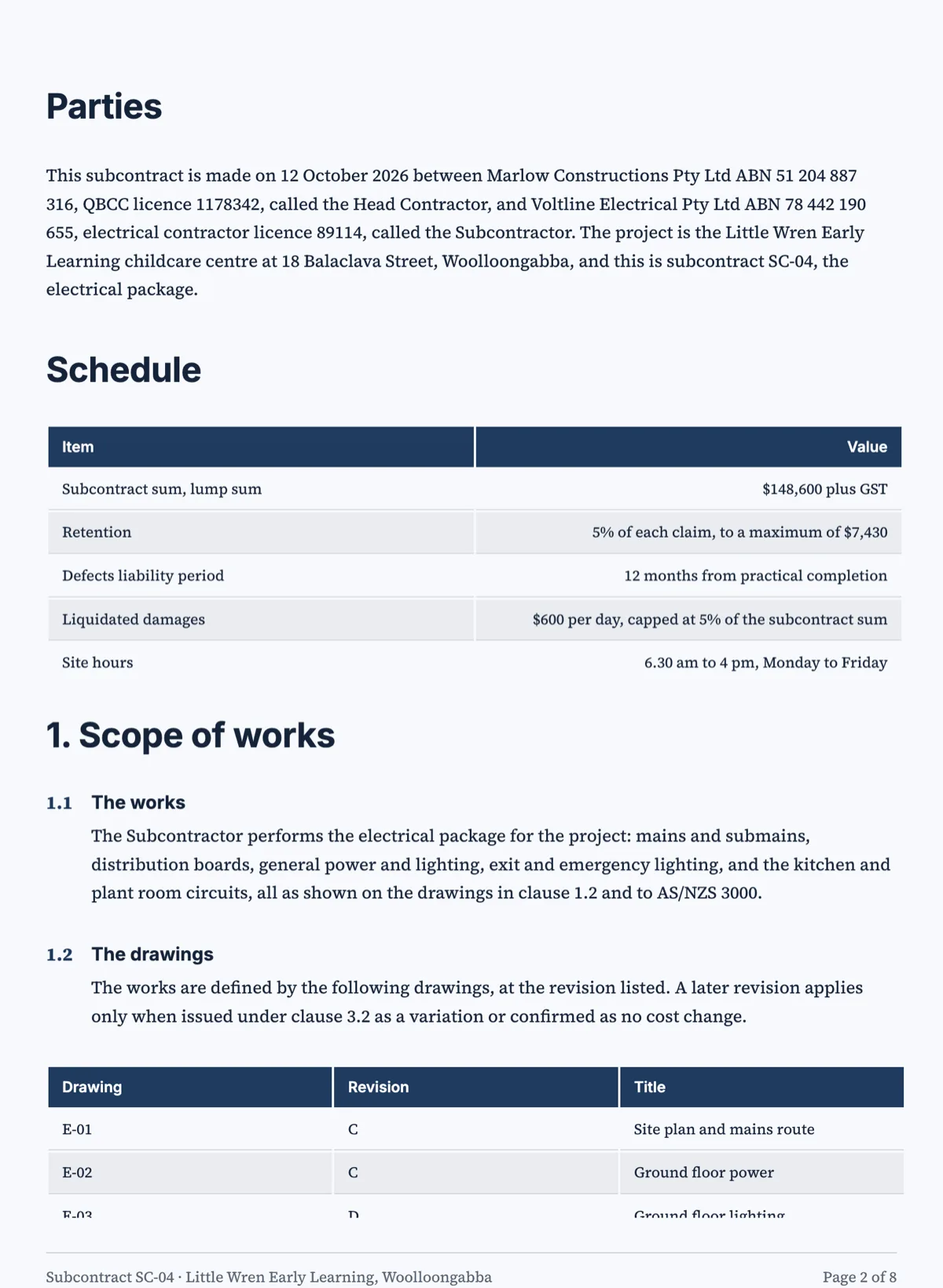 Subcontractor agreement template that flows the head contract downA subcontract exists to pass the head contract's obligations down one level and move the money back up on time. This one names the scope by drawing, sets the progress claim dates against the security of payment rules, holds retention and states the insurances, so the trade knows exactly when it is paid and for what.
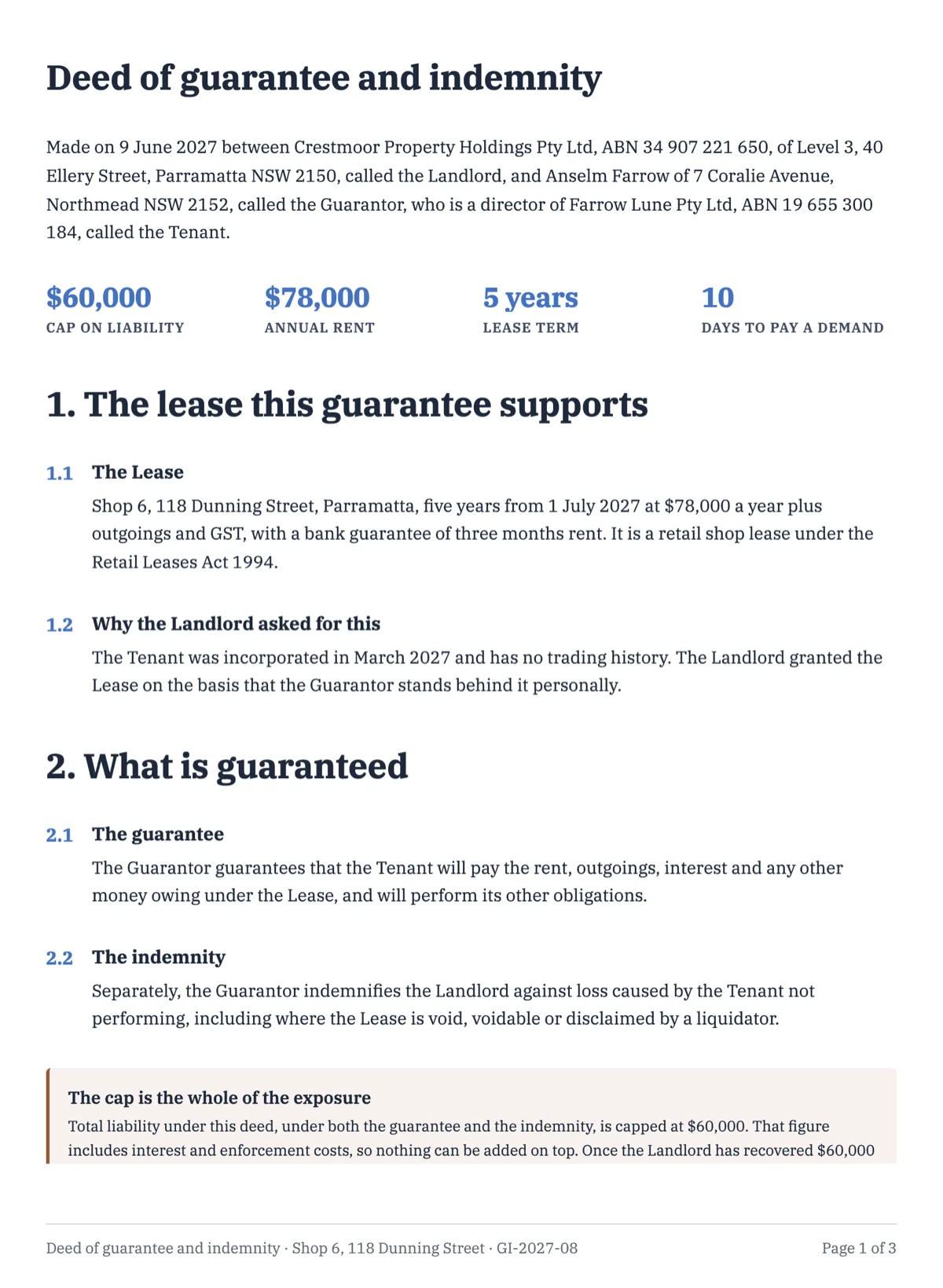 Personal guarantee template with a cap and a notice of demandA director asked to guarantee a lease wants to know one number: the most this can cost me. This three page deed answers it in a callout, capping the guarantor at $60,000 including interest and enforcement costs, then sets out the two steps the landlord has to take before a demand can be made at all.
Questions people ask
Can a landlord call on a bank guarantee without notice?
The bank will usually pay on a valid demand without asking the tenant, so whether notice is needed depends on the lease. If the lease requires notice before a call, calling without it is a breach that may allow a court to restrain the call. Many leases require notice only for some kinds of default.
When must a bank guarantee be returned?
When the contract or lease says. For construction, usually in stages at practical completion and the end of the defects period. For leases, after the tenant vacates and meets its obligations. A clause with a fixed number of days after the trigger avoids delays.
Is a bank guarantee better than a cash bond?
For the provider, usually, because the money stays in its hands and it can earn on it, though the bank charges fees and the guarantee reduces available credit. For the holder, a cash bond is simpler. In practice, bank guarantees are the norm in Australian construction and commercial leasing.
What happens if my bank guarantee expires?
If the contract requires a replacement before expiry and you do not provide one, the holder can often call the full amount and keep it as cash security. Check expiry dates when the guarantee is issued, and ask your bank to issue one without an expiry date if the contract allows it.
Can I stop a call on a bank guarantee?
Only in limited circumstances. Courts will generally restrain a call that breaches the contract's limits on calling, or that involves fraud or unconscionable conduct. A genuine dispute about whether money is owed is usually not enough if the contract allows calls for amounts claimed.
Put the clause in a finished document
The button opens the document generator with a starting description already filled in. Change it to match your own agreement before you run it.
Create a document with OneCraftRelated clauses
- Performance bond clause: sample, and on demand against conditionalA performance bond clause for a council road contract: a bond for 10% of the contract sum, release at practical completion, and on demand against conditional.
- Retention money clause: holding back part of a progress claimA retention money clause holds back part of each progress claim until defects are fixed. Australian sample wording, release triggers and a bank guarantee swap.
- Bond clause in a lease: amount, lodgement and returnA bond clause in a lease sets the security amount, where it is held and when it comes back. Victorian sample wording, NSW and retail lease variants.
- Make good clause: what a tenant leaves behindA make good clause sets the condition a tenant leaves the premises in at the end of a lease. Victorian retail sample wording, scope checklist and variants.
For everything the document generator can do, see the document maker.
Step by step in the builder: Create a document with AI, then Document builder components.
Written and checked by the OneCraft team. Last checked .