Contract clause
Performance bond clause: sample, and on demand against conditional
A performance bond clause requires a contractor to provide a guarantee from a third party, such as a bank or insurer, that pays the client up to a set amount if the contractor fails to perform. The clause sets the amount, the form of bond, when it can be called and when it is released.
A performance bond moves the risk of a contractor's default onto someone with deep pockets. The most important word in it is not the amount but whether it pays on demand or only once default is proven.
Nuwan Madhusanka · Co-founder
4 min read · Published
Sample clause
Written for a road upgrade contract between a fictional regional council and Keystone Civil, a fictional civil contractor.
Performance Security. (a) Within 14 days after the Contract Date, the Contractor must give the Principal a performance bond for 10% of the Contract Sum, issued by a bank or insurer approved by the Principal, in the form in Schedule 6. (b) The Principal may make a demand under the bond only to recover amounts it is entitled to under this contract, and must first give the Contractor 5 business days' written notice stating the amount and the reason. (c) The Principal must return the bond within 20 business days after the Date of Practical Completion, or after any later date by which all amounts due from the Contractor have been paid. (d) If the bond would expire before it is due to be returned, the Contractor must replace it at least 20 business days before expiry, failing which the Principal may call the full amount and hold it as cash security.
Sample wording, not legal advice.
Variants
On demand bond
Clients with bargaining power who want quick access to money without proving default first.
The Surety irrevocably and unconditionally undertakes to pay the Principal, on written demand and without reference to the Contractor or any dispute, any amount up to the Bond Amount stated in the demand.
Conditional or default bond
Contractors with enough leverage to require the client to prove a breach and its loss before payment.
The Surety will pay the Principal the amount of the loss the Principal proves it has suffered because of the Contractor's breach of the Contract, up to the Bond Amount, after the breach and the loss are established by agreement, adjudication or judgment.
Parent company guarantee instead
Subsidiaries of larger groups, where a guarantee from the parent costs less than a bank bond and the parent is financially strong.
The Guarantor guarantees to the Principal the due performance by the Contractor of its obligations under the Contract and agrees to indemnify the Principal against loss arising from the Contractor's failure to perform them.
What to negotiate
Amount and expiry
Ten percent of the contract sum is a common performance bond amount in Australia and the UK, sometimes reducing at practical completion. US federal construction under the Miller Act generally requires performance and payment bonds for contracts above a threshold. Contractors should resist a bond that runs well past completion, and ensure it has an expiry date or a clear return trigger, because an open bond ties up credit lines.
Calls in bad faith
An on demand bond pays when the client asks, so the contractor's protection is in the contract: a requirement to give notice before calling, and a restriction that the client may call only for amounts it is entitled to. Courts in Australia and the UK will generally restrain a call only for fraud or a clear breach of such a restriction, so the drafting does the real work.
Who issues it, and the cost
Banks issue bonds against the contractor's credit facilities, reducing what it can borrow. Insurers and surety companies issue them for a premium. The client should name acceptable issuers by credit rating, and the contractor should price the cost into its tender, because a 10% bond on a large contract is a real expense.
The risk of leaving it out
Without performance security, a client whose contractor collapses mid project has only an unsecured claim against an insolvent company, while it pays another contractor to finish the work. On a public road contract, that can mean months of delay and costs the ratepayers carry. For contractors, bonds are a cost of tendering for larger work.
On demand and conditional bonds compared
An on demand bond pays when the client makes a compliant written demand, without proving any breach. It is fast and certain for the client and risky for the contractor. A conditional bond pays only once default and loss are established, which protects the contractor but can take months. On demand bonds are standard in Australian construction and common in international contracts; conditional bonds are more common in the UK private sector and with US surety bonds, where the surety may investigate and arrange completion rather than simply pay. Law checked on 21 October 2026. This page explains how the clause works and is not legal advice.
Performance bonds in the United States
In the US, performance bonds are typically issued by surety companies rather than banks, and on federal construction the Miller Act, at 40 U.S.C. section 3131, requires a performance bond and a payment bond before a contract above a dollar threshold is awarded. A surety that receives a valid claim may finance the original contractor, take over the work, or pay. Many states have similar laws for state public works, often called little Miller Acts.
Bonds and bank guarantees
In Australia, contractors often provide unconditional bank guarantees rather than insurance bonds, and the two are treated in much the same way: both are on demand instruments. The bank guarantee clause page covers the Australian practice in detail, including leases. The drafting points are the same: the amount, notice before a call, return on time and replacement before expiry.
Writing the schedule
Attach the agreed form of bond as a schedule so the issuer's wording cannot change the deal. The form should state the beneficiary, the amount, whether it is on demand or conditional, the expiry, and how a demand is made. Ask the contractor's bank or surety to confirm it will issue in that form before the contract is signed, since some issuers will only use their own wording.
Documents that carry this clause
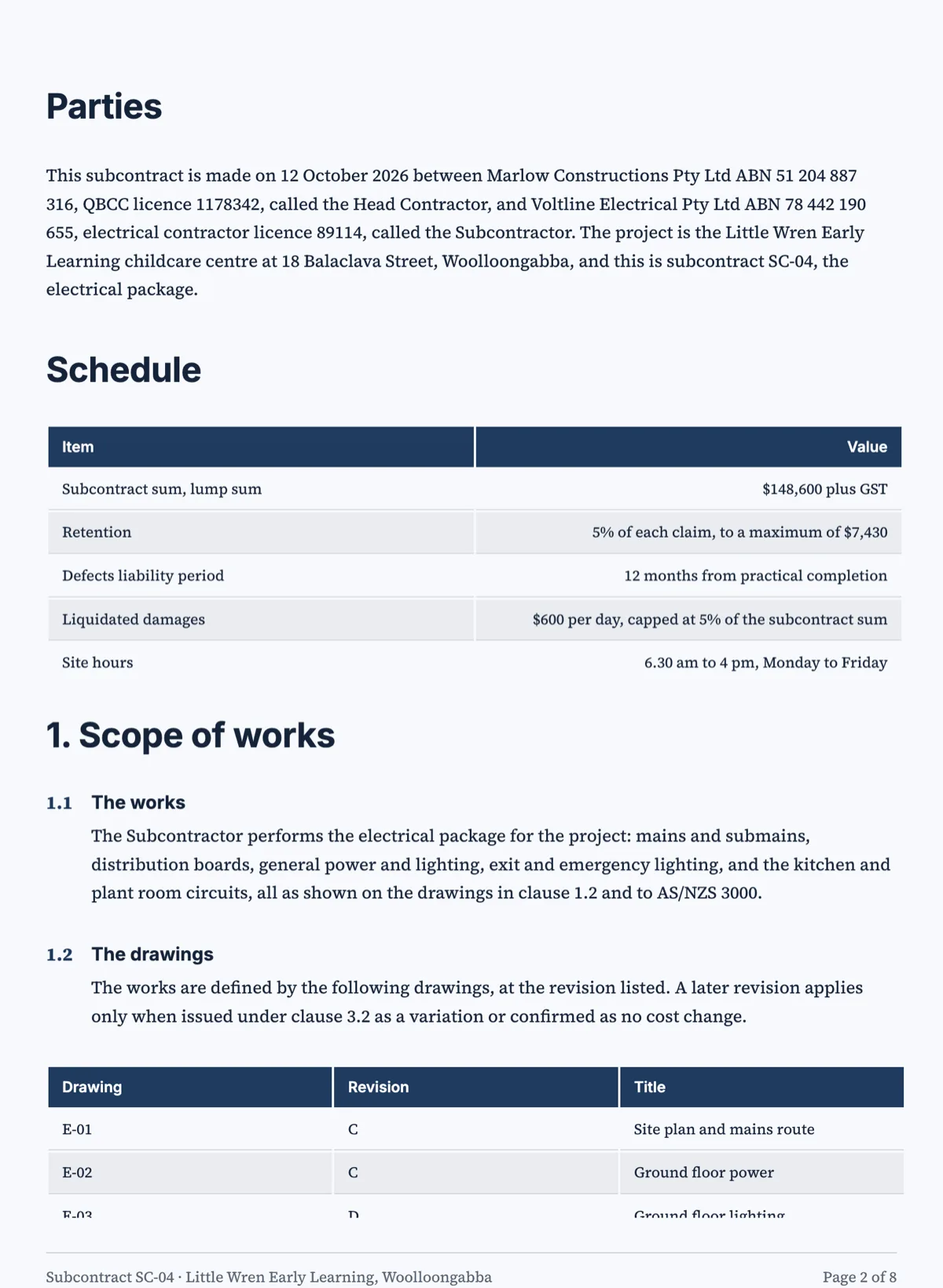 Subcontractor agreement template that flows the head contract downA subcontract exists to pass the head contract's obligations down one level and move the money back up on time. This one names the scope by drawing, sets the progress claim dates against the security of payment rules, holds retention and states the insurances, so the trade knows exactly when it is paid and for what.
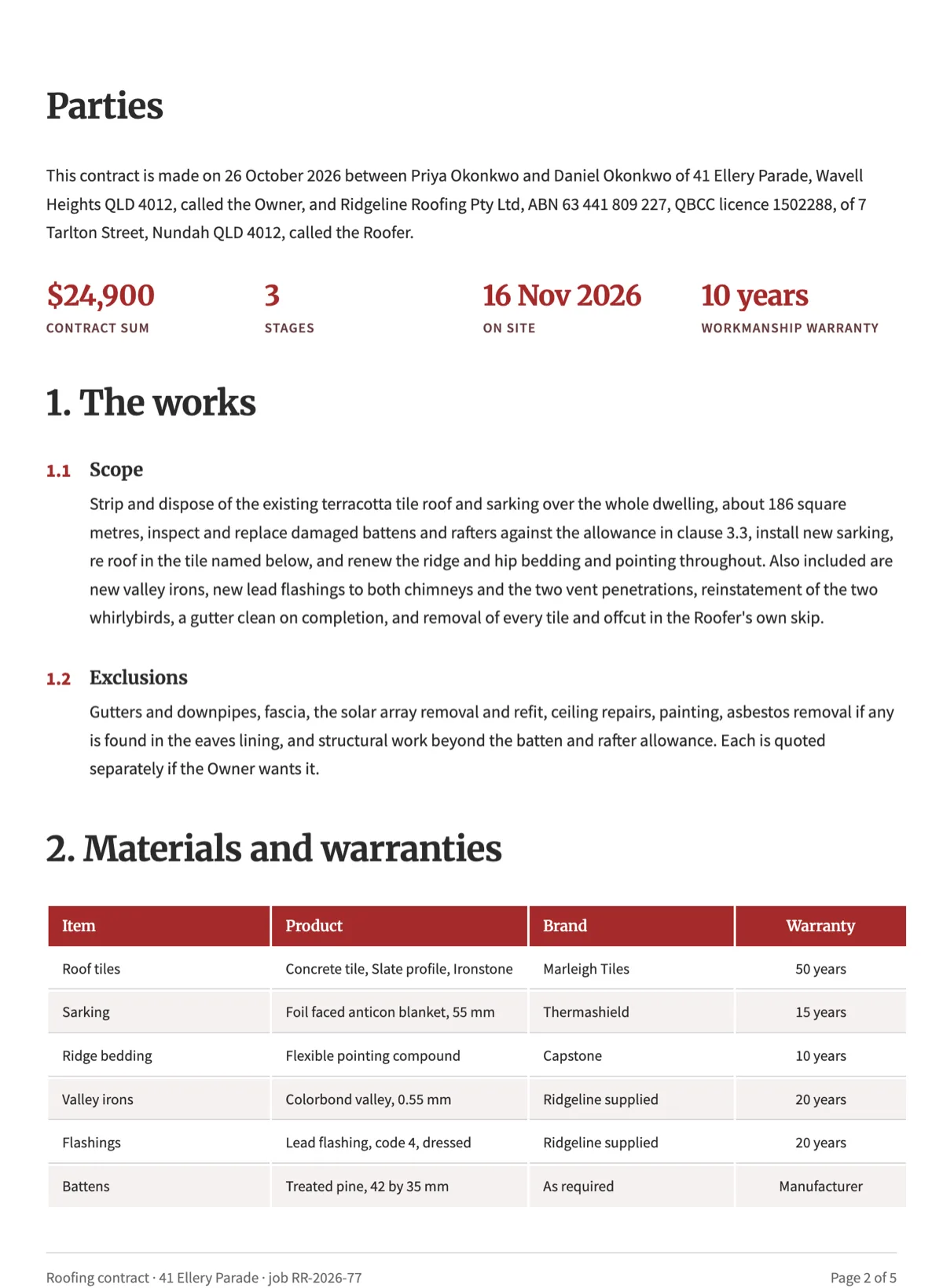 Roofing contract template with a materials table and a weather ruleA roof replacement is the one job where the house is open to the sky at the end of the day, so the clause that matters most is the one about closing it. This contract limits how much roof can be stripped at once, names every product with its warranty years, and says who pays when water gets in.
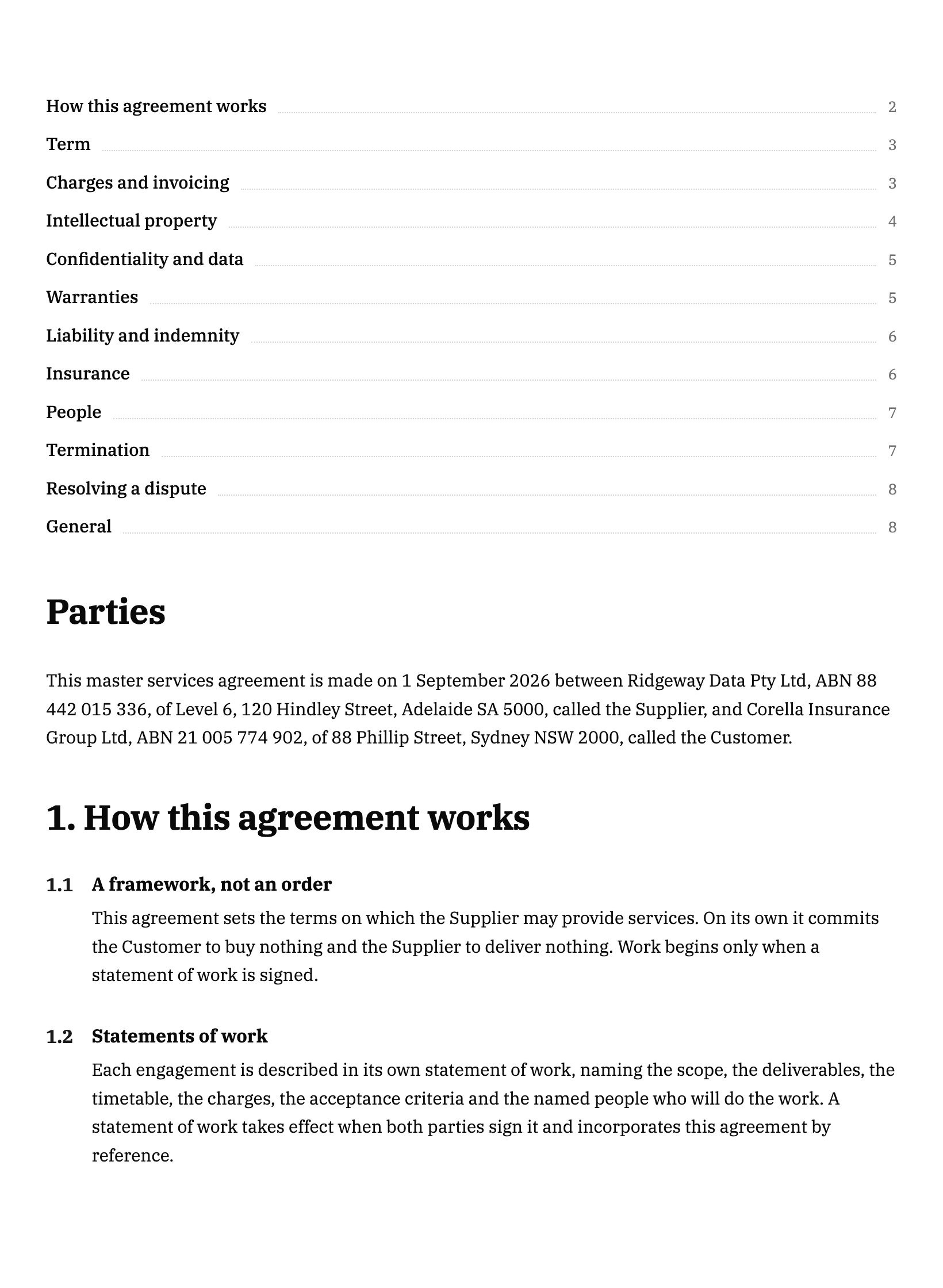 Master services agreementA data consultancy and an insurer sign this once and then buy work under it for three years. It is the rare contract whose whole purpose is to make the next twenty contracts short.
Questions people ask
What is a performance bond in a contract?
It is a promise by a bank, insurer or surety to pay the client up to a stated amount if the contractor fails to perform. The contract clause requires the contractor to provide it, sets the amount and form, and says when it can be called and when it must be returned.
What is the difference between an on demand and conditional bond?
An on demand bond pays when the client makes a valid written demand, without proving a breach. A conditional bond pays only once the contractor's default and the client's loss are established. On demand bonds favour the client; conditional bonds favour the contractor.
When is a performance bond released?
When the contract says, usually at practical completion or at the end of the defects liability period, sometimes in two stages. The clause should give a deadline for return after that date. A bond with no return trigger can tie up the contractor's credit long after the work is finished.
Can a client call on a bond without notice?
Under an on demand bond, the issuer will usually pay on a compliant demand regardless. Whether the client was entitled to call depends on the contract, so a contractor's protection is a contractual requirement to give notice first and to call only for amounts due. Breach of those terms may allow a court to restrain the call.
How much does a performance bond cost?
Insurance or surety bonds cost an annual premium, often a small percentage of the bond amount, depending on the contractor's financial strength. Bank guarantees usually carry a fee and reduce the contractor's borrowing capacity. Contractors should include the cost in their tender price.
Put the clause in a finished document
The button opens the document generator with a starting description already filled in. Change it to match your own agreement before you run it.
Create a document with OneCraftRelated clauses
- Bank guarantee clause: construction and lease securityA bank guarantee clause for a Perth fit out contractor and a lease: an unconditional guarantee, notice before a call, staged return and replacement.
- Retention money clause: holding back part of a progress claimA retention money clause holds back part of each progress claim until defects are fixed. Australian sample wording, release triggers and a bank guarantee swap.
- Defects liability clause: fixing defects after practical completionA defects liability clause sets how long a builder must return to fix defects after completion. Australian sample wording, typical periods and three variants.
- Practical completion clause: when the works are ready to useA practical completion clause defines when building work is finished enough to use. Australian sample wording, a handover checklist and certificate steps.
For everything the document generator can do, see the document maker.
Step by step in the builder: Create a document with AI, then Document builder components.
Written and checked by the OneCraft team. Last checked .