Contract clause
Hardship clause: sample wording and the difference from force majeure
A hardship clause deals with events that make a contract much more expensive or burdensome to perform without making it impossible. It requires the parties to renegotiate in good faith and says what happens if they cannot agree, such as adjustment by an expert or termination.
Force majeure covers the day the ship cannot sail. Hardship covers the year the fuel to sail it costs twice as much. A long supply contract usually needs both, because they answer different problems.
Indunil Asanka · Co-founder
4 min read · Published
Sample clause
Written for a five year seafood supply agreement between Coral Coast Seafoods, a fictional Townsville exporter, and a restaurant group buyer.
Hardship. (a) A party may give notice under this clause if, after the Commencement Date, the Freight Cost Index rises by more than 30% above its level at the Commencement Date and stays above that level for at least 60 days, so that performing this agreement on its current terms has become excessively onerous for that party. (b) Within 15 business days of a notice, the parties must meet and negotiate in good faith an adjustment of the Prices that fairly allocates the increased cost. (c) If they do not agree within 30 business days of the notice, either party may refer the adjustment to an independent expert appointed under clause 21, whose decision binds both parties. (d) Until an adjustment takes effect, the parties must continue to perform this agreement.
Sample wording, not legal advice.
Variants
Renegotiate only
Relationships built on trust, where the parties prefer a duty to talk without handing the outcome to anyone else.
If performance of this agreement becomes excessively onerous for a party because of events beyond its reasonable control that could not reasonably have been taken into account at signing, the parties must negotiate in good faith alternative terms that reasonably allow for those events.
Renegotiate, then expert adjustment
Long supply and service contracts with an objective cost driver, where a deadlock should end in a decision rather than a dispute.
If the parties cannot agree adjusted terms within 30 business days of a hardship notice, either party may refer the matter to an independent expert, who must adjust the price to share the increased cost fairly between the parties, having regard to the original allocation of risk.
Renegotiate, then termination
Contracts where neither party wants a third party setting the price and an exit is acceptable.
If the parties cannot agree adjusted terms within 30 business days of a hardship notice, the party affected may terminate this agreement by giving 60 days' written notice, without liability to the other party for the termination.
What to negotiate
The trigger threshold
A vague trigger, such as performance becoming more onerous, invites argument about every cost rise. A measurable trigger, such as a published index rising by a stated percentage for a stated period, makes the clause predictable. Parties should agree a threshold large enough to exclude ordinary fluctuation: 20% to 30% on a key input is common in supply contracts where that input is a large share of cost.
The index
Choose an index that tracks the cost actually at risk, is published regularly by a reliable source, and is unlikely to be discontinued, with a fallback if it is. For freight and fuel, a published fuel or freight index; for labour, a wage price index. The base level should be fixed at signing and recorded in the contract.
Who decides if talks fail
A duty to renegotiate with no consequence can leave the burdened party stuck. The options are an expert adjusting the price, which keeps the relationship going, termination, which lets the parties walk away, or a court or arbitrator, which the UNIDROIT Principles allow to adapt or end the contract. Each party should choose the outcome it can live with when it is on the losing side.
The risk of leaving it out
Without a hardship clause, a party whose costs explode is generally held to the bargain: in English and Australian law, a contract is not frustrated just because it has become much more expensive to perform. The burdened party may then perform at a loss, break the contract and face damages, or look for a force majeure clause that probably does not cover a price rise.
Hardship against force majeure
Force majeure deals with events beyond a party's control that prevent or delay performance, such as natural disasters or government action, and usually suspends obligations or allows termination. Hardship deals with events that leave performance possible but make it excessively onerous, and leads to renegotiation. The ICC publishes separate model clauses for each: the ICC Force Majeure Clause and the ICC Hardship Clause, both updated in 2020. Force majeure asks whether a party can perform; hardship asks whether it is fair to make it perform on the original terms. Law checked on 21 October 2026. This page explains how the clause works and is not legal advice.
The ICC and UNIDROIT models
The ICC Hardship Clause 2020 requires a party invoking it to show that continued performance has become excessively onerous due to an event beyond its reasonable control which it could not reasonably have been expected to take into account. The parties must then negotiate alternative terms, and if they fail, the clause offers options including termination or adaptation by a judge or arbitrator. Articles 6.2.1 to 6.2.3 of the UNIDROIT Principles of International Commercial Contracts take a similar approach and are often chosen to govern international contracts.
Hardship in Australian contracts
Australian law has no general hardship doctrine. Frustration applies only where performance becomes radically different, and a rise in cost rarely meets that bar. So any relief for cost increases has to be written into the contract, through a hardship clause, a price adjustment or rise and fall clause, or an index linked price. For a long export supply deal like Coral Coast Seafoods', the hardship clause sits alongside an annual price review: the review handles normal movement, and hardship handles the shock.
Drafting for continued performance
The sample requires both parties to keep performing while the adjustment is worked out. Without that, the burdened party might stop supplying as leverage in the negotiation, which damages the relationship the clause is meant to preserve. The expert route also needs a deadline and clear criteria, such as sharing the increased cost fairly, so the expert is deciding a narrow question rather than rewriting the deal.
Documents that carry this clause
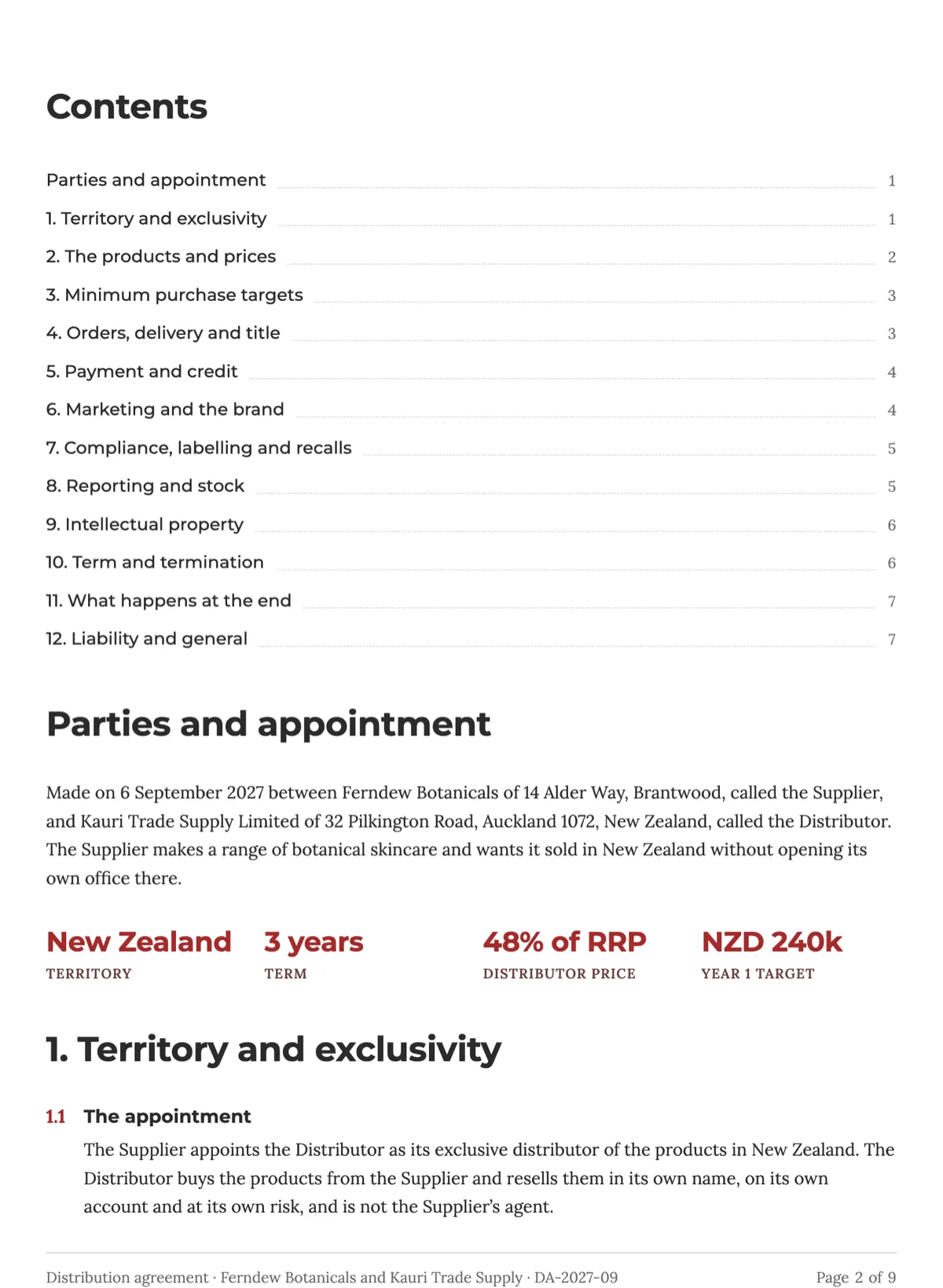 Distribution agreement template with territory and targetsAn exclusive distribution agreement is a trade: a territory in exchange for volume. This one appoints a New Zealand distributor for a skincare range at 48 per cent of recommended retail, with purchase targets rising from NZD 240,000 to NZD 420,000 across three years, and exclusivity that converts to non exclusive if a target is missed by more than 15 per cent.
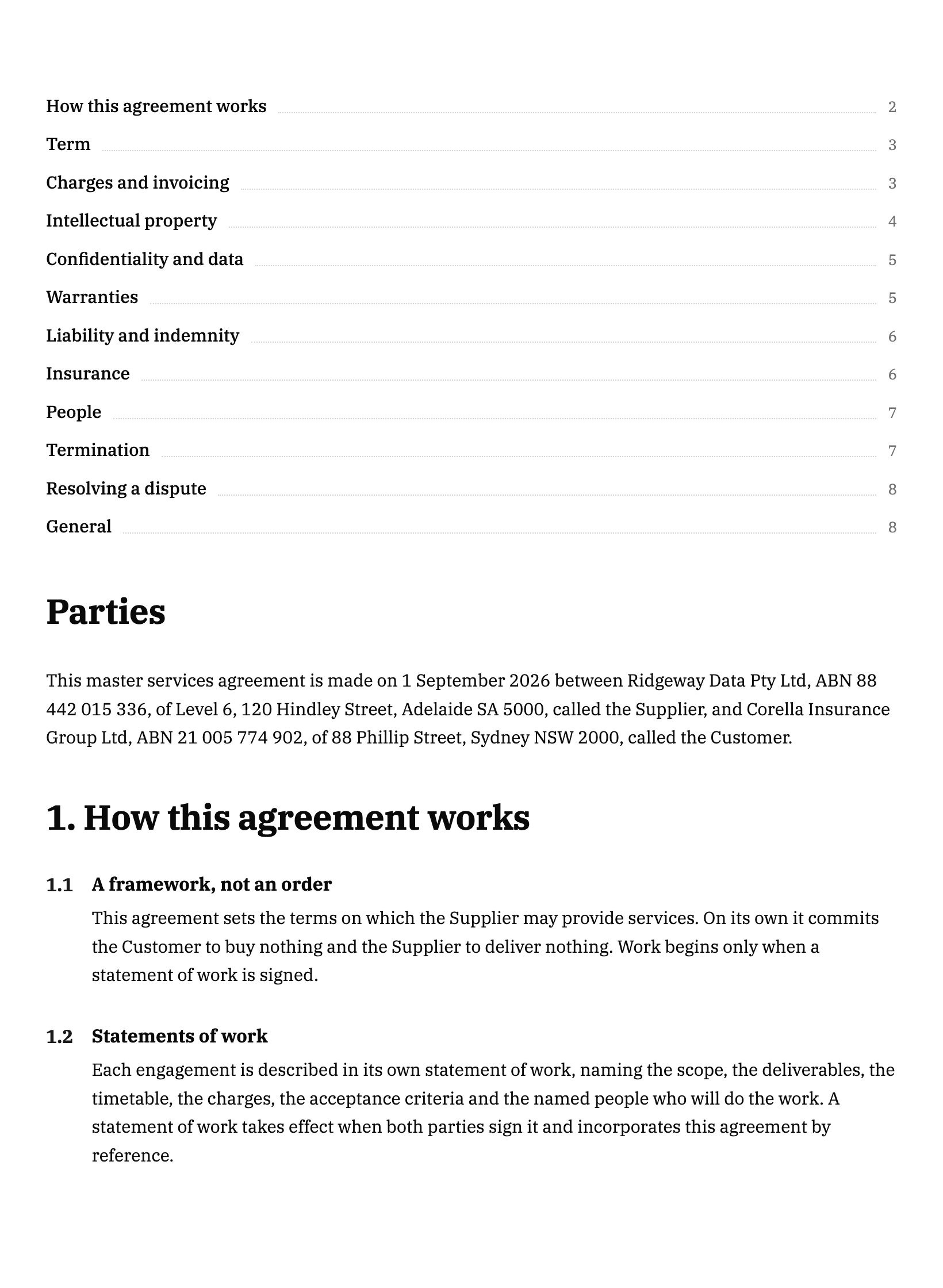 Master services agreementA data consultancy and an insurer sign this once and then buy work under it for three years. It is the rare contract whose whole purpose is to make the next twenty contracts short.
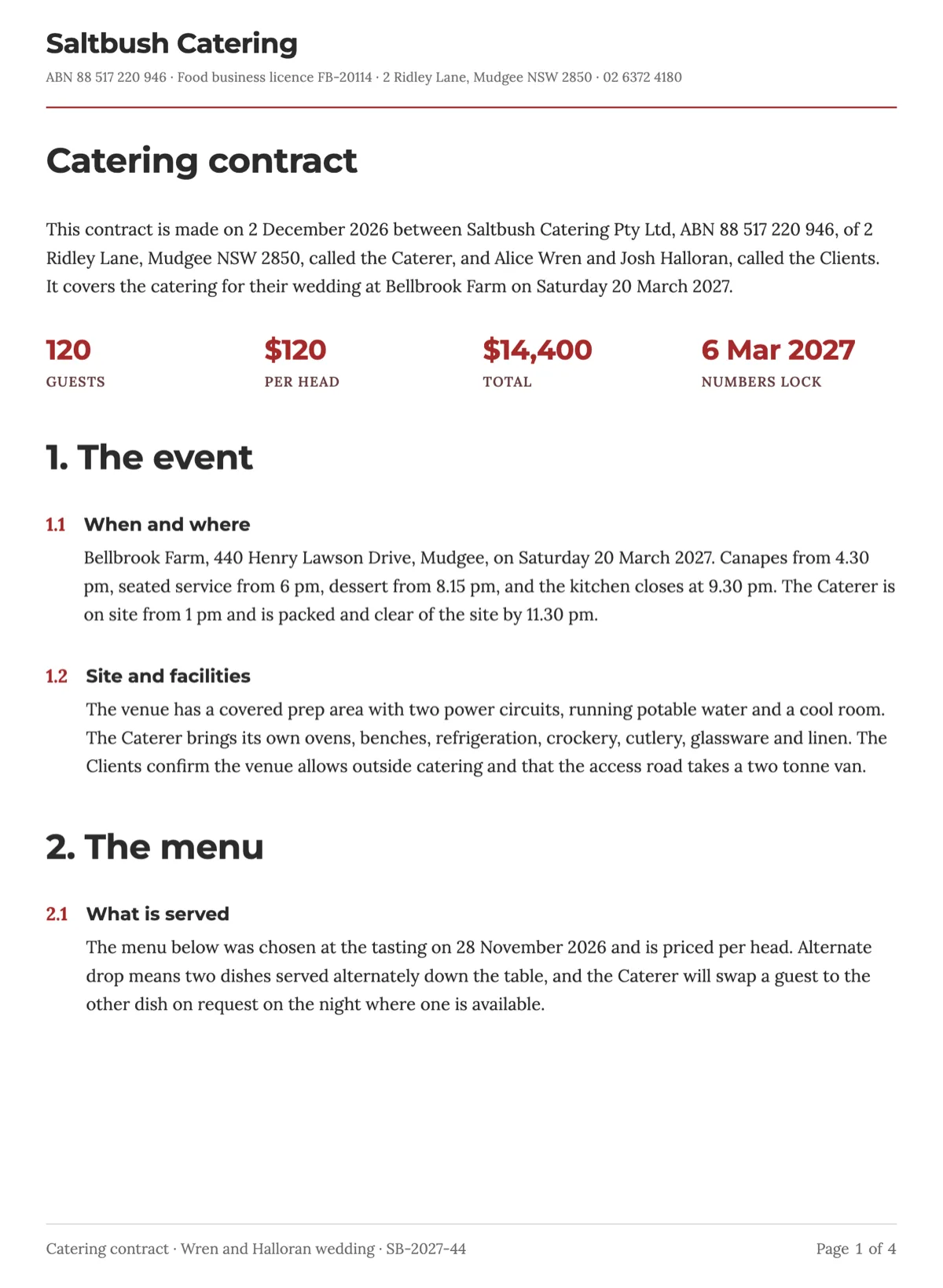 Catering contract template with a menu table and a guest numbers lockCatering is priced per head and delivered per plate, which is why the two clauses that matter most are the one that locks the number and the one that says who gets what. This contract prices six courses per head, freezes numbers 14 days out, and puts every dietary requirement in a matrix with the main and the dessert each guest is served.
Questions people ask
What is the difference between hardship and force majeure?
Force majeure applies when an event prevents or delays performance, and usually suspends obligations. Hardship applies when performance is still possible but has become excessively onerous, usually through a large cost increase, and triggers renegotiation. Many long term contracts include both, because a war might trigger one and a fuel price spike the other.
What counts as hardship in a contract?
Whatever the clause defines. Model clauses such as the ICC Hardship Clause require an event beyond the party's control, which it could not reasonably have foreseen, that makes continued performance excessively onerous. A well drafted commercial clause replaces those general words with a measurable trigger, such as an index rising by a set percentage.
Can a court rewrite the price under a hardship clause?
Only if the contract or the governing law gives it that power. The UNIDROIT Principles allow a court or arbitrator to adapt the contract, and the ICC clause offers adaptation as an option. Without such a provision, Australian and English courts will not rewrite a price, which is why the clause should name an expert or another decision maker.
Is a hardship clause the same as a rise and fall clause?
No. A rise and fall clause adjusts the price automatically for named costs, often in building contracts, whenever those costs move. A hardship clause sits dormant until a large, unforeseen change, then requires negotiation. Some contracts combine them: automatic adjustment for normal movement and hardship for extreme shocks.
Does COVID or inflation count as hardship?
It depends on the wording and timing. An event that was foreseeable when the contract was signed, such as inflation already running high, may fall outside clauses that require the event to be unforeseen. A clause with an index trigger avoids the argument: if the index crosses the threshold, the clause applies, whatever the cause.
Put the clause in a finished document
The button opens the document generator with a starting description already filled in. Change it to match your own agreement before you run it.
Create a document with OneCraftRelated clauses
- Force majeure clause: excusing performance when events interveneA force majeure clause excuses performance during events outside either party's control. Sample wording with a sixty day exit, variants and notice duties.
- Price adjustment clause: moving a price after signingA price adjustment clause lets a price move after signing and says how. Australian sample wording with notice and an exit right, plus three variants to compare.
- CPI escalation clause: the formula and the sample wordingA CPI escalation clause raises a price automatically with the consumer price index. Australian sample wording, the formula worked through, and four variants.
- Rise and fall clause in an Australian building contractA rise and fall clause for an Australian home builder: price adjustment for timber and steel above a base, evidence, a cap and the owner's right to cancel.
For everything the document generator can do, see the document maker.
Step by step in the builder: Create a document with AI, then Document builder components.
Written and checked by the OneCraft team. Last checked .