Contract clause
Rise and fall clause in an Australian building contract
A rise and fall clause, also called a cost escalation clause, lets a building contract price move up or down after signing when the cost of named items, such as materials or labour, changes. In Australian home building, state laws limit when and how such clauses can be used, so owners are not hit by open ended increases.
When timber and steel prices jumped in 2021 and 2022, many fixed price home building contracts became loss makers overnight. Rise and fall clauses are the builder's answer, and state home building laws are the owner's protection against them being used without limit.
Indunil Asanka · Co-founder
4 min read · Published
Sample clause
Written for a domestic building contract between Corio Homes, a fictional Geelong builder, and owners building a four bedroom house.
Rise and Fall in Material Costs. (a) The Contract Price includes the base prices for structural timber and reinforcing steel shown in Schedule 4, which the Builder has obtained from its suppliers in the 14 days before signing. (b) If the price the Builder pays for those materials rises above the base price before they are delivered, the Contract Price will be adjusted by the difference, and if the price falls, by the reduction. (c) The Builder must give the Owner written notice of any adjustment with supplier invoices and quotes showing the base and actual prices. (d) The total increase under this clause will not exceed 5% of the Contract Price. (e) If the Builder's notices show that the cap will be reached, the Owner may end this contract by written notice before the materials are ordered, and the Builder is entitled only to payment for work done.
Sample wording, not legal advice.
Variants
Named materials with a cap
Home building in a volatile market, where a builder cannot hold a price for months but owners need a ceiling.
The Contract Price may be adjusted for changes in the cost of the materials listed in Schedule 4 only, by reference to supplier invoices against the base prices, up to a total increase of 5% of the Contract Price.
Index based adjustment
Larger commercial projects where a published index is fairer than a builder's own invoices.
Each progress claim will be adjusted by the change in the Producer Price Index for house construction in the relevant capital city, published by the Australian Bureau of Statistics, between the base quarter in Schedule 4 and the quarter in which the work was done.
Fixed price, no rise and fall
Owners who want certainty, and builders willing to price the risk into the contract sum.
The Contract Price is fixed and is not subject to adjustment for any increase in the cost of labour or materials, except as a result of a variation requested by the Owner or a change in law.
What to negotiate
State limits on cost escalation
Several states regulate cost escalation clauses in home building. Victoria's Domestic Building Contracts Act 1995 restricts them in major domestic building contracts, allowing them only in limited cases, such as where the contract price is above a threshold set by regulation or where the clause is in a prescribed form that has been explained to the owner. Other states have their own rules for home building contracts. Builders should check the rules for the state before using a clause, and owners should ask how the clause complies.
Evidence
Owners should insist on evidence: the base price as a dated supplier quote, the actual price as an invoice, and the calculation. A clause allowing the builder to adjust for increased costs as it determines gives no way to check. Builders who keep supplier quotes from before signing make their claims easier to accept and harder to dispute.
The cap and an exit
A cap, often expressed as a percentage of the contract price, puts a ceiling on the owner's exposure. A right for the owner to end the contract if the cap will be reached gives a real choice, rather than being locked into a price they cannot afford. Builders usually accept a cap in exchange for keeping the clause.
The risk of leaving it out
Without a rise and fall clause, a fixed price building contract leaves the builder carrying every cost increase between signing and buying the materials. In a stable market that is manageable and priced in. In a volatile one, it has pushed builders into losses and insolvency, which leaves owners with half built homes, so a fair, capped clause can protect both sides.
How the adjustment works
In the sample, the base price for structural timber is $42,000 and for reinforcing steel $18,000, from supplier quotes dated before signing. When the frame is ordered four months later, timber costs $45,150, an increase of $3,150, and steel costs $17,400, a decrease of $600. The contract price rises by $2,550. On a $520,000 contract, the 5% cap is $26,000, so the adjustment is well within it. The builder sends the invoices with the notice, and the adjustment is added to the next progress claim. Law checked on 21 October 2026. This page explains how the clause works and is not legal advice.
Home building rules by state
Victoria restricts cost escalation clauses in major domestic building contracts under section 15 of the Domestic Building Contracts Act 1995, and Consumer Affairs Victoria publishes guidance for owners on building contracts. Queensland regulates domestic building contracts through the Queensland Building and Construction Commission and its legislation, including how contract prices may change. New South Wales, Western Australia and the other states set their own requirements for home building contracts. Because these rules change, a builder should check the current law with the state regulator before relying on a clause, and the clause should never be used to pass on increases the law does not allow.
Rise and fall in commercial contracts
Commercial building contracts are not covered by the domestic building statutes, so rise and fall terms are a matter of negotiation. Large projects often use index based adjustment, which avoids arguments about a contractor's purchasing, while smaller ones use named materials. Some standard forms include optional rise and fall provisions that the parties can select. A hardship clause can sit alongside it for extreme events.
Writing it into the contract
Put the base prices and the materials covered in a schedule, with the date they were obtained, so the clause has a fixed reference point. In a contract drafted with the AI document generator, ask for the rise and fall clause, the schedule as a table, and the owner's termination right together, and check the result against the state rules before it is signed.
Documents that carry this clause
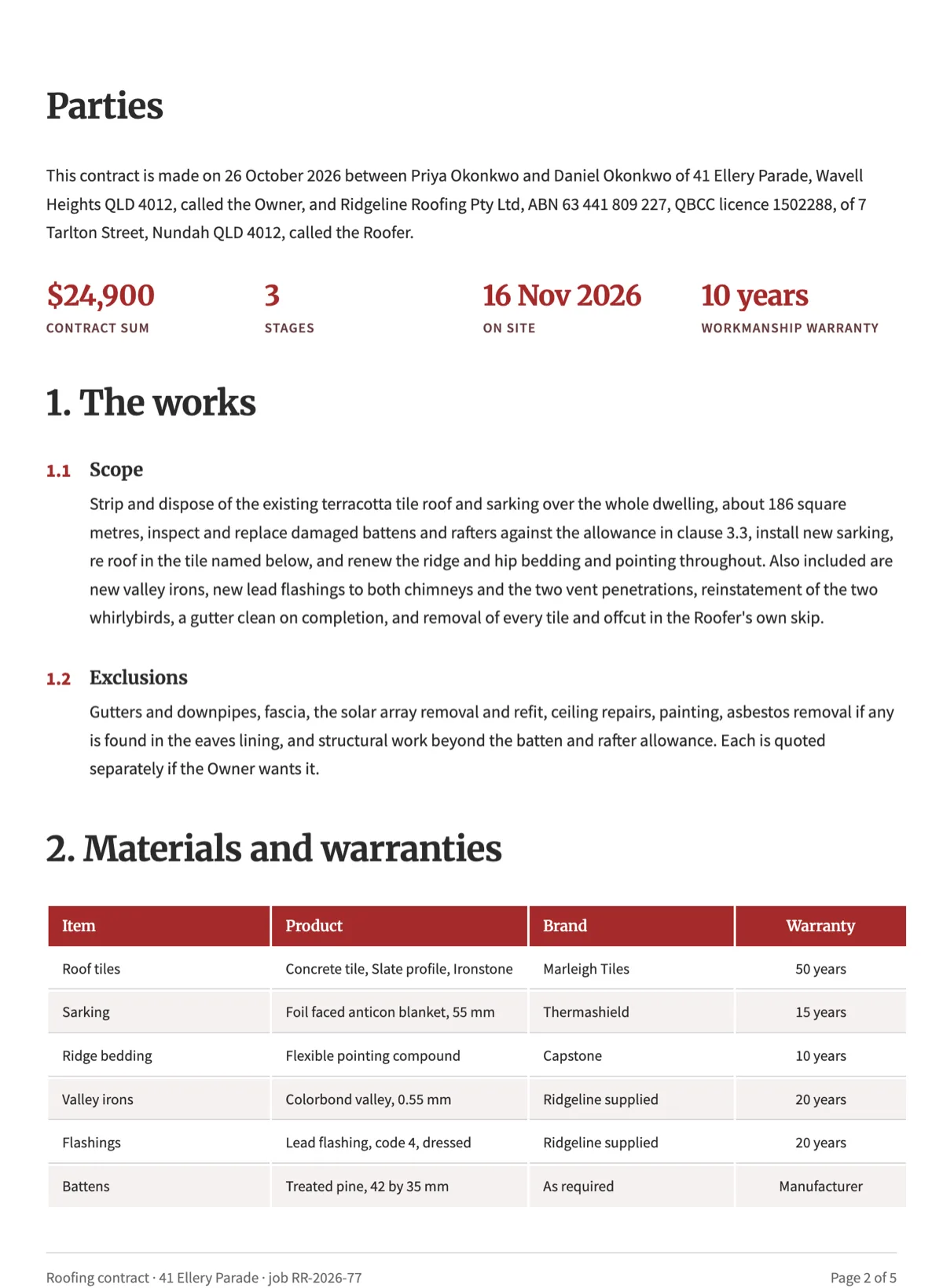 Roofing contract template with a materials table and a weather ruleA roof replacement is the one job where the house is open to the sky at the end of the day, so the clause that matters most is the one about closing it. This contract limits how much roof can be stripped at once, names every product with its warranty years, and says who pays when water gets in.
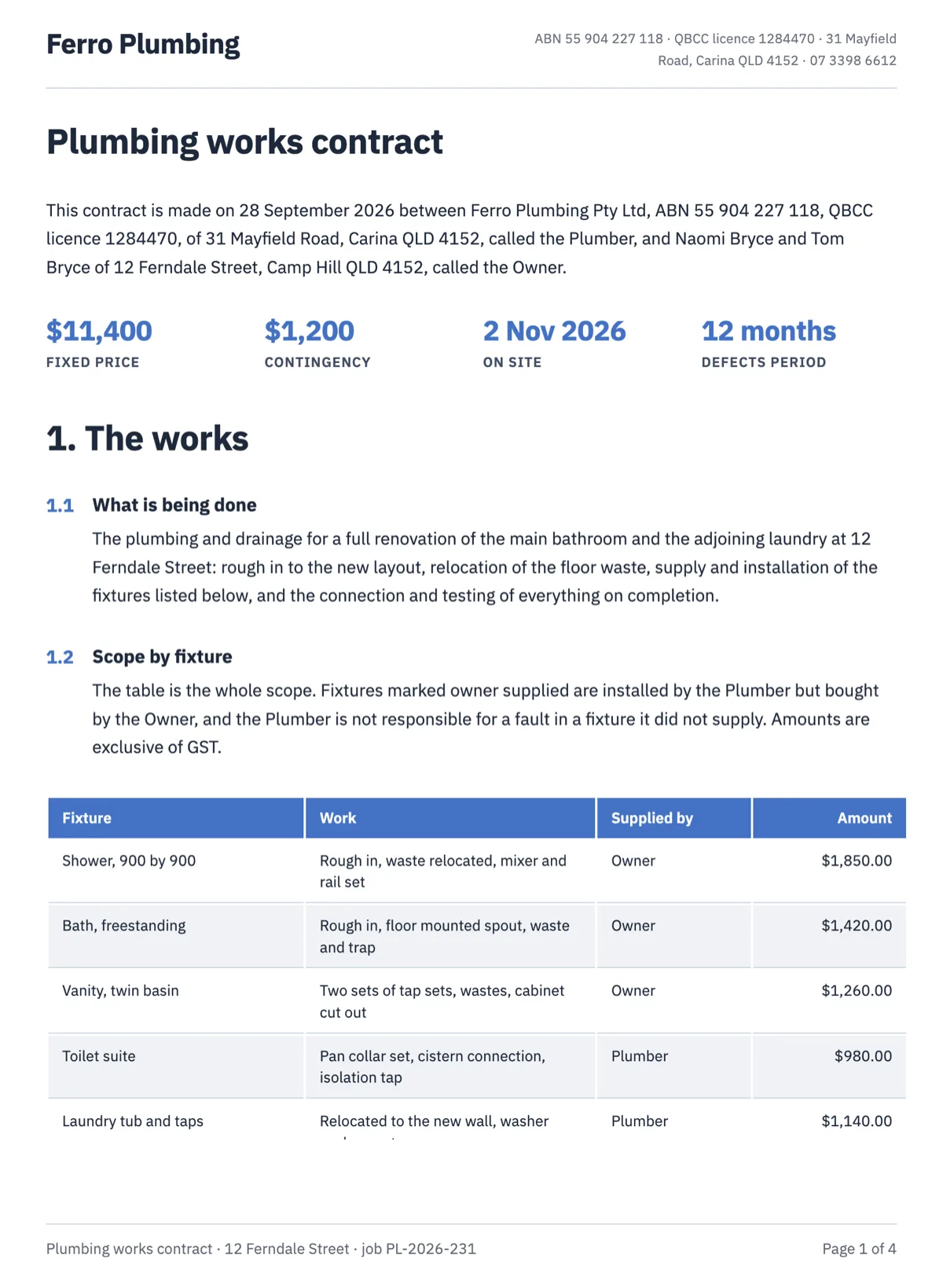 Plumbing works contract with a fixture scope table and a compliance certificateA bathroom job goes over budget in the hour the floor comes up and somebody finds old cast iron drainage. This contract prices every fixture separately, holds a named allowance for what nobody could see, and makes the final payment wait for the compliance certificate.
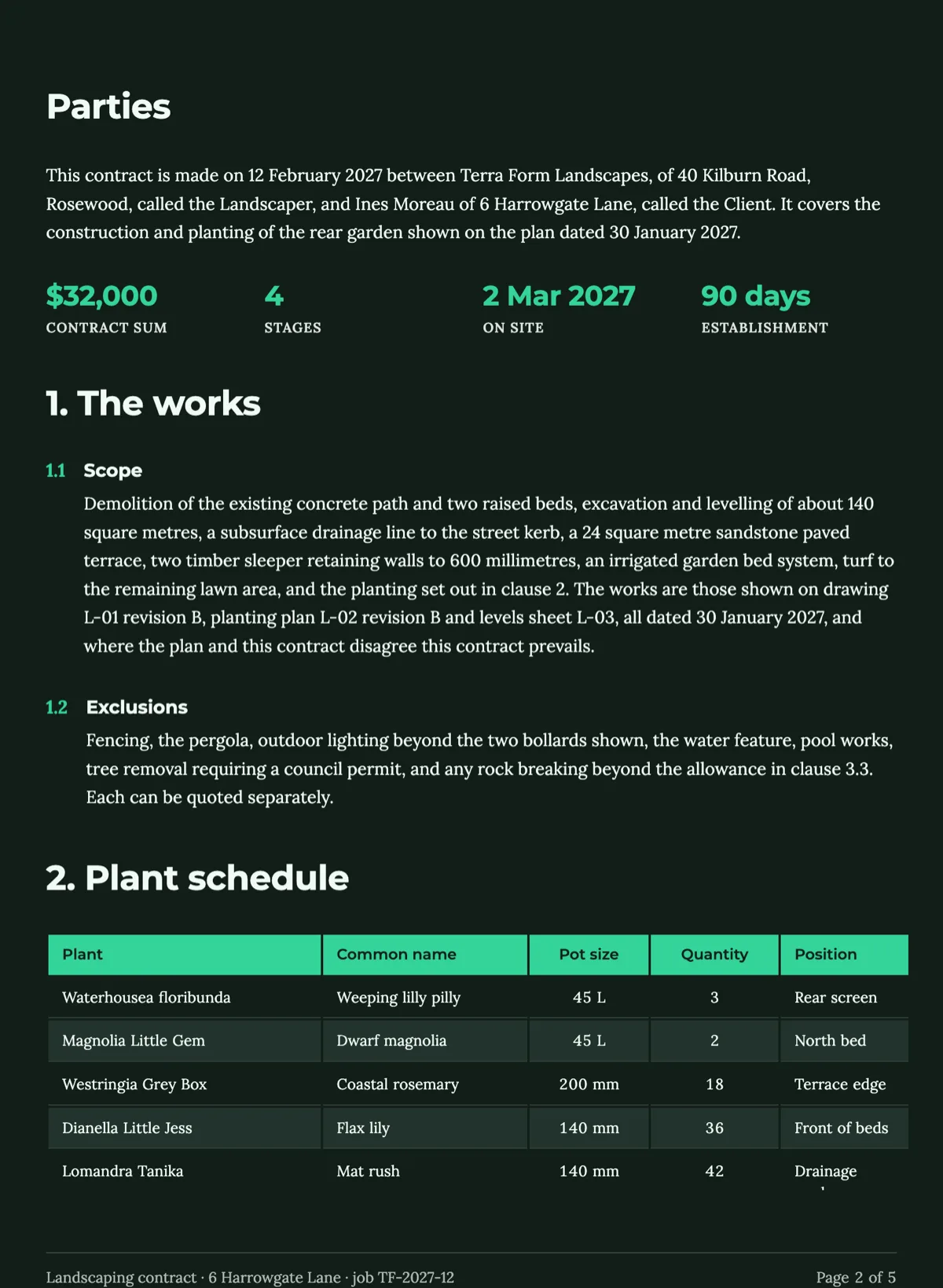 Landscaping contract template with a plant schedule and an establishment periodA garden build is two jobs in one: construction that is finished when it is finished, and planting that is only finished three months later. This contract prices the construction in four stages, lists every plant with its pot size and quantity, and holds the landscaper to a 90 day establishment period for anything that dies.
Questions people ask
Are rise and fall clauses legal in home building contracts?
Yes, within limits that depend on the state. Victoria restricts cost escalation clauses in major domestic building contracts, and other states regulate home building contracts in their own ways. A clause that does not comply may be unenforceable, so builders should check the current rules with their state regulator.
Can my builder increase the price after signing?
Only if the contract allows it, for example through a rise and fall clause, a variation you request, or a provisional sum or prime cost item that turns out higher. In a truly fixed price contract without such terms, the builder cannot simply pass on cost increases.
What evidence must a builder show?
Whatever the clause requires, and a good clause requires dated supplier quotes showing the base price, invoices showing the actual price, and the calculation of the difference. If your contract lets the builder adjust without evidence, ask for this wording to be added before signing.
Do rise and fall clauses work in both directions?
They should. A fair clause reduces the price if the cost of the named materials falls below the base, as the sample does. Clauses that only allow increases are one sided, and owners should ask for falls to be passed on as well.
Is a rise and fall clause the same as a provisional sum?
No. A provisional sum is an allowance for work that cannot be priced at signing, adjusted to the actual cost. A rise and fall clause adjusts the price of work that was priced, because the cost of its materials or labour changed. Both can move the final price, so read them together.
Put the clause in a finished document
The button opens the document generator with a starting description already filled in. Change it to match your own agreement before you run it.
Create a document with OneCraftRelated clauses
- Price adjustment clause: moving a price after signingA price adjustment clause lets a price move after signing and says how. Australian sample wording with notice and an exit right, plus three variants to compare.
- CPI escalation clause: the formula and the sample wordingA CPI escalation clause raises a price automatically with the consumer price index. Australian sample wording, the formula worked through, and four variants.
- Construction variations clause: directing and pricing changed workA construction variations clause sets how changes to building work are directed and priced. Australian sample wording with schedule rates, cost plus and quotes.
- Hardship clause: sample wording and the difference from force majeureA hardship clause sample for a five year supply deal: renegotiation when costs pass a trigger, expert adjustment or exit, and hardship against force majeure.
For everything the document generator can do, see the document maker.
Step by step in the builder: Create a document with AI, then Document builder components.
Written and checked by the OneCraft team. Last checked .