Contract clause
Non circumvention clause: protecting an introduction
A non circumvention clause stops a party from using an introduction to deal directly with the introduced contact and cut out the person who made it. It usually lasts for a set period and either bans direct dealing or requires the introducer's commission to be paid on any deal.
An agent's value is in who they know. Once a buyer has met the factory, the agent can be bypassed with one email. A non circumvention clause is how introducers make sure the relationship they created still pays them.
Nuwan Madhusanka · Co-founder
3 min read · Published
Sample clause
Written for an introduction agreement between Mekong Bridge Trading, a fictional sourcing agent, and a Brisbane furniture importer it is introducing to a furniture factory.
Non Circumvention. (a) For 24 months after the date of each introduction, the Client must not, and must ensure its related entities do not, purchase goods from, or enter into any agreement with, an Introduced Party except through the Agent, unless the Client pays the Agent the commission in paragraph (b). (b) The commission is 6% of the value of goods purchased from an Introduced Party during that period, payable within 30 days after each purchase. (c) Introduced Parties are the businesses listed in the Schedule, which the Agent may add to by written notice given within 7 days after an introduction, describing the introduction. (d) This clause does not apply to a business with which the Client can show, by written records, it was already dealing before the introduction.
Sample wording, not legal advice.
Variants
Commission protected
Agents and brokers whose main concern is being paid, not stopping the relationship.
If the Client deals directly with any Introduced Party within 24 months after the introduction, the Client must pay the Agent a commission of 6% of the value of all transactions with that party during that period.
Full bar on direct dealing
Introducers who must control the relationship, such as exclusive distributors, accepting more enforceability risk.
For 24 months after an introduction, the Client must not contact, solicit or deal with any Introduced Party, directly or indirectly, except through the Agent.
Time limited to named contacts
Short engagements, where the protection should apply only to specific people actually introduced.
This clause applies only to the individuals and businesses named in each introduction notice, and only for 12 months after that notice. It does not restrict dealings with any other person in the same organisation.
What to negotiate
A schedule of introduced parties
Disputes usually turn on whether a business was really introduced. A schedule, updated by notice soon after each introduction, settles that. Clients should resist protection for every business the agent ever mentions; agents should record introductions promptly with evidence, such as the introduction email, so the schedule cannot be challenged later.
Commission instead of a ban
A ban on dealing is a restraint of trade and must be reasonable to be enforced. A commission obligation is easier to justify and enforce, because it compensates the introducer rather than stopping trade. Many clients accept commission readily while refusing an outright ban, and many introducers really only want to be paid.
Restraint of trade risk
Courts in Australia, the UK and the US test restraints for reasonableness: protecting a legitimate interest, such as the introducer's commission, for a reasonable period and scope. A 24 month period tied to named introductions is far more likely to be upheld than an open ended ban on dealing with an entire industry. Pre existing relationships should always be excluded.
The risk of leaving it out
Without a non circumvention clause, an introducer usually has no claim if the client deals directly with the contact, unless it can show a breach of confidence or a separate agreement to pay. A confidentiality clause alone rarely helps, because the identity of a business is often not confidential. Introducers who work on commission rely on this clause to be paid.
Ban against commission versions
Ban: the client must not deal with the introduced party at all for the period. Strong protection, but more likely to be challenged as a restraint, and it may cost the client a good supplier. Commission: the client may deal directly but must pay the agreed commission. Easier to enforce and accept, and gives the agent what it usually wants. Hybrid: a ban unless the commission is paid, as in the sample, which combines a clear rule with a lawful way through it. Law checked on 21 October 2026. This page explains how the clause works and is not legal advice.
The introduced parties schedule
A practical schedule lists, for each introduced party: the business name and location; the date of introduction; how the introduction was made, such as an email or a meeting; the individual contacts introduced; and the protection period end date. Keeping it current makes the clause enforceable and reduces the scope for argument. Clients can ask to be notified of each addition so they can object if they already knew the business.
NCNDA agreements
In trading and brokering, non circumvention is often combined with non disclosure in an NCNDA, a non circumvention and non disclosure agreement. Many circulating NCNDA templates are vague, cover all contacts forever, and are of doubtful enforceability. A short, specific clause tied to named introductions, a time limit and a commission is more useful than a long generic NCNDA.
Competition law
In Australia, the Competition and Consumer Act 2010 prohibits some restrictive arrangements, and restraints between businesses that substantially lessen competition can raise issues. An ordinary commission based non circumvention clause between an agent and a client rarely does, but broad exclusive dealing terms across a market should be checked.
Documents that carry this clause
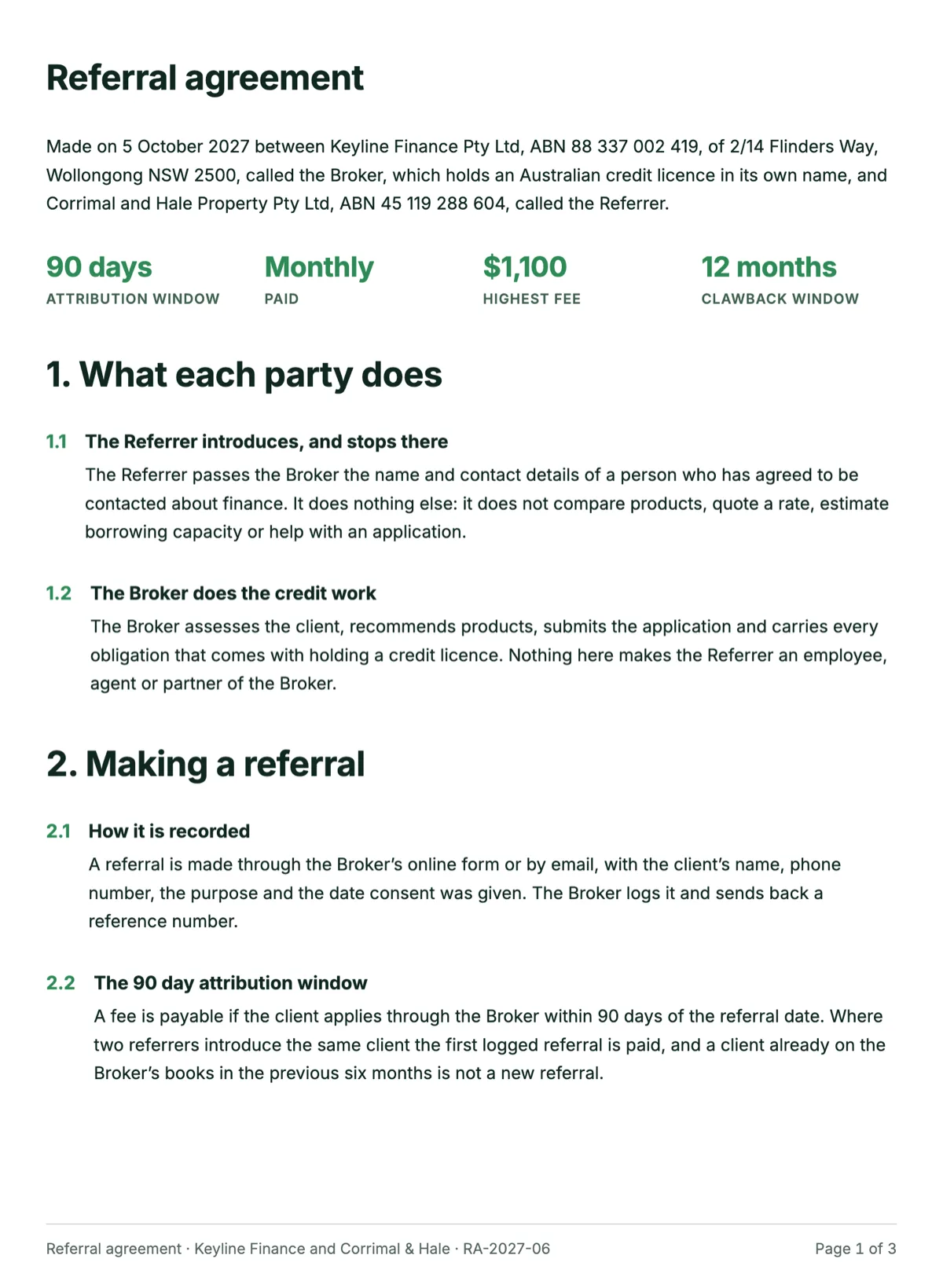 Referral agreement template with a fee table by productA referral agreement works when it is clear where the referral stops and the advice starts. This one has a real estate agency passing buyers to a mortgage broker for a fee that ranges from $250 to $1,100 by product, attributed for 90 days, paid monthly, and clawed back if the lender claws back first.
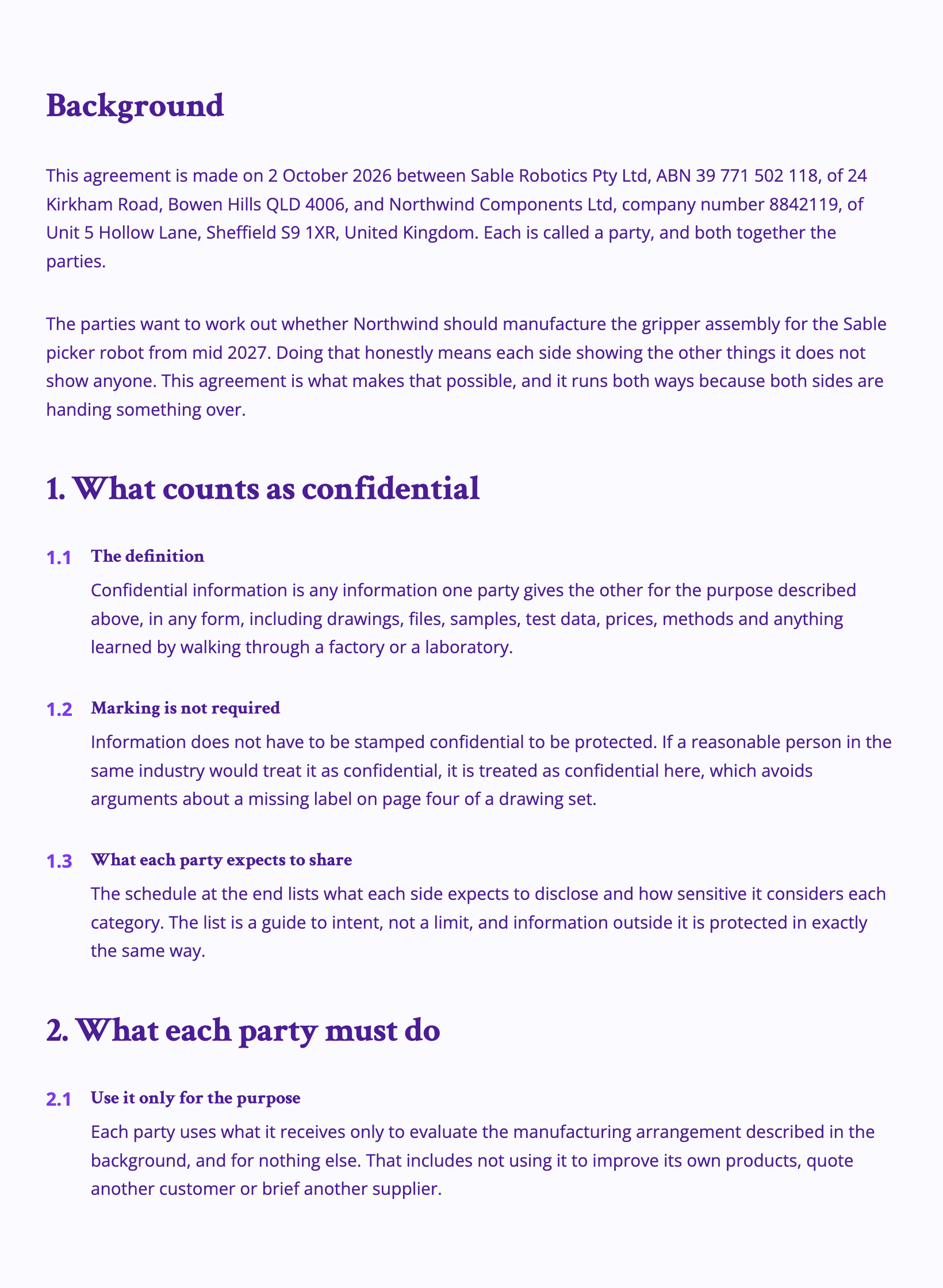 Mutual NDAA robotics company and a British parts maker want to look inside each other before agreeing to anything. Both sides are handing over trade secrets, which is the only real reason to make an NDA mutual.
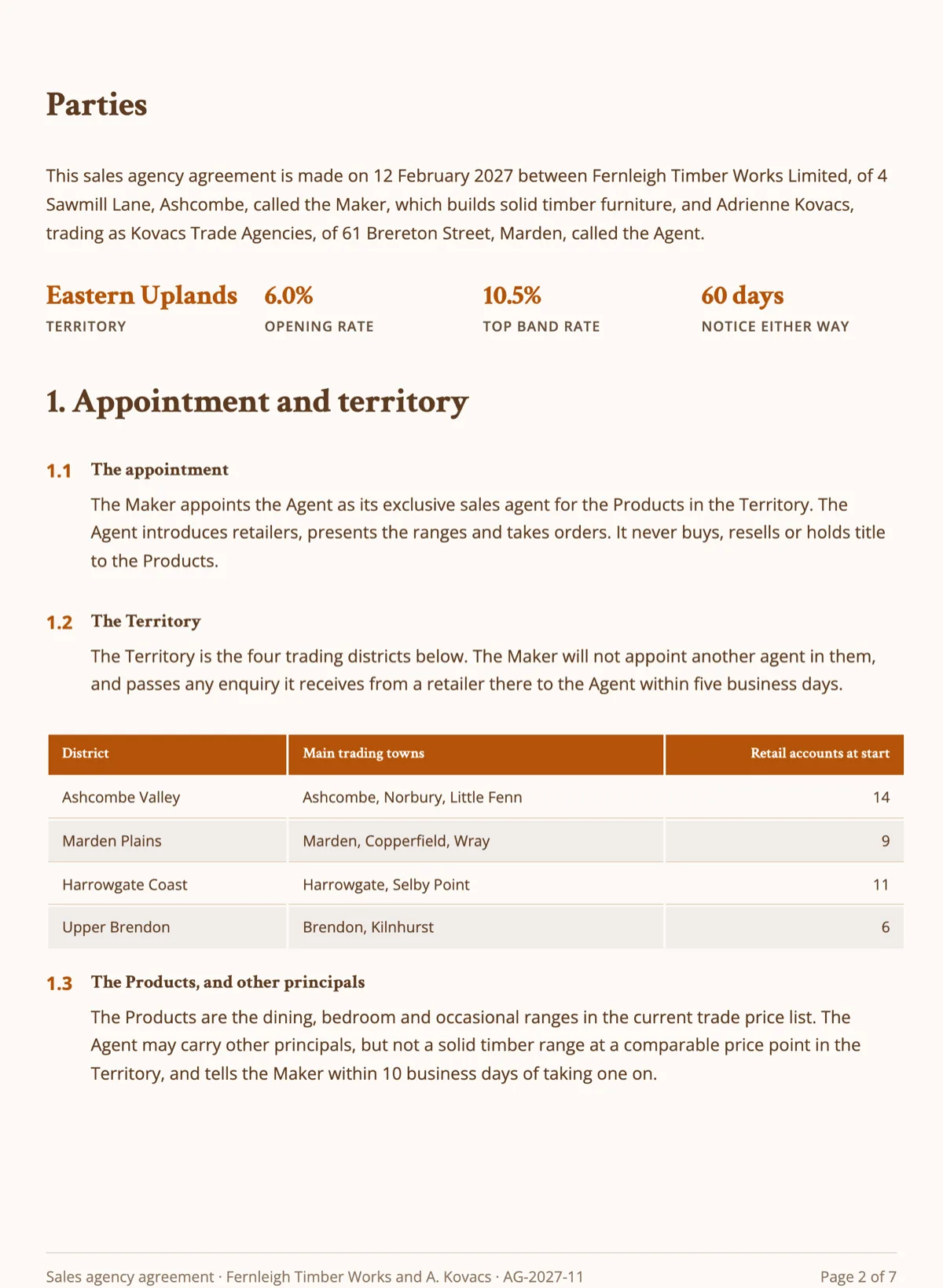 Sales agency agreement with a commission ladder and a named territoryA sales agency agreement has to answer two questions before anything else: what the agent is allowed to promise on your behalf, and exactly how the commission is worked out. This finished example answers both on the page, with a four band ladder from 6.0 to 10.5 per cent, a worked example on $520,000 of sales, and a table of six decisions the agent may and may not make.
Questions people ask
Is a non circumvention clause enforceable?
Often, if it is reasonable: limited to parties actually introduced, for a reasonable period, protecting a legitimate interest such as the introducer's commission, and excluding relationships the client already had. Clauses that require commission rather than banning dealing are easier to enforce. Very broad or open ended bans are at risk.
How long should a non circumvention clause last?
Commonly one to three years from each introduction, long enough to cover the deal the introduction led to and early repeat business. Longer periods are harder to justify as reasonable. Tying the period to each introduction, rather than the agreement date, is fairer to both sides.
What is an NCNDA?
An NCNDA is a non circumvention and non disclosure agreement, common in brokering and trading. It combines a promise not to bypass the introducer with confidentiality obligations. Many template NCNDAs are vague; a specific clause naming the introduced parties, the period and the commission is more reliable.
Does a confidentiality clause stop circumvention?
Usually not by itself. The identity of a supplier or buyer is often not confidential information, especially if the business advertises publicly, so using it to deal directly may not breach confidentiality. A separate non circumvention or commission clause is needed to protect the value of the introduction.
What if the client already knew the introduced party?
Most clauses exclude existing relationships, provided the client can show it was already dealing with the business before the introduction, usually through written records. Clients should keep evidence of existing suppliers and raise them as soon as the agent introduces them.
Put the clause in a finished document
The button opens the document generator with a starting description already filled in. Change it to match your own agreement before you run it.
Create a document with OneCraftRelated clauses
- Non solicitation clause for clients and staffA non solicitation clause stops a former employee approaching clients or staff. Australian sample wording for clients and staff, with three variants.
- Confidentiality clauseA confidentiality clause inside a wider contract, not a standalone NDA. Sample consulting wording, mutual and one way variants, the tail period and exceptions.
- Exclusivity clause: dealing only with each other, within limitsAn exclusivity clause commits a party to deal only with the other for a period. Australian venue catering sample, supply and territory variants, ACCC limits.
- Restraint of trade clause: building a cascade for a business saleA restraint of trade clause limits competing after a business sale or exit. How an Australian cascading restraint is built, with sale and shareholder variants.
For everything the document generator can do, see the document maker.
Step by step in the builder: Create a document with AI, then Document builder components.
Written and checked by the OneCraft team. Last checked .