Contract clause
Social media clause for an employment contract
A social media clause in an employment contract sets what an employee may post about the employer, its clients and colleagues, on work and personal accounts, requires confidential information and client images to stay off social media, and links breaches to the employer's social media policy and disciplinary process.
A social media clause tells staff what they can and cannot post about their job, the business, its clients and their colleagues, on work accounts and their own. It works best as a short contract term pointing to a fuller policy, and it reaches out of hours posts only where they have a real connection with the employment.
Indunil Asanka · Co-founder
3 min read · Published
Sample clause
Written for casual employment agreement for a barista at Harbour Street Cafe, a fictional cafe in Wollongong NSW.
Social Media. (a) The Employee must not post, on any platform or account, information that is confidential to the Employer, its customers or its suppliers, including takings, rosters, supplier prices and customer details. (b) The Employee must not post photographs or video of customers, or of other staff at work, without their consent. (c) The Employee must not identify themselves as speaking for the Employer, or post on the Employer's accounts, unless authorised in writing by the Manager. (d) The Employee must not post material about the Employer, a customer or a colleague that is harassing, discriminatory, threatening or that a reasonable person would see as seriously damaging to the Employer's business. (e) The Employer's Social Media Policy, as changed from time to time, applies. It does not form part of this agreement, but a serious or repeated breach of it may lead to disciplinary action.
Sample wording, not legal advice.
Variants
Staff who run company accounts
Employees who post for the business, where account ownership and passwords must stay with the employer.
Accounts the Employee creates or manages for the Employer, and their followers and content, belong to the Employer. The Employee must hand over all logins on request and on leaving, and must not change account names or delete content without approval.
Health or care settings
Workplaces with patients, children or animals, where any image or detail posted can breach privacy or professional rules.
The Employee must not share client names, health details or photographs taken at the Clinic on any platform, and must not post about the Clinic's clients even without names.
Light touch for low risk roles
Small teams where a short reminder is enough and detail would only date quickly.
The Employee must keep the Employer's confidential information and customers' privacy off social media, and must not post anything about colleagues that would breach the Employer's bullying or harassment policies.
What to negotiate
Keep the policy out of the contract
Making the social media policy part of the contract binds the employer to it too, and makes every update a contract change. The usual approach, as in the sample, is a short contractual duty plus a policy that applies but does not form part of the agreement, which keeps the employer free to update it.
Out of hours posts need a connection
An employer's control over what employees post in their own time is limited. Tribunals have accepted discipline for out of hours conduct where it has a sufficient connection with the employment, such as abusing a colleague or revealing confidential information, but not for ordinary personal opinions unrelated to work. Write the clause around those connections.
Proportionate consequences
Dismissal for a single post can be harsh, unjust or unreasonable, particularly where the employee did not know the rules. A clause that refers to a policy, training on it, and a disciplinary process with warnings for lesser breaches gives the employer a fair process if it later needs to act.
The risk of leaving it out
Without a social media clause or policy, an employer that disciplines or dismisses an employee over a post may struggle to show the employee knew the standard expected, which weakens its position in an unfair dismissal claim. It also leaves no clear rule on client photos and confidential information, which are the posts that cause the most harm.
Social media and unfair dismissal
Under Part 3-2 of the Fair Work Act 2009, an eligible employee can claim a dismissal was harsh, unjust or unreasonable. The Fair Work Commission considers whether there was a valid reason related to conduct, whether the employee was told of it and had a chance to respond, and other relevant matters. Commission decisions have found dismissals over social media posts unfair where there was no policy, or the response was out of proportion, and fair where posts harassed colleagues or harmed the business. Law checked on 21 October 2026. This page explains how the law works and is not legal advice.
Privacy and client images
Photographs and details of customers, patients or children posted by staff can breach privacy obligations the business owes and professional codes in health, education and care. The work experience example forbids sharing client names or photos from a vet clinic, including on social media, and says the clinic will not photograph the student without a parent's written consent. The same rule belongs in any role with client contact.
Contract term and policy together
The casual employment example lists the cafe's policies, including social media, as applying from time to time without forming part of the agreement, and the council social media policy example shows what a full policy covers: official accounts, personal accounts, approvals and breaches. A short contract term plus a policy is easier to maintain than a long clause that tries to cover every platform.
Where the clause sits in a generated document
Employment contracts, work experience and volunteer agreements, and social media policies carry these terms. When asking the AI document generator for a contract, list the confidential items, the photo rule, who may post for the business and the policy it should refer to.
Documents that carry this clause
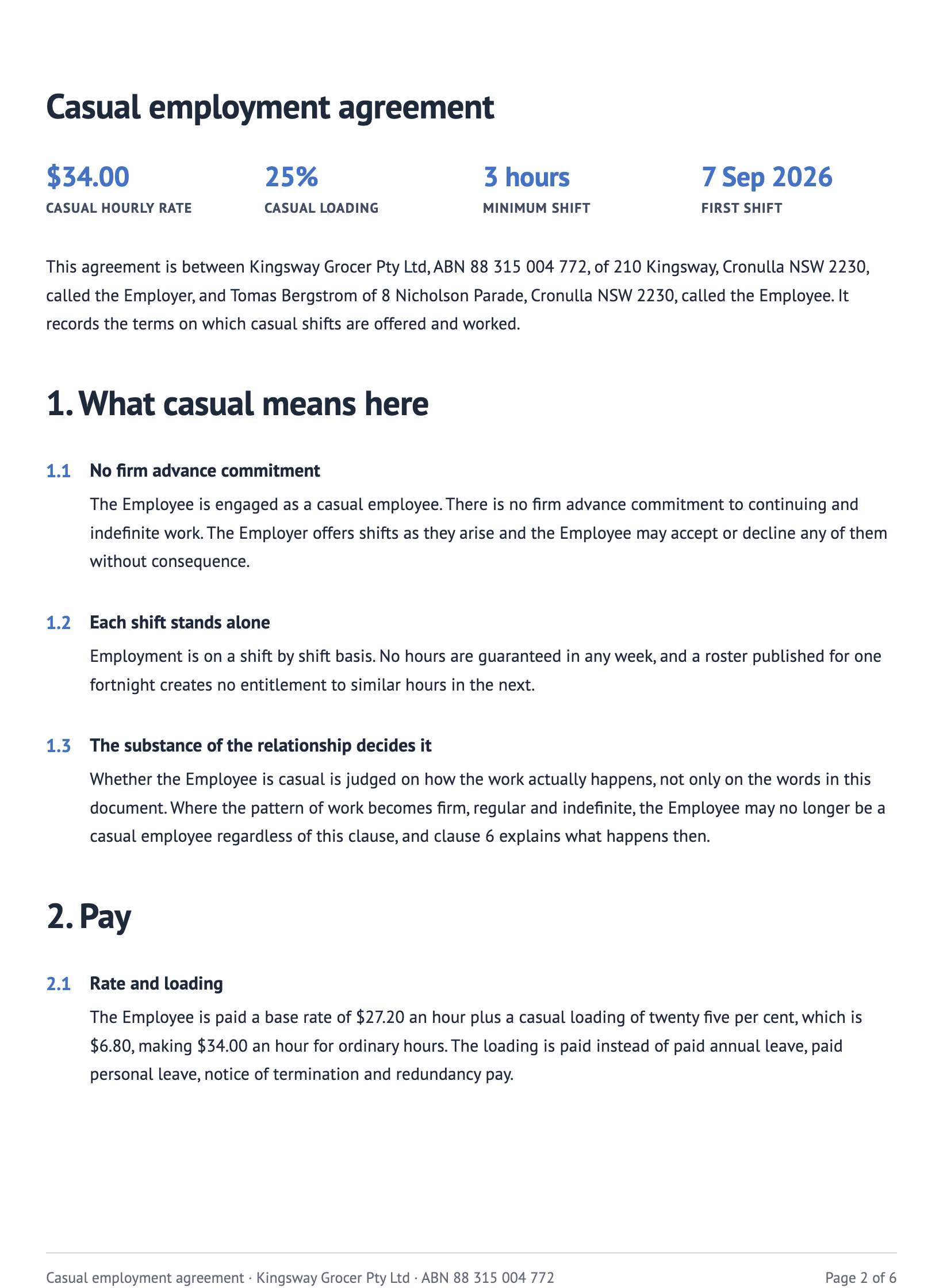 Casual employment agreementA retail assistant is paid $34.00 an hour, which is a base of $27.20 plus a twenty five per cent loading. The agreement shows how every other rate is built from that base, and what the loading is paid instead of.
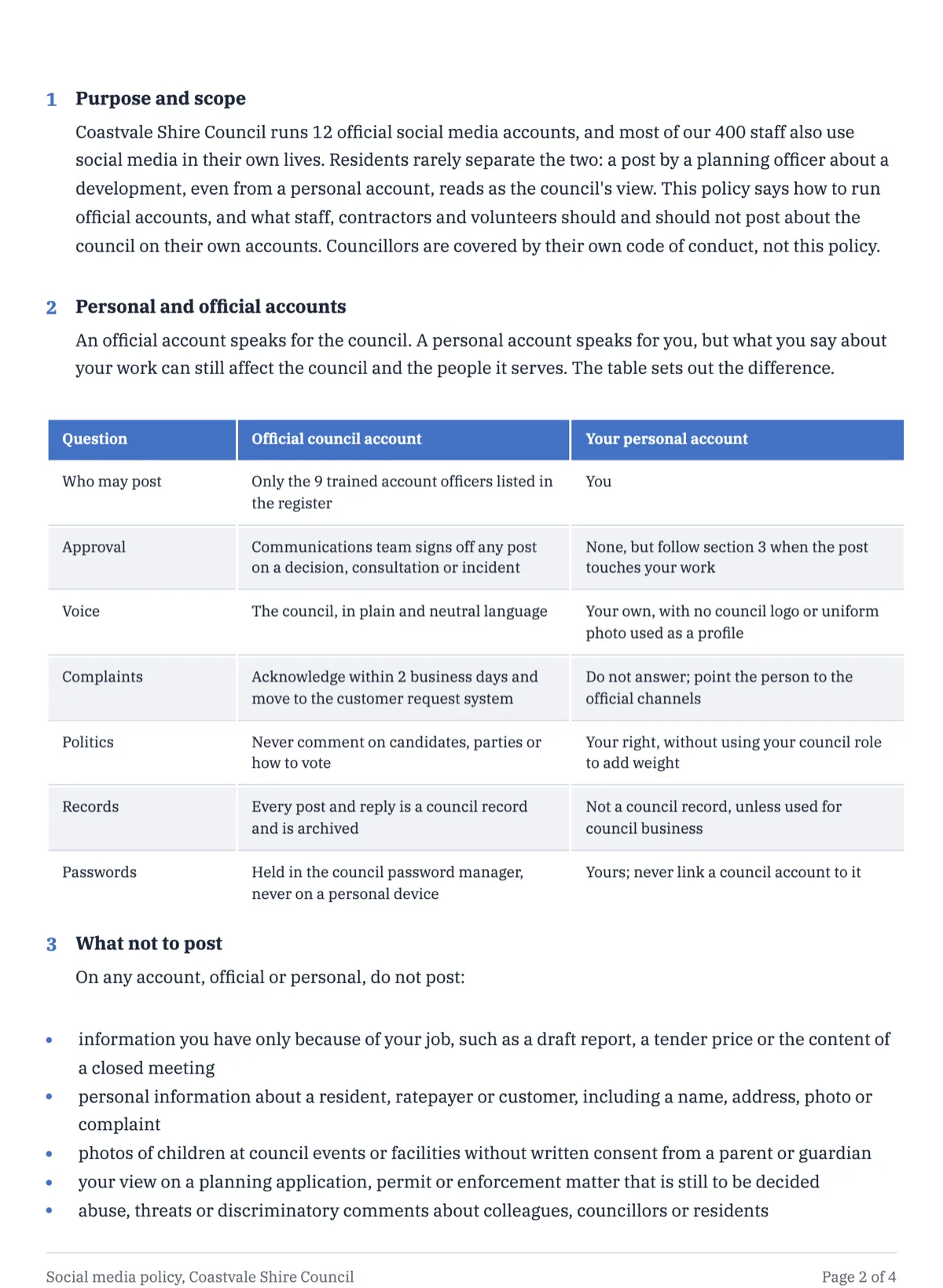 Social media policy template that separates personal and official accountsA social media policy has to tell staff two different things: how the organisation's official accounts are run, and what they can and cannot say about work on their own accounts. This four page policy for a council with 400 staff puts the two side by side in a table, then sets out what not to post, a disclosure rule and how breaches are handled.
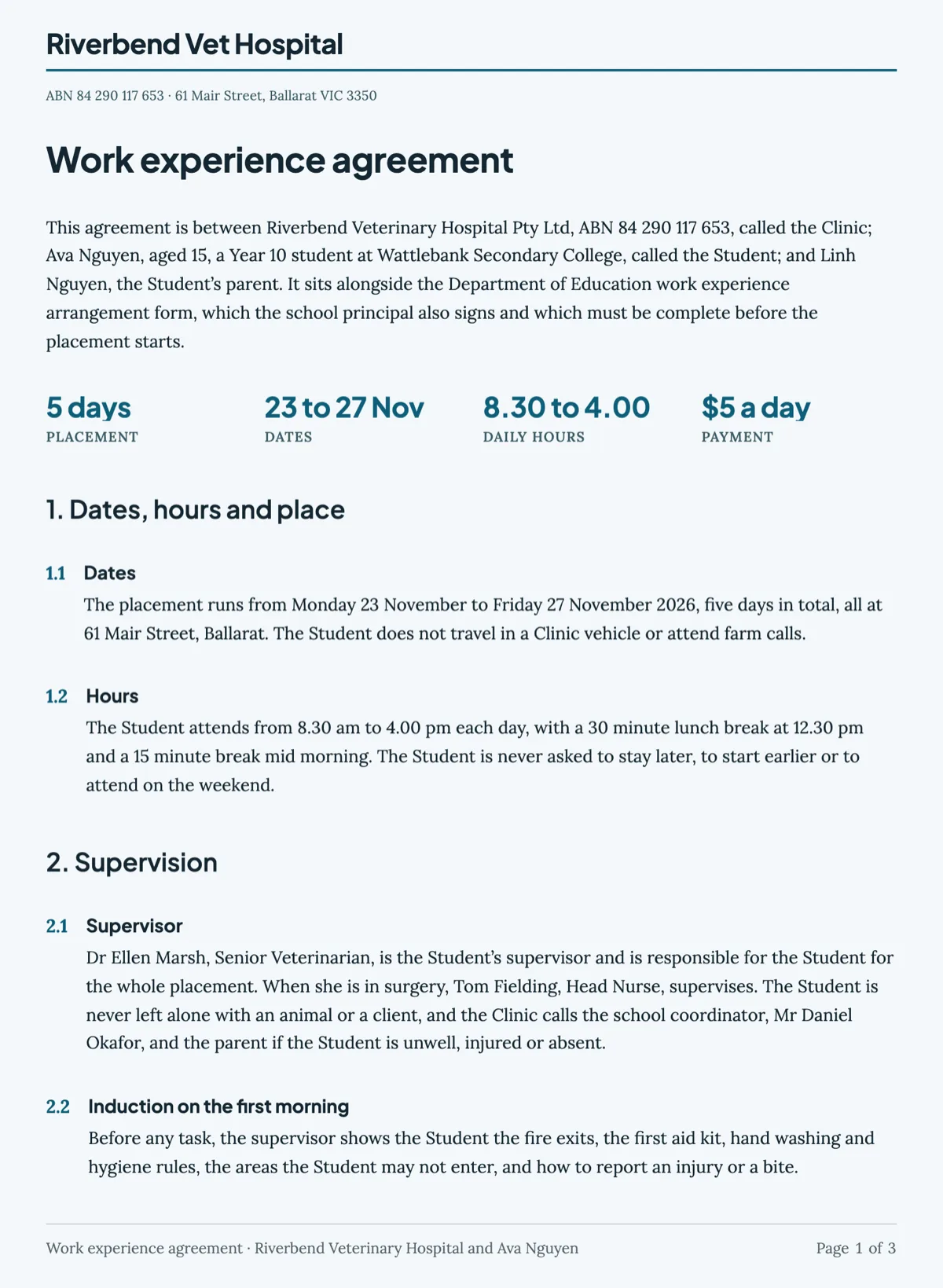 Work experience agreement template for a Year 10 student placementA work experience agreement template sets out when and where a school student will be, who is responsible for them, what they may and may not do, and who covers them if they are hurt. In Victoria it sits alongside the Department of Education arrangement form, and for a student under 18 a parent signs as well.
Questions people ask
Can my employer control what I post on my own social media?
Only to a point. An employer can set rules about confidential information, client privacy and conduct towards colleagues, and can act on out of hours posts with a real connection to the job. It generally cannot discipline you for ordinary personal opinions unrelated to work.
Can I be fired for a social media post in Australia?
Yes, in some cases, such as posts that harass a colleague, reveal confidential information or seriously damage the business. The dismissal must still be fair: a valid reason, a chance to respond, and a response proportionate to the conduct, judged against any policy.
Should the social media policy be part of the contract?
Usually not. If the policy forms part of the contract, the employer is bound by it too and must get agreement to change it. Most contracts require staff to follow policies that apply from time to time without making them contract terms.
Who owns a business social media account an employee set up?
The contract should say the business does, along with its followers and content, and that the employee must hand over logins. Without a clause, disputes about accounts built by a departing employee can be hard to resolve, especially if the account uses their name.
Can staff post photos of customers?
Only with the customer's consent, and a clause should say so. Photos of customers, patients or children can breach privacy obligations and professional rules. Even where consent is given, many businesses limit posting to official accounts run by authorised staff.
Put the clause in a finished document
The button opens the document generator with a starting description already filled in. Change it to match your own agreement before you run it.
Create a document with OneCraftRelated clauses
- Hours of work clause for an Australian employment contractHours of work clause sample for Australian employment contracts: 38 ordinary hours, reasonable additional hours, averaging, rosters and the right to disconnect.
- Public holiday clause for an Australian employment contractPublic holiday clause sample for Australian employment contracts: paid days off, requests to work, the right to refuse, penalty rates and part time patterns.
- Confidentiality clauseA confidentiality clause inside a wider contract, not a standalone NDA. Sample consulting wording, mutual and one way variants, the tail period and exceptions.
- Non disparagement clause: wording for settlement deeds and exitsA non disparagement clause stops a party making negative statements about the other. Sample settlement wording, mutual versions and review site carve outs.
For everything the document generator can do, see the document maker.
Step by step in the builder: Create a document with AI, then Document builder components.
Written and checked by the OneCraft team. Last checked .