Contract clause
Successors and assigns clause: what it does and does not do
A successors and assigns clause states that a contract binds, and benefits, each party's successors and permitted assigns, meaning whoever lawfully takes over a party's position. It confirms the contract survives a lawful transfer, but it does not by itself give anyone permission to transfer the contract.
Almost every US commercial contract ends with a sentence about successors and assigns, and many readers assume it lets either party hand the deal to someone else. It does not. It only makes sure that whoever properly steps into a party's shoes is bound and benefits.
Nuwan Madhusanka · Co-founder
4 min read · Published
Sample clause
Written for a supply agreement between Wabash Packaging, a fictional Chicago packaging maker, and Loop Street Foods, a fictional food manufacturer.
Successors and Assigns. (a) This Agreement binds and benefits the parties and their respective successors and permitted assigns. (b) Neither party may assign this Agreement, or delegate its performance, except as permitted by Section 18 (Assignment), and any purported assignment in breach of Section 18 is void. (c) For the purposes of this Section, a successor includes any entity into which a party is merged or consolidated, or which acquires all or substantially all of that party's assets, where it assumes that party's obligations under this Agreement by operation of law or in writing. (d) Nothing in this Agreement gives any person other than the parties and their successors and permitted assigns any right or remedy under it.
Sample wording, not legal advice.
Variants
Binding effect only
Short contracts where the assignment clause does the real work and this sentence is a confirmation.
This Agreement will be binding on and inure to the benefit of the parties and their respective successors and permitted assigns.
With a merger successor sentence
Contracts where a party wants clarity that a merger or asset sale passes the contract without consent.
A merger, consolidation or sale of all or substantially all of a party's assets is not an assignment requiring consent if the successor assumes this Agreement in writing, and the successor will be bound by and entitled to the benefit of this Agreement.
With personal obligations excluded
Contracts that depend on a particular person's skill, where obligations should not pass to anyone else.
This Agreement binds the parties and their successors and permitted assigns, except that the obligations of the Consultant under Schedule 2 are personal and may not be performed by any successor or assign without the Client's prior written consent.
What to negotiate
Why it does not permit assignment
Courts generally read a successors and assigns clause as describing who is bound after a lawful transfer, not as authorising transfers. The word permitted, as in permitted assigns, points back to the assignment clause. A party that wants freedom to assign must negotiate the assignment clause itself, and a party that wants to restrict assignment should make sure the assignment clause, not this one, says so clearly.
Mergers
In a statutory merger, the surviving company usually takes over the merged company's contracts by operation of law, and some courts have held that certain merger structures are not an assignment at all. A party that wants a say on mergers needs a change of control clause, or an assignment clause that expressly treats mergers as assignments, because a successors clause alone will not give it.
Personal services
Contracts for a particular person's skill, such as a named consultant or performer, generally cannot be delegated without consent even without a clause, because the other party bargained for that person. Stating that certain obligations are personal, as in the third variant, avoids argument where the contract also contains a general successors clause.
The risk of leaving it out
Leaving the clause out rarely changes the legal result, because successors by operation of law are generally bound anyway and the assignment clause governs transfers. But its absence can create doubt in a merger or asset sale about whether the benefit of the contract passed, and the third party wording in paragraph (d) is often placed here to prevent outsiders claiming rights.
What the clause does and does not do
It does confirm that a lawful successor, such as a company that absorbs a party in a merger, is bound by and can enforce the contract. It does confirm that a permitted assignee takes the benefit and burden. It does not permit either party to assign or delegate; that is the assignment clause's job. It does not give the other party rights on a change of ownership; that needs a change of control clause. It does not let third parties enforce the contract, and paragraph (d) says so expressly. Reading it beside the assignment clause, rather than alone, avoids most misunderstandings. Law checked on 21 October 2026. This page explains how the clause works and is not legal advice.
Assignment and delegation in US law
Under US contract law, rights under a contract are generally assignable and duties delegable unless the contract, a statute, or the nature of the performance prevents it. UCC section 2-210 states this for sales of goods, including that a delegation does not relieve the delegating party of its duty. An anti assignment clause can make an assignment a breach, or, if it says so clearly, void, which is why the sample states that a purported assignment in breach is void.
Successors in other jurisdictions
English and Australian contracts often use similar wording, though statutory mergers are less common there and a transfer of a business usually requires a novation of each contract, with the other party's consent, for the burden to pass. In those jurisdictions a successors and assigns clause is even more clearly a confirmation rather than a source of rights.
Drafting tips
Use permitted assigns, not just assigns, so the clause does not imply that any assignee is accepted. Cross refer to the assignment clause by number. If mergers are intended to pass the contract without consent, say so expressly, as in the second variant. Keep the third party rights sentence, which in the US prevents arguments that an outsider is an intended beneficiary.
Documents that carry this clause
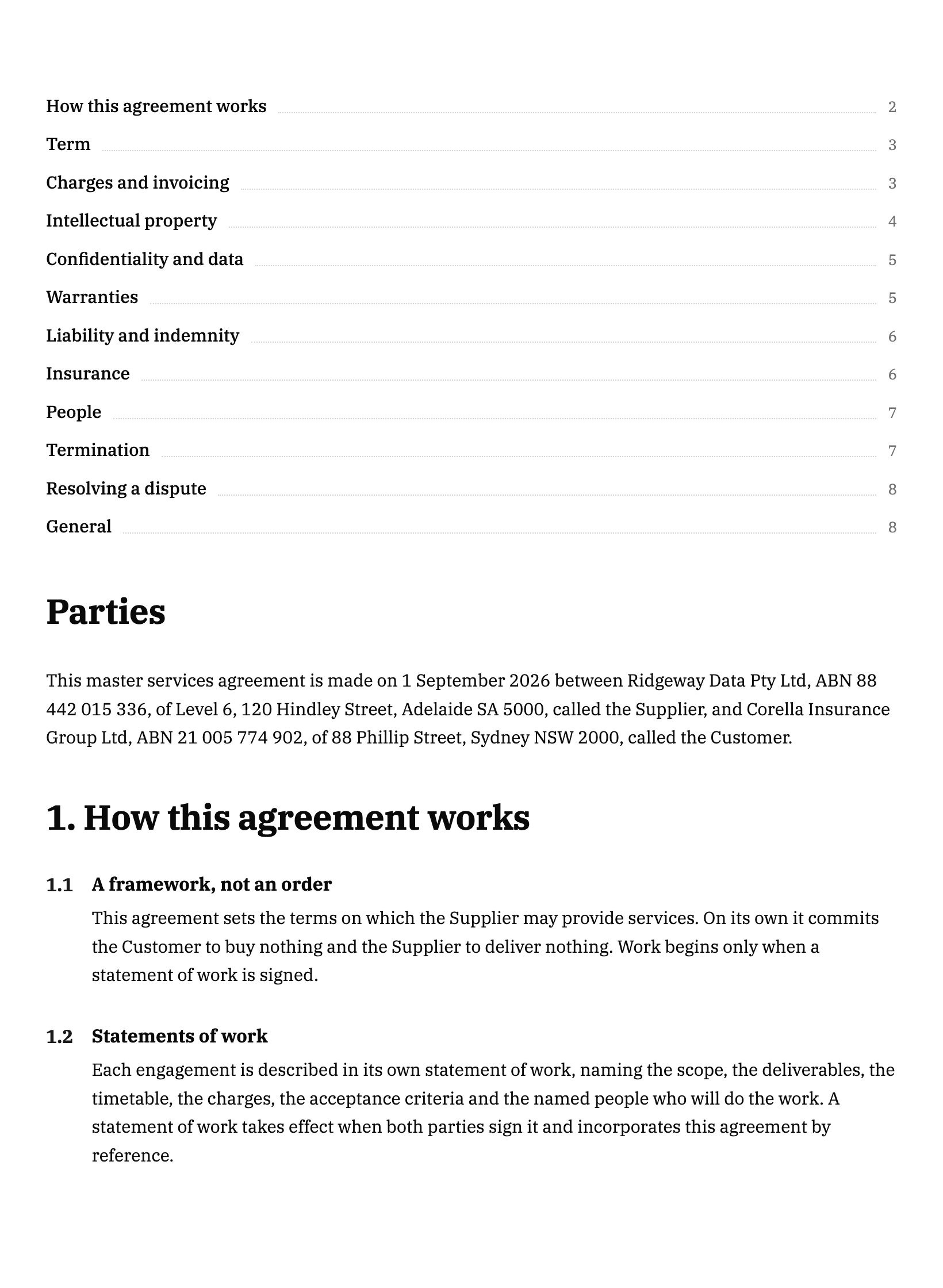 Master services agreementA data consultancy and an insurer sign this once and then buy work under it for three years. It is the rare contract whose whole purpose is to make the next twenty contracts short.
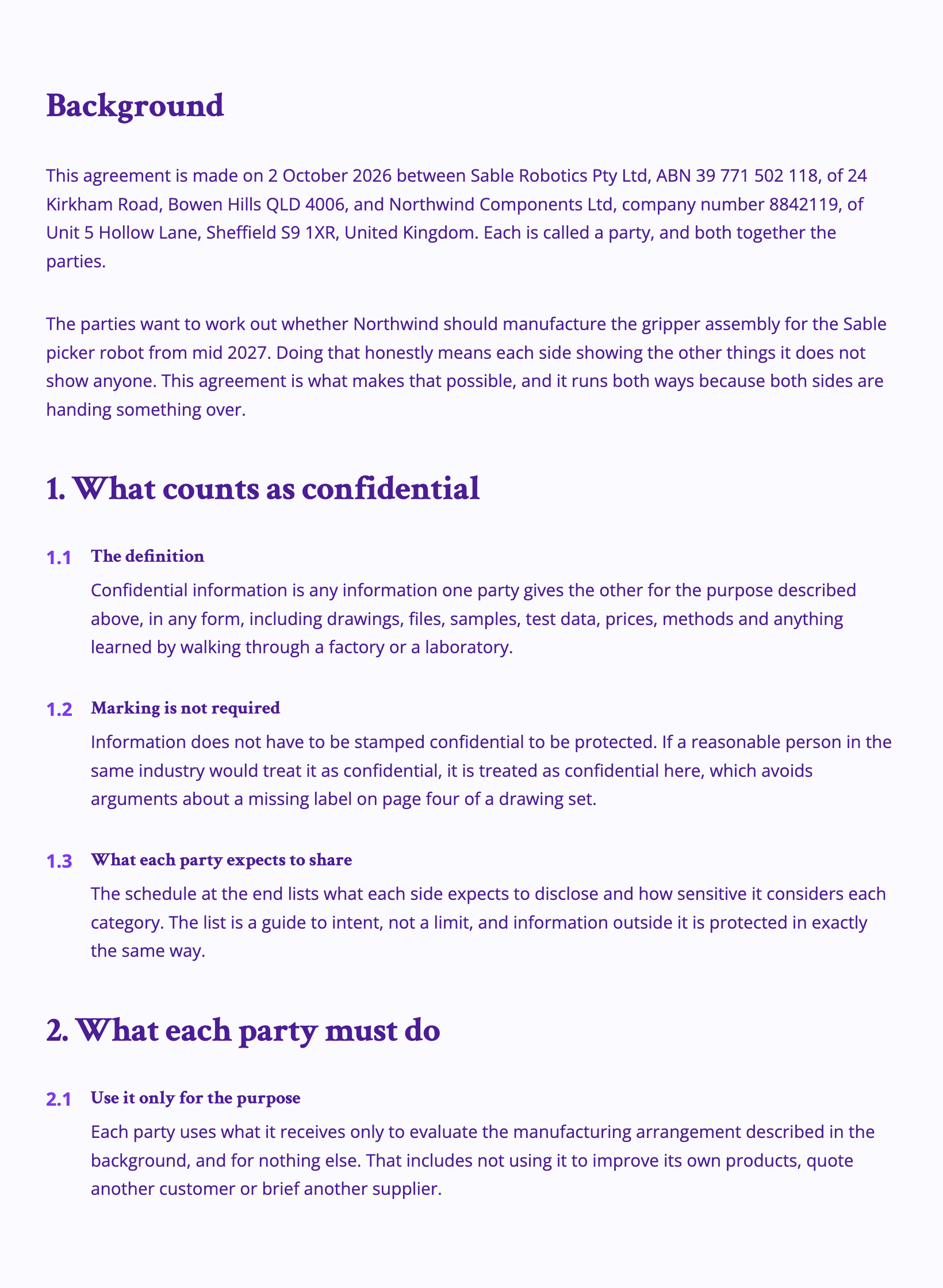 Mutual NDAA robotics company and a British parts maker want to look inside each other before agreeing to anything. Both sides are handing over trade secrets, which is the only real reason to make an NDA mutual.
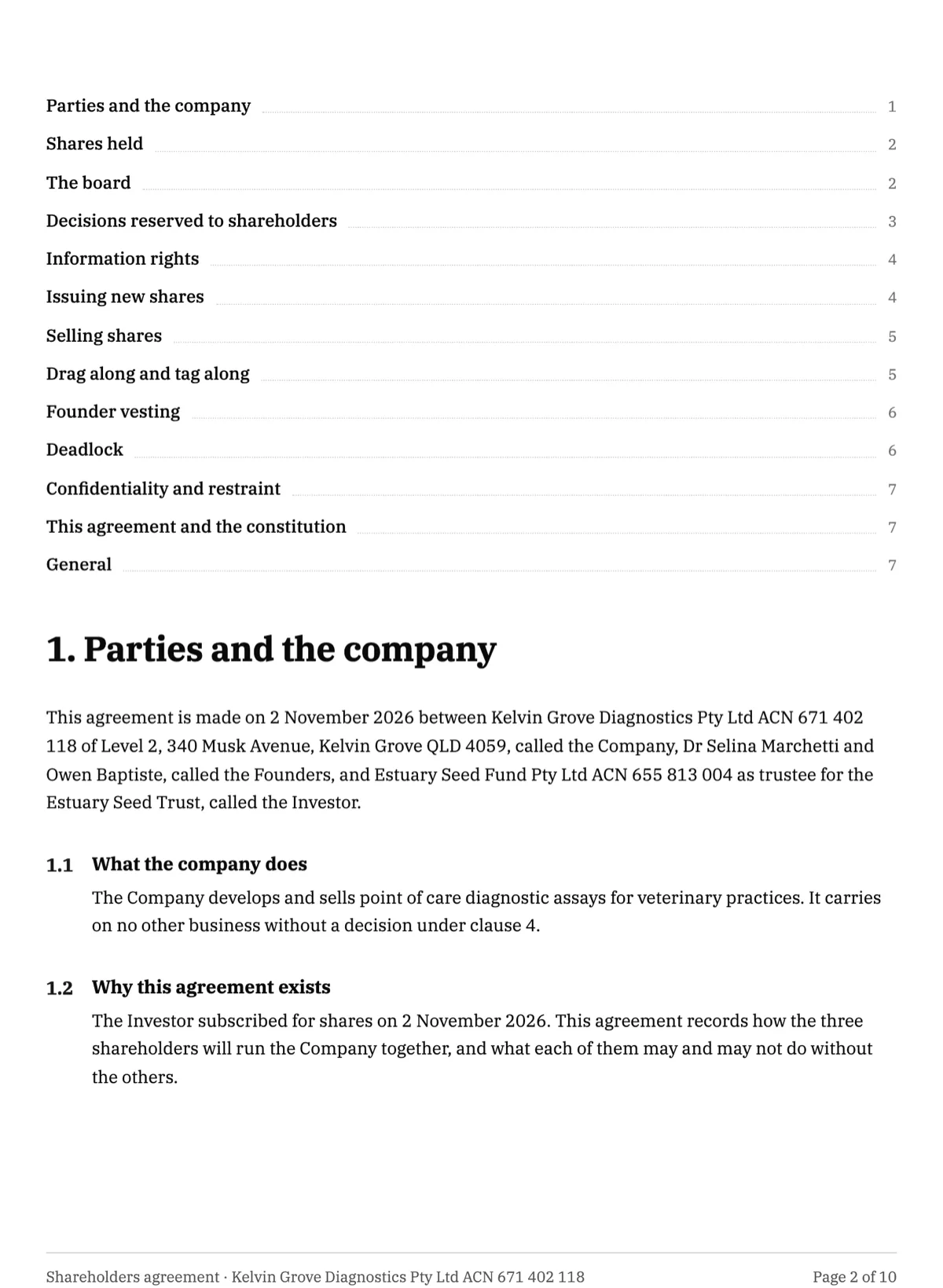 Shareholders agreement template for a company after a seed roundA shareholders agreement template sets out who owns what, who sits on the board, which decisions need shareholder consent, how shares are sold, and how a deadlock ends. This one is filled in for a Queensland veterinary diagnostics company that has just taken $1.5 million from one seed fund, leaving the two founders with 80 per cent between them. Its central number is an 85 per cent consent threshold for eight reserved matters, and the page below shows what that number does and does not protect.
Questions people ask
What does successors and assigns mean in a contract?
It means the contract binds and benefits whoever lawfully takes over a party's position: a successor, such as a company that merges with the party, and an assign, someone to whom the contract is properly transferred. It confirms who is bound after a transfer, not whether a transfer is allowed.
Does a successors clause allow assignment?
No. Courts generally treat it as describing the effect of a permitted transfer, not as permission for one. Whether a party may assign depends on the assignment clause and the general law. The words permitted assigns make that link explicit.
What happens in a merger?
In a statutory merger, the surviving company usually takes over the merged company's contracts by operation of law and becomes bound as its successor. Whether that counts as an assignment needing consent depends on the contract and the merger structure. A change of control clause is the way to require consent.
Is the clause needed if there is an assignment clause?
It is not strictly needed, but it is customary and helpful. It confirms that permitted assignees and successors are bound and benefit, and it often carries the sentence excluding third party rights. Many lawyers combine it with the assignment clause in one section.
Does the clause bind a buyer of the business?
Only if the buyer becomes a successor by law, such as in a merger, or takes a permitted assignment of the contract. A buyer of assets is not automatically bound by contracts it does not assume. Contracts it wants to keep should be assigned or novated as part of the sale.
Put the clause in a finished document
The button opens the document generator with a starting description already filled in. Change it to match your own agreement before you run it.
Create a document with OneCraftRelated clauses
- Assignment clause: who else may step into the contract's benefitsAn assignment clause controls whether a party can transfer its rights under a contract. Sample consent wording, a change of control trigger and three variants.
- Novation clause: agreeing now to swap a party laterA novation clause commits the parties to replace one party with another when a trigger occurs. Australian sample wording, deed form and business sale variants.
- Change of control provision: when the other party is taken overA change of control provision for a software reseller deal: control as over 50% of votes or the board, a 30 day termination right, and a diligence checklist.
- Entire agreement clause: the written contract is the whole dealAn entire agreement clause says the signed contract is the whole deal. Australian sample wording, non reliance and US integration variants, and the ACL limit.
For everything the document generator can do, see the document maker.
Step by step in the builder: Create a document with AI, then Document builder components.
Written and checked by the OneCraft team. Last checked .