Contract clause
Turnover rent clause: base rent plus a share of sales
A turnover rent clause makes part or all of a retail tenant's rent depend on its sales, usually a base rent plus a percentage of gross turnover above a threshold. The clause defines turnover, sets the percentage and threshold, and requires the tenant to report sales so the rent can be calculated and checked.
Turnover rent lets a landlord share in a tenant's good years and softens the bad ones for the tenant. Almost every dispute about it comes down to two questions: what counts as turnover, and how the landlord can check the figures.
Indunil Asanka · Co-founder
4 min read · Published
Sample clause
Written for a shopping centre lease between a fictional centre owner in Fremantle and Northbank Homewares, a fictional homewares retailer.
Turnover Rent. (a) In addition to the Base Rent of $64,000 a year, the Tenant must pay Turnover Rent equal to 8% of Gross Sales in each Lease Year above $800,000. (b) Gross Sales means the total price of goods and services sold from the Premises, and of orders placed at the Premises for later delivery, less GST, refunds actually given and staff discounts, but does not include online sales placed elsewhere and collected at the Premises. (c) Within 14 days after each month, the Tenant must give the Landlord a statement of Gross Sales for the month, and within 60 days after each Lease Year, a statement for the year certified by a registered auditor. (d) The Landlord may, once a Lease Year and on 10 business days' notice, have the Tenant's sales records inspected by its auditor. If Gross Sales are understated by more than 2%, the Tenant must pay the inspection cost. (e) The Landlord must keep the Tenant's sales information confidential, except as required by law.
Sample wording, not legal advice.
Variants
Base rent plus turnover
The usual shape, giving the landlord a guaranteed minimum and a share of strong trading.
The Tenant must pay the Base Rent and, in addition, a Percentage Rent equal to 7% of the amount by which Gross Sales in each Lease Year exceed the Threshold in Item 9, payable within 30 days after the annual statement is due.
Turnover only
Pop up stores, new concepts or difficult locations, where the landlord accepts full trading risk to secure a tenant.
The rent for each month is 12% of the Tenant's Gross Sales for that month, payable within 14 days after the end of the month together with a statement of Gross Sales.
Turnover with a floor
Leases where the landlord wants a share of sales but needs a minimum to cover outgoings and finance.
The rent for each Lease Year is the greater of $48,000 and 9% of Gross Sales for that Lease Year. The Tenant pays $4,000 a month on account, and any balance is payable within 30 days after the annual statement.
What to negotiate
What counts as turnover
The definition is where money moves. Tenants want GST, refunds, staff discounts, gift card sales until redeemed and online sales excluded. Landlords want sales made from the premises, including orders placed in store for delivery, included. Click and collect is the frequent battleground. Spell out each category, because a general phrase like all sales made from the premises will be argued both ways.
Audit rights
A landlord can only rely on turnover rent if it can check the figures. The tenant should provide monthly statements and an annual certified statement, and the landlord should have a right to inspect records, limited to once a year and on notice. A cost shifting rule, where the tenant pays for the audit if sales were understated beyond a small margin, discourages under reporting.
Confidentiality
Sales figures are commercially sensitive, and a tenant does not want them shared with competing tenants or future landlords. The clause should require the landlord to keep them confidential, with limited exceptions such as disclosure to financiers or a buyer of the centre under confidentiality obligations. Some state retail leases laws also restrict how a landlord may use or disclose turnover information.
The risk of leaving it out
Without a turnover rent clause, rent is fixed regardless of trading, which gives the landlord certainty but no upside, and leaves the tenant paying the same rent in a poor year. For centres that depend on the mix and success of their tenants, turnover rent aligns interests, and its absence can make a landlord less willing to support a struggling tenant.
A worked rent table
Using the sample's base rent of $64,000 and 8% of gross sales above $800,000: at sales of $700,000, the turnover rent is nil and total rent is $64,000. At $1,000,000, turnover rent is 8% of $200,000, which is $16,000, and total rent is $80,000. At $1,300,000, turnover rent is 8% of $500,000, which is $40,000, and total rent is $104,000. The threshold is often set near the sales at which the base rent alone would be a market rent, so the turnover component only applies to above average trading. Law checked on 21 October 2026. This page explains how the clause works and is not legal advice.
Definition checklist
A turnover definition should say whether it includes or excludes: GST and other taxes; refunds and exchanges; staff and loyalty discounts; gift cards when sold or when redeemed; layby and deposits; online orders delivered from the premises; online orders collected at the premises; sales by concessions or sublicensees operating in the premises; delivery charges; and sales of fixtures or assets. Each answer moves rent, so decide them before the lease is signed rather than at the first audit.
Retail leases laws
Retail leases in Australia are governed by state laws, such as Victoria's Retail Leases Act 2003, which regulate how leases are disclosed and how disputes are resolved, and in some states how a landlord may use turnover information or include online sales. Small business commissioners, including the Victorian Small Business Commission, help with disputes about turnover rent statements and audits.
Using turnover rent with a radius clause
Landlords that rely on turnover rent often add a radius clause, so a tenant cannot open a nearby store that draws sales away from the centre. A softer alternative is a turnover inclusion, where sales from a nearby store count towards the centre store's turnover. Tenants negotiating turnover rent should consider both clauses together.
Documents that carry this clause
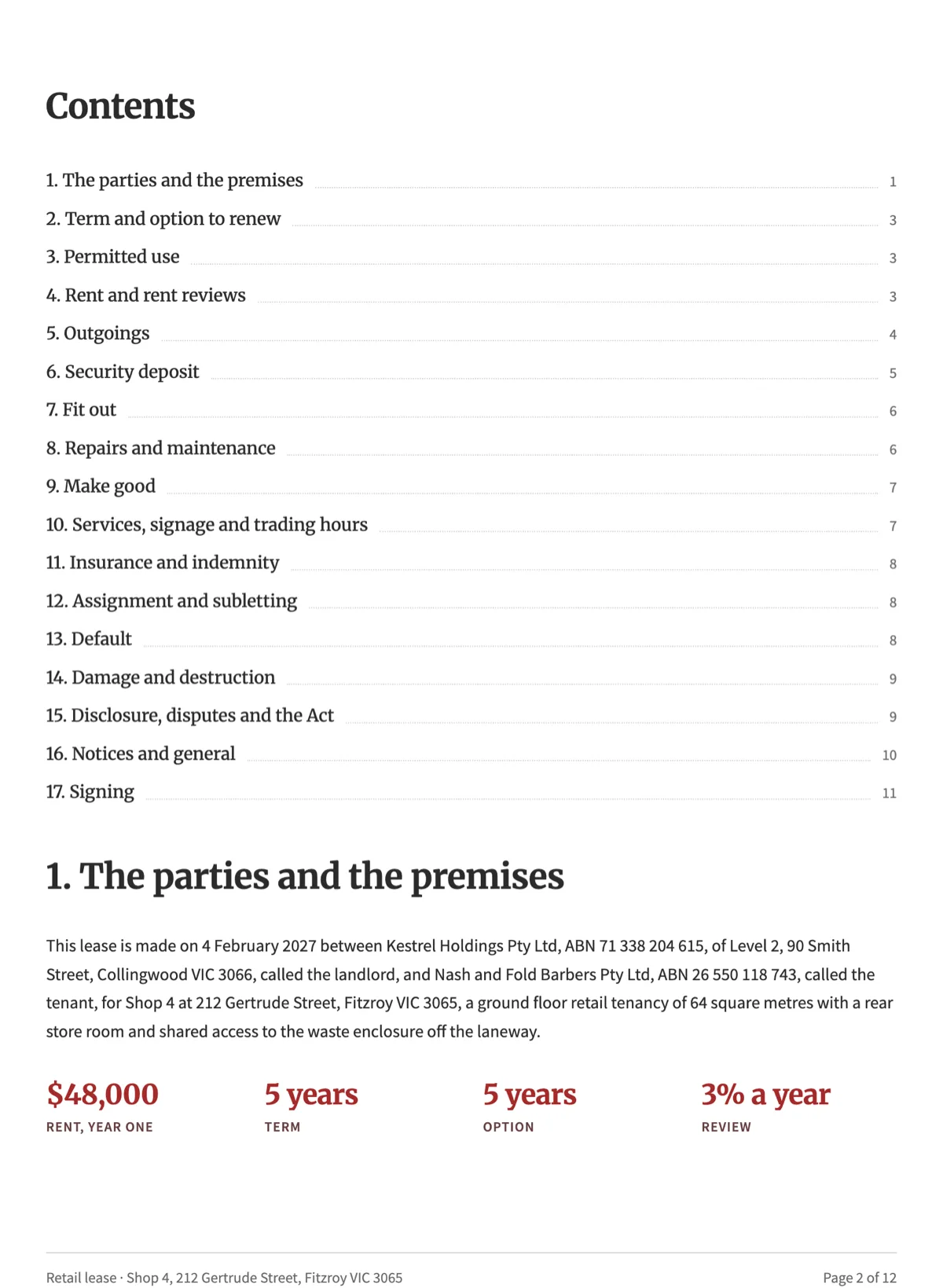 Commercial lease agreement template with outgoings and fit out termsA retail lease is decided by three numbers and two clauses: the rent, the review, the outgoings, the fit out contribution and the make good. This 12 page Victorian lease sets all five out in the open, including the outgoings the landlord is not allowed to recover at all.
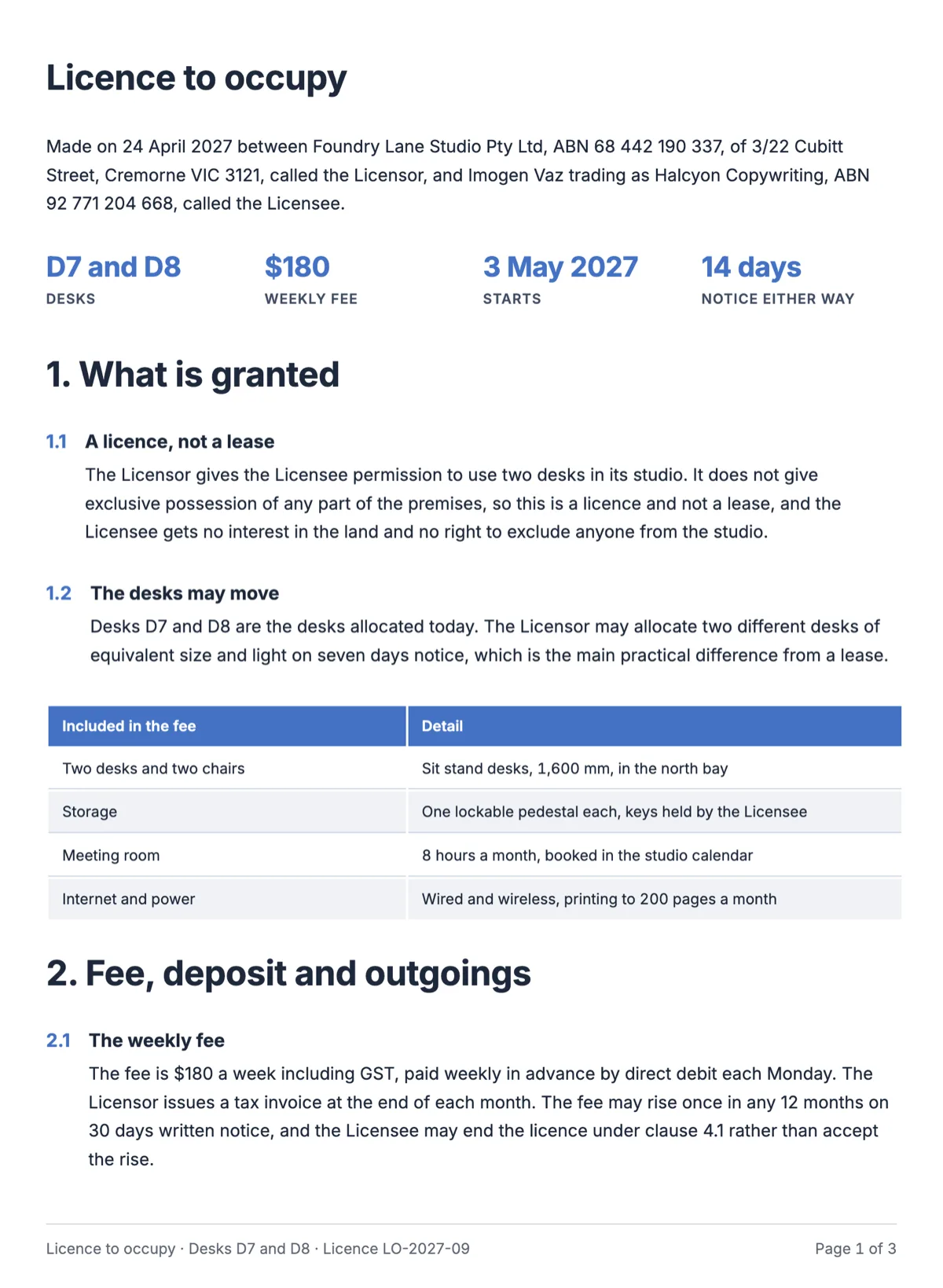 Licence to occupy template for desk space without a leaseA licence to occupy gives someone permission to use space without giving them exclusive possession of it, which is the line between a licence and a lease. This one covers two desks in a Melbourne studio at $180 a week including GST, with fixed access hours, a right to move the desks on seven days notice, and 14 days to end it from either side.
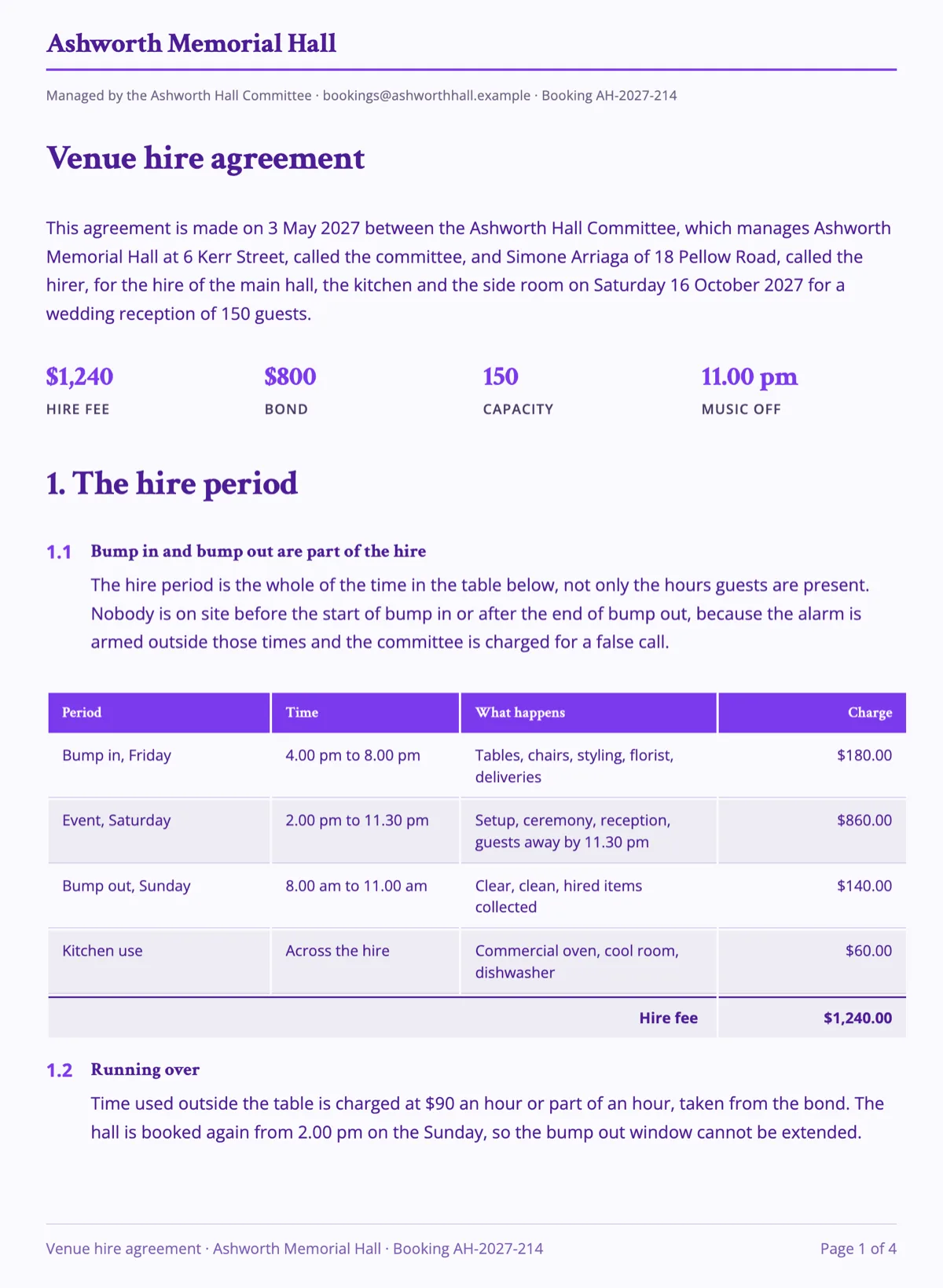 Venue hire agreement template with bump in, noise and a bondHall hire disputes are almost always about time and noise: the hirer thought the hire started when guests arrived, and the committee thought music stopped at eleven. This agreement prices bump in, the event and bump out as three separate periods, and ties the curfew to the planning permit rather than to a preference.
Questions people ask
How is turnover rent calculated?
Usually as a percentage of gross sales above a threshold, added to a base rent. With an 8% rate, an $800,000 threshold and sales of $1,000,000, the turnover rent is 8% of $200,000, or $16,000, on top of the base rent. Some leases use a percentage of all sales, or the greater of a minimum and a percentage.
Do online sales count for turnover rent?
Only if the lease says so. Many modern leases exclude online sales placed elsewhere, while including orders placed in store. Click and collect and returns of online orders are common sources of dispute, so the definition should deal with each expressly. Some state laws affect how online sales may be counted.
Can my landlord audit my accounts?
If the lease gives an audit or inspection right, yes, usually limited to sales records, once a year and on notice. Leases often require an annual statement certified by an auditor. If an audit finds sales were understated beyond a small margin, the tenant commonly pays its cost.
Does turnover rent replace rent reviews?
Not necessarily. Many leases have a base rent subject to reviews plus a turnover component. If the base rent rises under a review while the threshold stays the same, total rent can rise faster than expected, so check how the threshold moves when the base rent changes.
Is turnover information kept confidential?
It should be. A good clause requires the landlord to keep sales figures confidential, with limited exceptions such as disclosure to its financiers or a buyer of the centre who agrees to keep them confidential. Some state retail leases laws also restrict how landlords may use or disclose a tenant's turnover information.
Put the clause in a finished document
The button opens the document generator with a starting description already filled in. Change it to match your own agreement before you run it.
Create a document with OneCraftRelated clauses
- Rent review clause: fixed, CPI or marketA rent review clause sets when lease rent changes and how. Victorian retail lease sample wording, fixed, CPI and market review variants, and the ratchet rule.
- Outgoings clause: the building costs on top of rentAn outgoings clause sets which building costs a tenant pays on top of rent. Victorian retail sample wording, what is recoverable and gross lease variants.
- Audit rights clauseAn audit rights clause lets a customer inspect a supplier's records or systems to check compliance. Sample with a yearly audit on 20 days notice, and variants.
- Radius clause in a retail leaseA radius clause for a shopping centre cafe lease: no second outlet within 3 km for 3 years, an exception for an existing store, and how far a radius can go.
For everything the document generator can do, see the document maker.
Step by step in the builder: Create a document with AI, then Document builder components.
Written and checked by the OneCraft team. Last checked .