Contract clause
Radius clause in a retail lease
A radius clause in a retail lease stops the tenant from opening or running a competing outlet within a set distance of the centre or premises, usually for a set period. Landlords use it to protect the centre's turnover; because it restrains trade, it must be reasonable to be enforced.
Shopping centre landlords often earn more when a tenant's customers can only find that brand in one place nearby. A radius clause protects that, but a clause that is too wide or too long can stop a growing business from expanding at all.
Indunil Asanka · Co-founder
3 min read · Published
Sample clause
Written for a retail lease between the owner of Wattle Grove Shopping Centre, a fictional suburban centre, and Crema Lane, a fictional cafe tenant.
Radius Restriction. (a) During the first 3 years of the Term, the Tenant must not, and must ensure its related entities do not, operate a cafe under the name Crema Lane or any similar name within 3 kilometres of the Centre, measured in a straight line from the Centre's main entrance. (b) Paragraph (a) does not apply to the Tenant's existing cafe at 12 Hart Street, Wattle Grove, or to any relocation of that cafe within 500 metres of its current site. (c) Paragraph (a) does not restrict online sales, catering or delivery from the Premises. (d) The parties agree this restriction is reasonable to protect the Landlord's legitimate interest in the trading performance of the Centre.
Sample wording, not legal advice.
Variants
Fixed radius
Most centre leases, setting a distance and a period, with any exceptions listed.
The Tenant must not carry on a business similar to the Permitted Use within 2 kilometres of the Centre during the Term, other than at the Premises and the locations listed in Item 14.
Radius with turnover inclusion
Leases with turnover rent, where the landlord accepts a nearby store if its sales count towards the centre store's turnover.
If the Tenant operates another store within 3 kilometres of the Centre during the Term, the gross sales of that store will be included in the Tenant's Gross Sales for the purposes of calculating turnover rent under this Lease.
No radius clause
Tenants with bargaining power, such as anchor or national tenants, or centres where a radius restriction would not be accepted.
Nothing in this Lease restricts the Tenant or its related entities from carrying on any business at any location other than the Premises.
What to negotiate
Distance
The distance should reflect the centre's real catchment. A neighbourhood centre might justify 1 to 3 kilometres; a regional centre more. A distance that covers half a city is hard to justify as protecting the centre and risks being an unreasonable restraint. Tenants should map the radius against their expansion plans before agreeing.
Time limit
A restriction lasting the whole term, and especially one that continues after the lease ends, is harder to justify than one covering the first few years, while the store establishes its customers. A clause ending after 2 or 3 years, as in the sample, is a common compromise.
Existing stores and how the landlord uses it
Existing outlets within the radius should be excluded by name, along with relocations nearby. Tenants should also ask whether the landlord applies the same clause to competitors in the centre, and whether the landlord will release the restriction if the centre loses its anchor tenant or significantly changes.
The risk of leaving it out
Without a radius clause, a landlord cannot stop a tenant opening another outlet across the road, which can draw customers out of the centre and reduce turnover rent. For the tenant, the absence of a clause is a benefit, so the clause is usually the landlord's request and the tenant's concession, to be traded for a better rent or incentive.
Restraint of trade and reasonableness
A radius clause restrains the tenant's trade, so under the general law it is enforceable only to the extent it is reasonable to protect a legitimate interest of the landlord, such as the centre's trading performance, and not contrary to the public interest. A court may strike down a clause that is wider than necessary in distance, duration or the kind of business covered. Competition law may also be relevant where a restriction substantially lessens competition, and small business tenants can raise unfair or unconscionable conduct. Law checked on 21 October 2026. This page explains how the clause works and is not legal advice.
Retail lease laws and disclosure
Each state has a retail leases law, such as Victoria's Retail Leases Act 2003, that regulates retail shop leases, requires landlords to give disclosure statements before a lease is entered into, and provides low cost dispute resolution through small business commissioners. Tenants should check whether the disclosure statement mentions any radius restriction and should not sign a lease with a restriction that was not disclosed and discussed. The Victorian Small Business Commission and the Small Business Development Corporation in Western Australia publish guidance for retail tenants.
Online sales and delivery
Modern radius clauses should say whether online sales, delivery and catering count as operating within the radius. A clause written before delivery apps can be read to catch a delivery kitchen, or not, depending on its wording. The sample excludes online sales and delivery from the premises, which most tenants will want, and many landlords accept.
Negotiating it
Treat the radius as part of the commercial deal. A tenant accepting a wide radius can ask for a lower rent, a longer rent free period or a fit out contribution. Landlords that need turnover protection can offer a shorter period or a turnover inclusion instead of a ban, which gives the tenant freedom to expand while the landlord still shares in nearby sales.
Documents that carry this clause
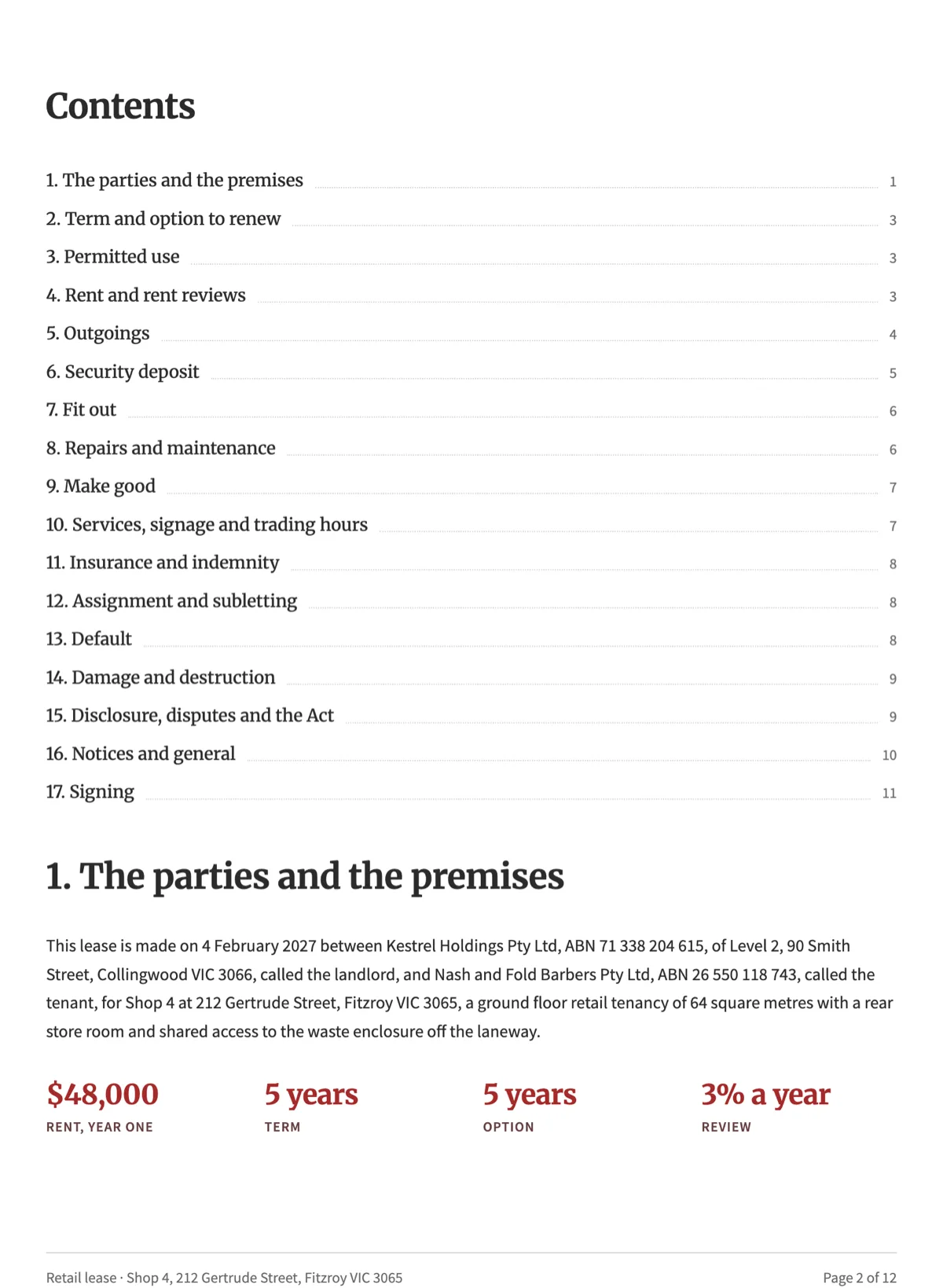 Commercial lease agreement template with outgoings and fit out termsA retail lease is decided by three numbers and two clauses: the rent, the review, the outgoings, the fit out contribution and the make good. This 12 page Victorian lease sets all five out in the open, including the outgoings the landlord is not allowed to recover at all.
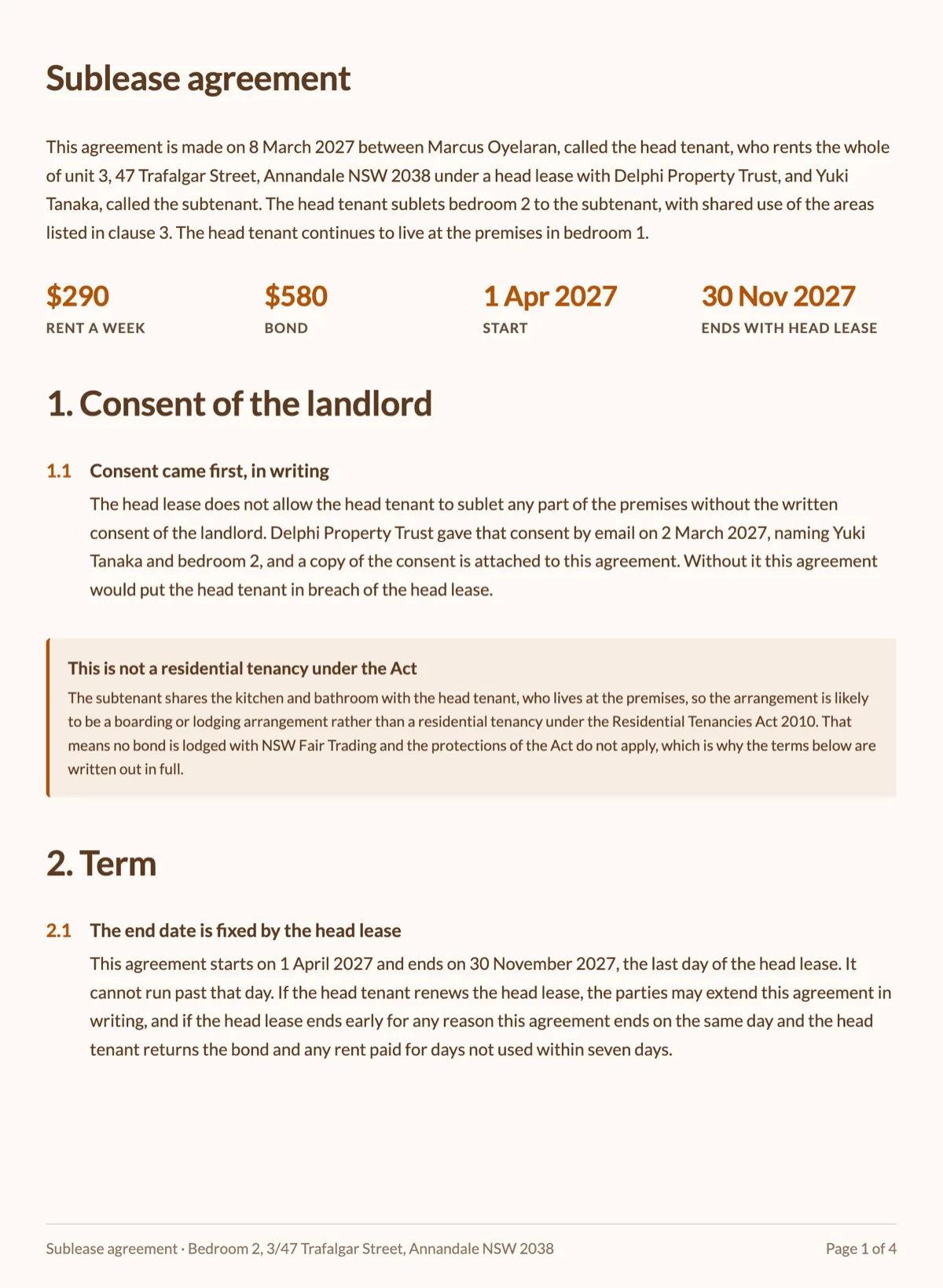 Sublease agreement template with the head lease consent recordedSubletting a room goes wrong in two places: the landlord never consented, and nobody wrote down what the occupant is actually renting. This agreement fixes the consent on the first page with a date and an email, then sets out the room, the shared areas and who keeps each one in order.
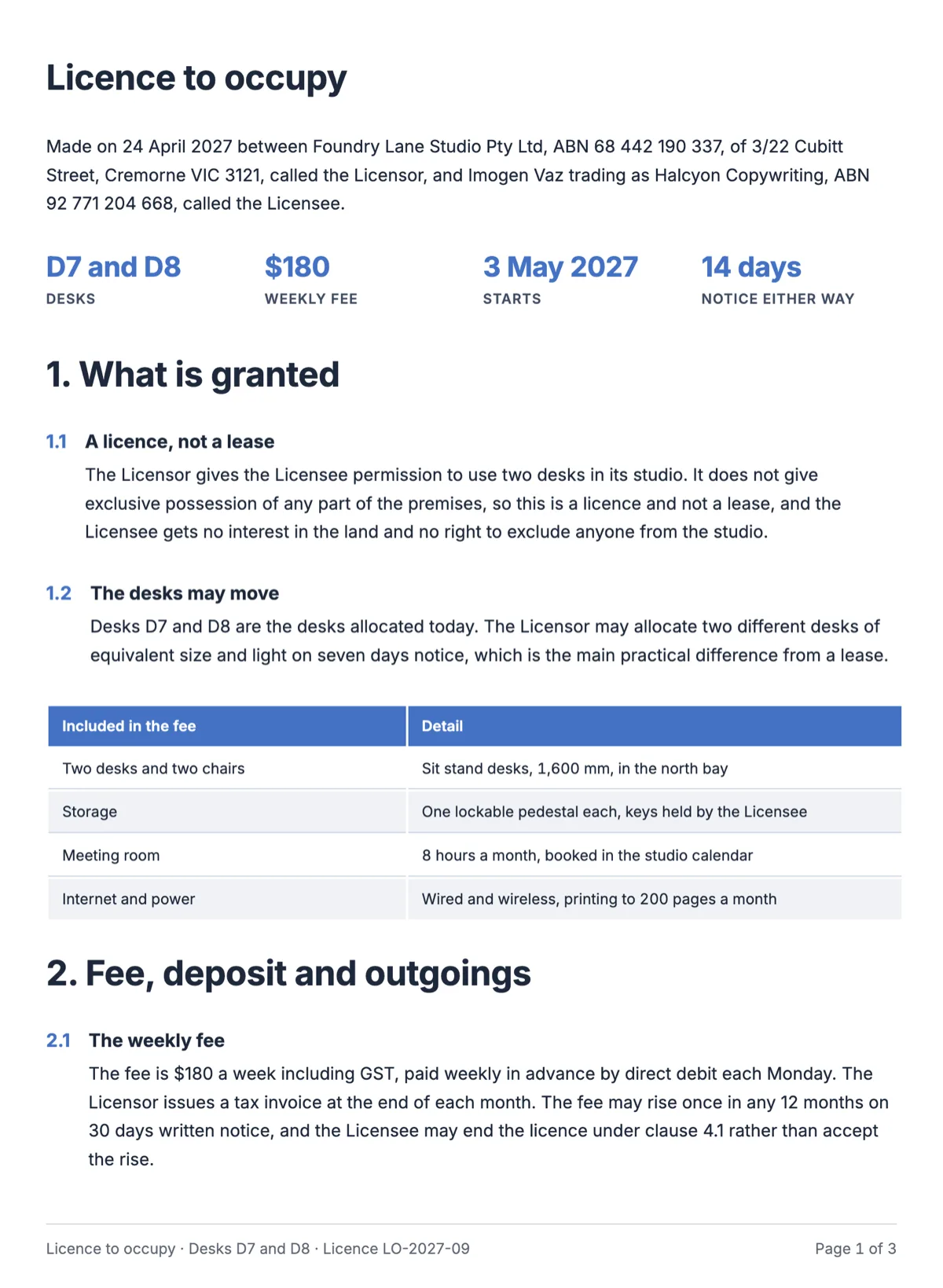 Licence to occupy template for desk space without a leaseA licence to occupy gives someone permission to use space without giving them exclusive possession of it, which is the line between a licence and a lease. This one covers two desks in a Melbourne studio at $180 a week including GST, with fixed access hours, a right to move the desks on seven days notice, and 14 days to end it from either side.
Questions people ask
What is a radius clause in a lease?
It is a lease term that stops the tenant operating a competing or similar store within a set distance of the centre or premises, for a set period. Landlords use it to protect the centre's turnover and the rent linked to it. It is common in shopping centre leases.
Is a radius clause enforceable?
If it is reasonable in distance, duration and scope to protect the landlord's legitimate interest, generally yes. A clause wider than necessary may be unenforceable as a restraint of trade, and competition law or unfair conduct rules may be relevant in some cases.
Can I negotiate the radius?
Yes. Distance, duration, the kind of business covered and exceptions for existing or relocated stores are all negotiable. Tenants can also trade acceptance of a radius for a lower rent or incentives. Get advice before signing, because a radius can limit future expansion for years.
Does a radius clause cover online sales?
Only if the wording catches them. Many older clauses do not mention online sales or delivery, which leads to disputes. A modern clause should say expressly whether online sales, delivery kitchens and catering from other premises count, and tenants usually ask for them to be excluded.
What happens if I breach a radius clause?
The landlord may seek an injunction to stop the competing store, claim damages for lost turnover rent, or treat the breach as a default under the lease. Some clauses instead require the other store's sales to be added to turnover, which is less drastic for both sides.
Put the clause in a finished document
The button opens the document generator with a starting description already filled in. Change it to match your own agreement before you run it.
Create a document with OneCraftRelated clauses
- Permitted use clause: what the premises may be used forA permitted use clause limits what leased premises may be used for. Victorian retail lease sample wording, narrow and broad variants, and what to negotiate.
- Exclusivity clause: dealing only with each other, within limitsAn exclusivity clause commits a party to deal only with the other for a period. Australian venue catering sample, supply and territory variants, ACCC limits.
- Restraint of trade clause: building a cascade for a business saleA restraint of trade clause limits competing after a business sale or exit. How an Australian cascading restraint is built, with sale and shareholder variants.
- Turnover rent clause: base rent plus a share of salesA turnover rent clause for a homewares tenant: base rent plus 8% of gross sales above a threshold, monthly returns, annual audit and a rent table.
For everything the document generator can do, see the document maker.
Step by step in the builder: Create a document with AI, then Document builder components.
Written and checked by the OneCraft team. Last checked .