Classic form
Interpreter booking request for home care visits
An interpreter booking request records the language, whether the interpreter is needed on site, by phone or by video, when and for how long, what kind of conversation it is, any gender preference and where to go. This Australian home care version uses a client ID rather than a name, and says why family members should not interpret.
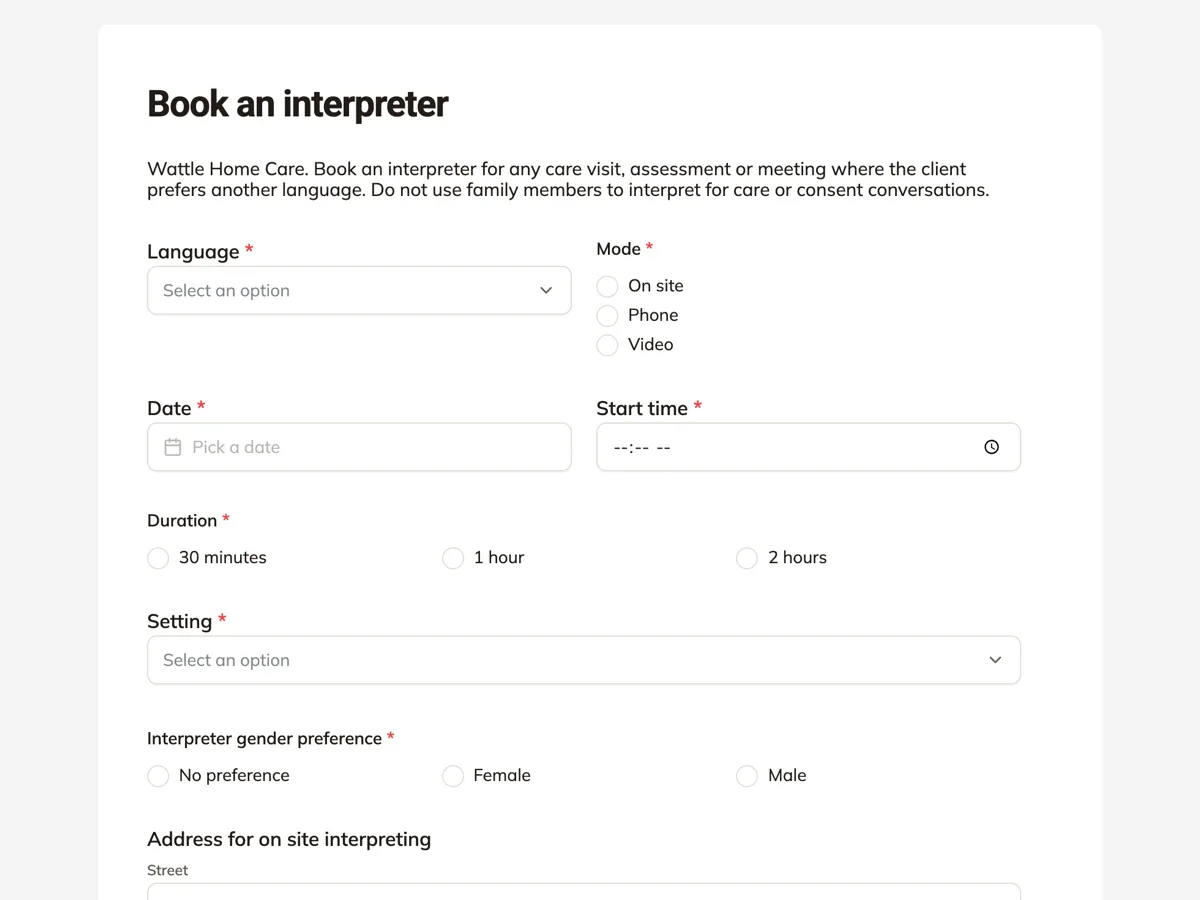
The form itself
A static copy of the finished form, exactly as it renders. Nothing here can be filled in or submitted, so read it as a reference and build your own from the button above.
Every field, and what it collects
The complete field list, in the order respondents meet it.
- LanguageDropdownRequired
- Options: Arabic · Cantonese · Greek · Italian · Mandarin · Vietnamese · Auslan · Other, in notes
- ModeSingle choiceRequired
- Options: On site · Phone · Video
- DateDateRequired
- Start timeTimeRequired
- DurationSingle choiceRequired
- Options: 30 minutes · 1 hour · 2 hours
- SettingDropdownRequired
- Options: Care assessment · Care plan review · Medication discussion · Family meeting · Complaint or feedback meeting
- Interpreter gender preferenceSingle choiceRequired
- Options: No preference · Female · Male
- Address for on site interpretingAddress
- Client referenceShort textRequired
What each field on this form collects
The language comes from a list of the agency's most requested languages, including Auslan, beside the mode: on site, phone or video. Date and start time share a row, then duration and the setting, from a care assessment to a complaint meeting. A single choice records any gender preference. An address block is used for on site work, and the client reference is an ID rather than a name.
Why not ask a family member
When a care conversation involves consent, medication or a complaint, a family member interpreting can leave out what they think the client should not hear, add their own view, or simply not know the terms. Professional interpreters are trained to interpret accurately and impartially and to keep what they hear confidential. In Australia, NAATI certifies interpreters, and the Translating and Interpreting Service provides phone and on site interpreting that many government funded services can use. The intro sets the rule, so staff book an interpreter instead of relying on whoever is at home.
Setting and preference
Knowing the setting lets the coordinator choose an interpreter familiar with health and aged care terms, and plan for a longer booking when a care plan review is likely to run over. A gender preference matters in personal care and in some cultures, and offering it plainly on the form makes it a normal request rather than an awkward one. Using a client ID instead of a name keeps the booking system from collecting more health information than it needs.
How to adapt this form
A hospital adds the ward and the clinician running the appointment. A school adds the student's year level and whether the meeting is a parent teacher interview. A legal service adds the matter type and whether the interpreter needs legal experience. A provider that books many sessions for the same client adds a question asking whether the client would like the same interpreter each time, which helps trust.
What makes this form work
A rule in the intro
Do not use family members to interpret for care or consent conversations. Staff know the expectation before they decide a booking is not worth the trouble.
Auslan is on the list
The language list includes Auslan alongside spoken languages. Deaf clients are not an afterthought in a separate process.
An ID, not a name
The client reference asks for an ID and says no names. Bookings travel through more hands than care records, and the form keeps health details out of them.
Questions people ask
How do you book an interpreter in Australia?
Through a professional interpreting service, such as the Translating and Interpreting Service for many government funded services, or a private agency. Give the language, mode, date, time, duration, setting and address. NAATI certification shows an interpreter's credentials. This form collects those details for the coordinator.
Should family members interpret in health or care settings?
Generally not for important conversations such as consent, medication or complaints. Family members may not interpret accurately or impartially, and the client may not speak freely. Use a professional interpreter, and record when a client declines one, so the decision is the client's and is written down.
What is the difference between on site, phone and video interpreting?
On site suits complex or emotional conversations and clients with hearing difficulties. Phone is fast and good for short conversations. Video works when on site is not possible and visual cues matter, including for Auslan. Choose the mode by the conversation, not by what is easiest to book.
How far ahead should an interpreter be booked?
As early as possible, especially for less common languages and on site bookings, which may need several days. Phone interpreters can often be reached on demand. This form is for planned bookings; same day phone needs go to the coordinator.
Can clients request a female or male interpreter?
Many services try to meet gender preferences, particularly for personal care or health discussions, though availability varies by language. This form asks so the coordinator can try to match the request and tell staff if it cannot be met, which gives the worker a chance to talk with the client beforehand.
What does an interpreter need to know before the session?
The setting, how long it will run, any specialist terms likely to come up and who will be present. A short briefing before the session helps. The setting field on this form gives the coordinator most of that, and the worker can brief the interpreter on arrival or at the start of the call.
Build your own in about a minute
The button below opens the generator with this use case already described. Change the wording to match your own, generate, then edit anything you like.
Make one like thisNot ready to start? See the AI form builder page first.
Other form examples
Freedom of information request form for a council
A freedom of information request form has to describe the documents clearly enough for an agency to find them, say who is asking and how they want access, and deal with the application fee. This one does that for a Victorian council, with a date range to narrow the search, a hardship waiver option and the four forms of access.
Parking permit application for a council permit zone
A parking permit application asks what kind of permit is needed, which vehicles it covers, proof that the applicant lives in the zone, for how long and in which zone, with a signed declaration. This Australian council version also covers carer and trade permits, which are where most of the questions come from.
Overtime request form with an hours table by day
An overtime request form records the extra hours an employee worked, why, who approved them and how they will be paid. This one does that for an Australian civil construction crew, with a five row hours table, the employee's classification under the Building and Construction General On-site Award and a signature confirming the hours.
Want the steps in the builder? Read Date, time and address fields, then Limit bookings to staff. For everything this generator can do, see the form maker.
Written and checked by the OneCraft team. Last checked .