Contract clause
Pay when paid clause: banned in UK construction, and what replaces it
A pay when paid clause makes a contractor's payment to its subcontractor conditional on the contractor first being paid by the client. In UK construction contracts, section 113 of the Housing Grants, Construction and Regeneration Act 1996 makes such a clause ineffective unless the party further up the chain is insolvent.
Main contractors would like to pass the risk of a slow paying client down to their subcontractors. For construction work in the UK, Parliament decided in 1996 that they mostly cannot, and replaced pay when paid with a fixed timetable of due dates and notices.
Nuwan Madhusanka · Co-founder
4 min read · Published
Sample clause
Written for a subcontract between a main contractor and Mersey Building Services, a fictional Liverpool mechanical and electrical subcontractor, on a school extension.
Payment. (a) The Subcontractor may submit an application for payment on the 25th day of each month. The due date for each payment is 7 days after the Contractor receives the application, and the final date for payment is 30 days after the due date. (b) Within 5 days after each due date, the Contractor must give a payment notice stating the sum it considers due and how it is calculated. (c) If the Contractor intends to pay less than the notified sum, it must give a pay less notice no later than 7 days before the final date for payment. (d) The Contractor must pay the notified sum, or the sum in a valid pay less notice, by the final date whether or not it has been paid by the Employer, except where the Employer is insolvent within the meaning of section 113 of the Housing Grants, Construction and Regeneration Act 1996.
Sample wording, not legal advice.
Variants
The banned wording
Shown so it can be recognised and removed; this is what section 113 makes ineffective.
The Contractor shall pay the Subcontractor within 7 days of the Contractor receiving payment from the Employer in respect of the Subcontract Works, and shall be under no obligation to pay any sum unless and until it has been paid by the Employer.
Compliant fixed timetable
Any UK construction subcontract, using due and final dates that do not depend on upstream payment.
The due date for each interim payment is 7 days after the Contractor receives the Subcontractor's application, and the final date for payment is 28 days after the due date. Payment is not conditional on the Contractor receiving payment from any other person.
The upstream insolvency exception
Contractors who want the one protection the Act allows, if their client becomes insolvent.
If the Employer becomes insolvent, as defined in section 113 of the Housing Grants, Construction and Regeneration Act 1996, the Contractor's obligation to pay sums relating to work for which it has not been paid by the Employer is suspended to the extent the Act permits.
What to negotiate
Due dates and final dates
Every construction contract must provide an adequate mechanism for determining what is due and when, and a final date for payment. If it does not, the Scheme for Construction Contracts fills the gap, with a final date 17 days after the due date. Subcontractors should check the final date is a fixed number of days, not tied to anything happening upstream, and that it is no longer than the main contract allows.
Payment and pay less notices
The payer must give a payment notice within 5 days of the due date, and if it wants to pay less than the notified sum it must give a pay less notice before the deadline the contract sets. Without a valid pay less notice, the notified sum must be paid in full. These notices replaced pay when paid as the main way contractors control cash flow, and missing one is a common and costly mistake.
Pay when certified
Since the Local Democracy, Economic Development and Construction Act 2009 amended the 1996 Act, a payment mechanism that makes payment conditional on the performance of obligations under another contract, or on a decision under another contract, such as a certificate under the main contract, is also ineffective. Subcontractors should look for wording that ties their payment to the main contract certificate and resist it.
The risk of leaving it out
A pay when paid clause in a UK construction contract simply does not work, except on upstream insolvency, so including one gives a contractor false comfort and a subcontractor a misleading document. Leaving payment timing vague is worse still, because the Scheme then imposes its own dates and the parties lose control of the timetable.
The payment notice timetable that replaces it
Under the 1996 Act as amended, the payment sequence runs like this. The contract sets a due date, often linked to an application or a fixed date each month. Within 5 days after the due date, the payer gives a payment notice of the sum it considers due. The payee may give its own notice in default. If the payer intends to pay less, it gives a pay less notice before the deadline the contract sets before the final date. The notified sum, or the pay less sum, must be paid by the final date. If it is not, the payee may suspend work after giving 7 days' notice, and can refer the dispute to adjudication. Law checked on 21 October 2026. This page explains how the clause works and is not legal advice.
The insolvency exception
Section 113 allows one exception: a clause making payment conditional on receiving payment from a third person still works if that third person, or someone further up the chain on whose payment the third person depends, is insolvent. That protects a main contractor whose client collapses from having to fund the subcontractors out of its own pocket for the unpaid work. The definition of insolvency follows the Act, so a client that is merely slow or disputing payment does not trigger it.
Outside the UK
Australia goes further: the security of payment Acts in every state and territory make pay when paid provisions unenforceable in construction contracts, with no insolvency exception of the UK kind, and give subcontractors statutory rights to claim progress payments. New Zealand's Construction Contracts Act 2002 also prohibits them. In the United States, the rules differ by state: some courts treat pay when paid as a timing provision and pay if paid as a true condition, and some states restrict both.
What to do with an inherited clause
Many subcontracts still carry old pay when paid wording. A subcontractor should not rely on its ineffectiveness alone, because payment disputes are cheaper to avoid than to adjudicate. Ask for the clause to be replaced with fixed due and final dates before signing. A main contractor should replace it in its standard form, because using it suggests the rest of the payment terms may not comply either.
Documents that carry this clause
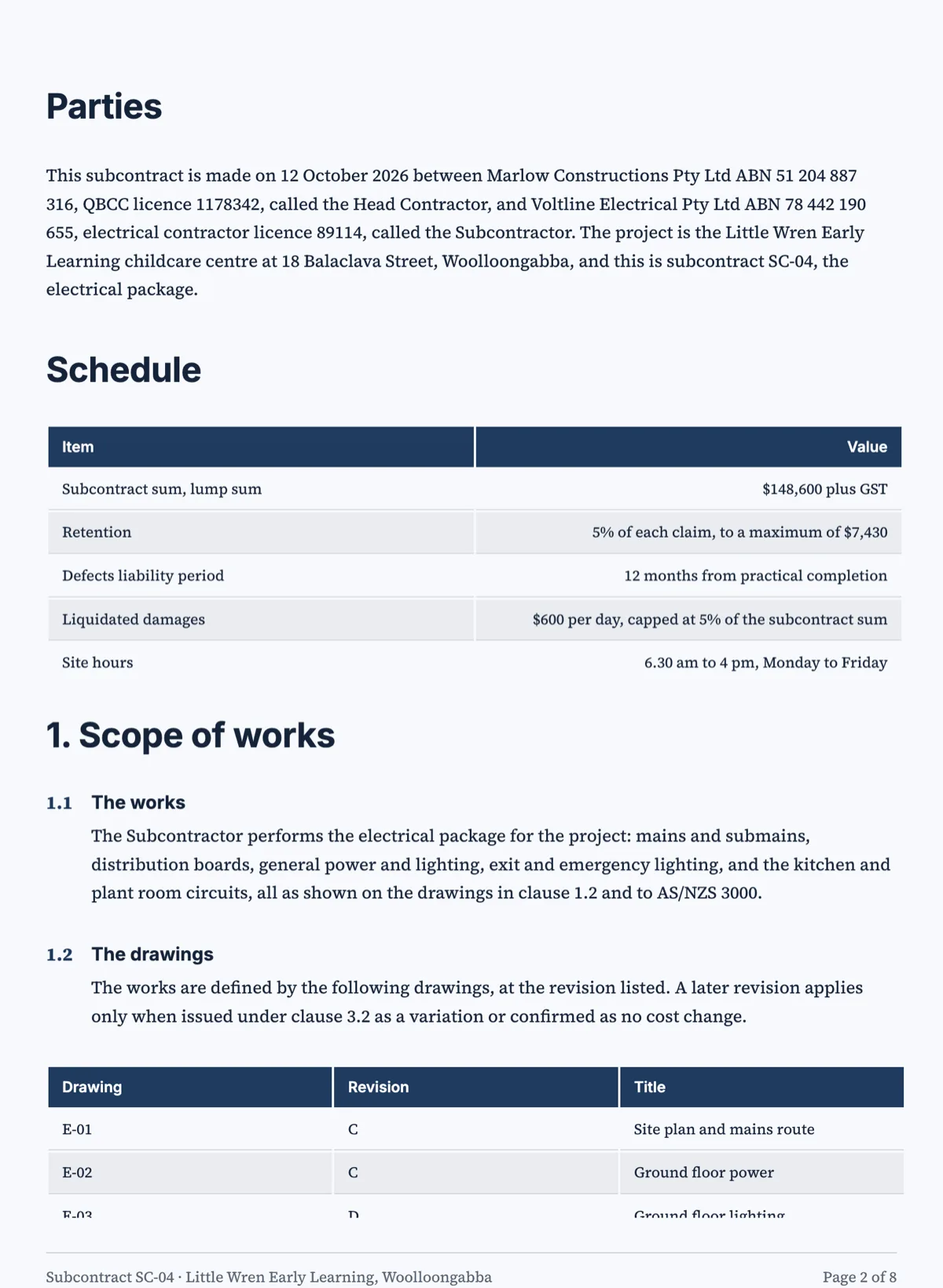 Subcontractor agreement template that flows the head contract downA subcontract exists to pass the head contract's obligations down one level and move the money back up on time. This one names the scope by drawing, sets the progress claim dates against the security of payment rules, holds retention and states the insurances, so the trade knows exactly when it is paid and for what.
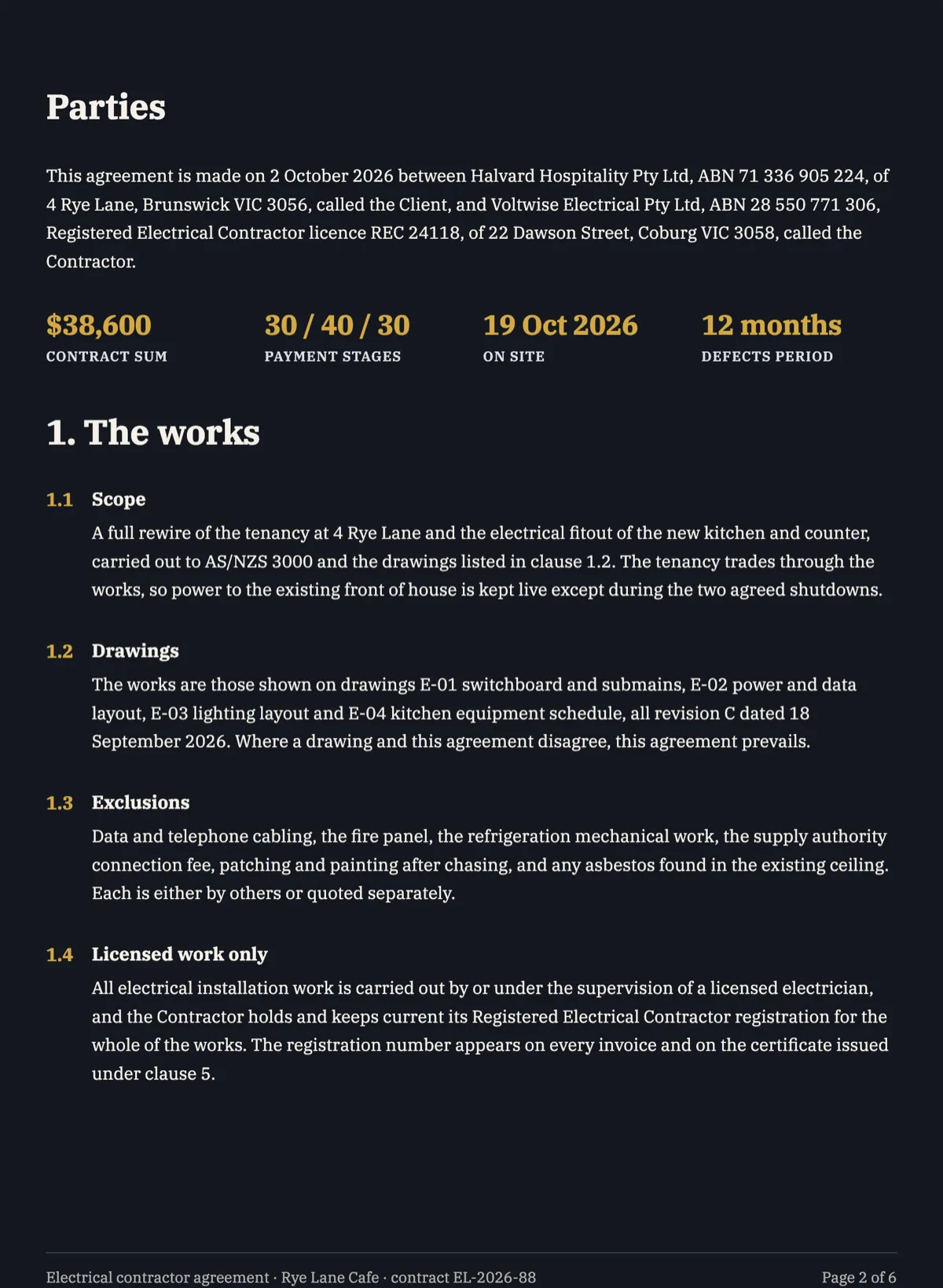 Electrical contractor agreement with a licence clause and staged paymentsElectrical work is the one trade where the paperwork at the end matters as much as the work, because without the certificate the installation is not signed off. This agreement ties the last payment stage to that certificate and sets the progress claim deadlines the payment legislation actually uses.
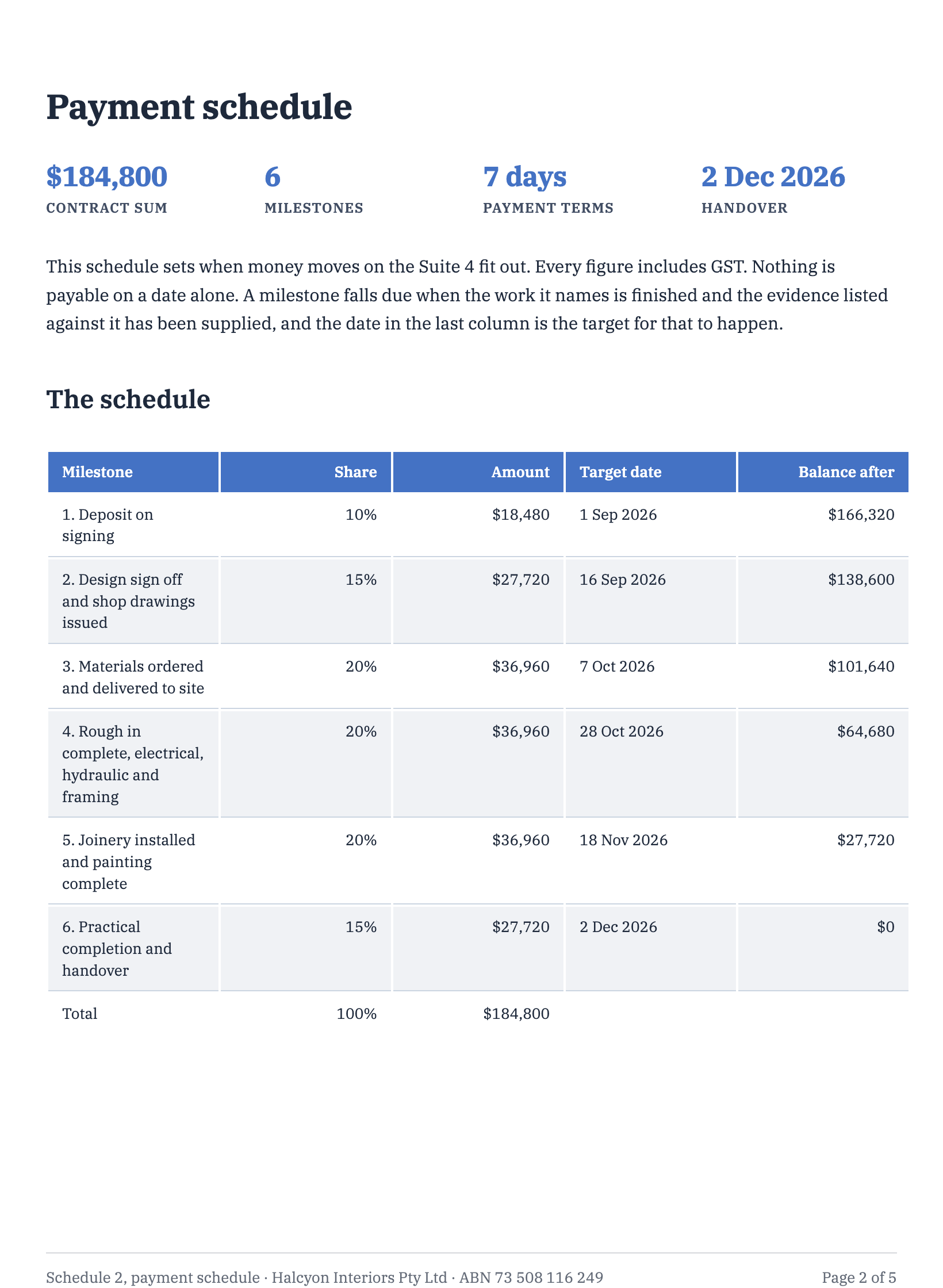 Payment scheduleA $184,800 fit out is paid in six milestones, and every one of them is a piece of work rather than a date. The running balance column is the part both sides check, because it falls to zero only when the handover pack changes hands.
Questions people ask
Are pay when paid clauses legal in the UK?
They are not unlawful to write, but in construction contracts covered by the Housing Grants, Construction and Regeneration Act 1996 they are ineffective, except where the party further up the chain is insolvent. The subcontractor must be paid by the final date whether or not the main contractor has been paid.
What replaces a banned pay when paid clause?
The Scheme for Construction Contracts fills the gap, setting the payment terms the contract failed to provide, including a final date for payment 17 days after the due date. Better drafting avoids the Scheme by setting clear due dates, final dates and notice deadlines in the contract itself.
What is the insolvency exception?
Section 113 allows a payment to be made conditional on receipt from a third person if that third person, or another party further up the chain on whose payment it depends, is insolvent. Slow payment or a dispute with the client is not enough; the client must be formally insolvent as the Act defines.
Does the ban apply to all contracts?
It applies to construction contracts as defined in the 1996 Act, which covers most building, civil engineering and related work in England, Wales and Scotland. Some work is excluded, such as contracts with residential occupiers for work on their own homes, and some process plant and extraction work.
Can I suspend work if I am not paid?
Yes. If a sum due is not paid in full by the final date and no valid pay less notice was given, the 1996 Act lets you suspend some or all of your work after giving at least 7 days' notice of your intention and the grounds. You are also entitled to reasonable costs and time arising from the suspension.
Put the clause in a finished document
The button opens the document generator with a starting description already filled in. Change it to match your own agreement before you run it.
Create a document with OneCraftRelated clauses
- Security of payment clause: working with the state payment lawsA security of payment clause sets how a contract works with the state payment laws. NSW sample wording, Victorian and Queensland variants and a guide by state.
- Progress claims clause: getting paid as the work advancesA progress claims clause sets how a contractor claims payment as work advances. NSW sample wording, the claim to payment timetable and three variants.
- Retention money clause: holding back part of a progress claimA retention money clause holds back part of each progress claim until defects are fixed. Australian sample wording, release triggers and a bank guarantee swap.
- Set off clause: deducting what the other side owesA set off clause lets one party deduct what the other owes it from what it owes. Australian sample wording, a no set off variant, and the insolvency position.
For everything the document generator can do, see the document maker.
Step by step in the builder: Create a document with AI, then Document builder components.
Written and checked by the OneCraft team. Last checked .