Form examples
Real forms, field by field
Every form here is finished and readable in full. The field lists come from how these forms are actually written in the trade, not from a template gallery, and each page says why a field is there before you copy it.
What the builder does, feature by feature, is on the AI form builder page.
350 examples, page 5 of 15
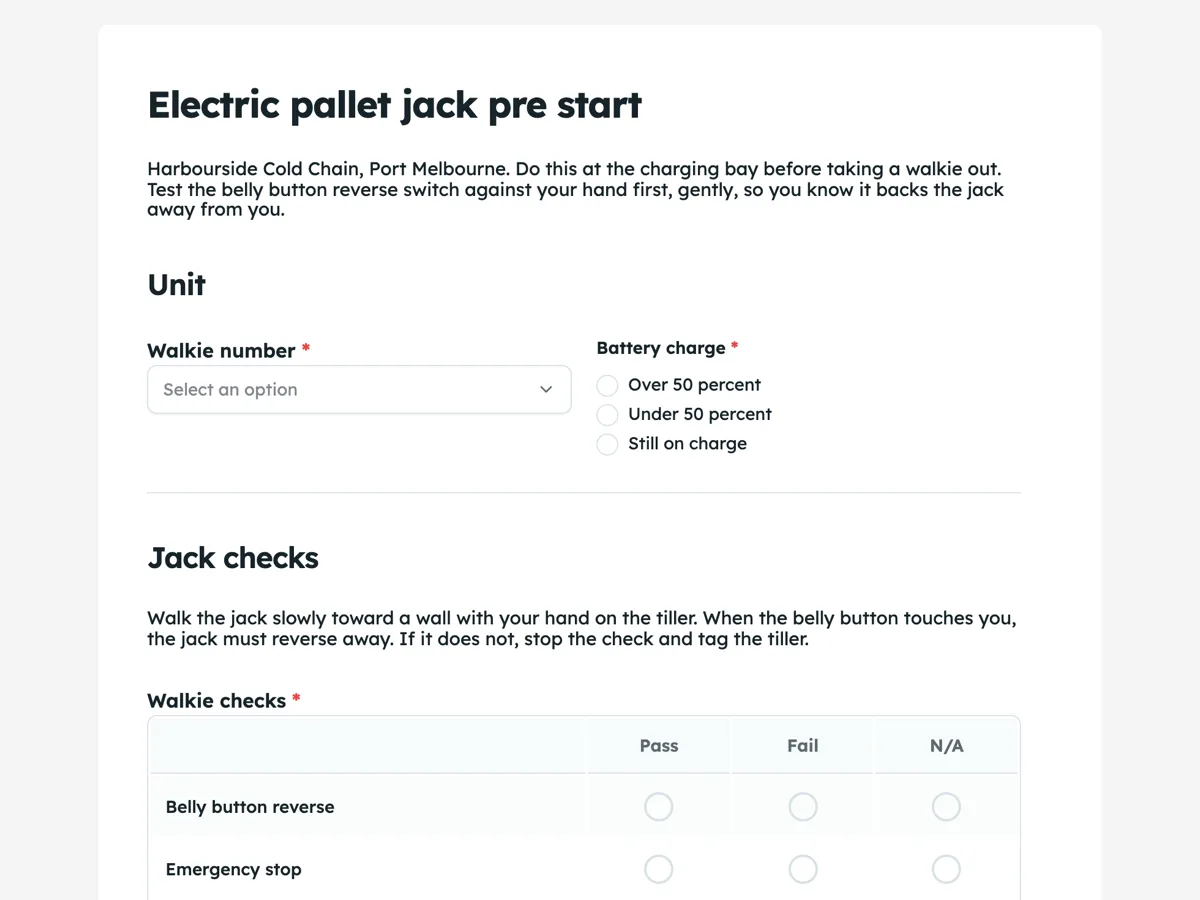
Electric pallet jack pre start checklist
An electric pallet jack pre start checklist tests the belly button reverse switch, emergency stop, horn, tiller brake and wheels before the jack leaves the charging bay. This cold chain version also records the battery charge and whether the jack is going into a chiller or freezer.
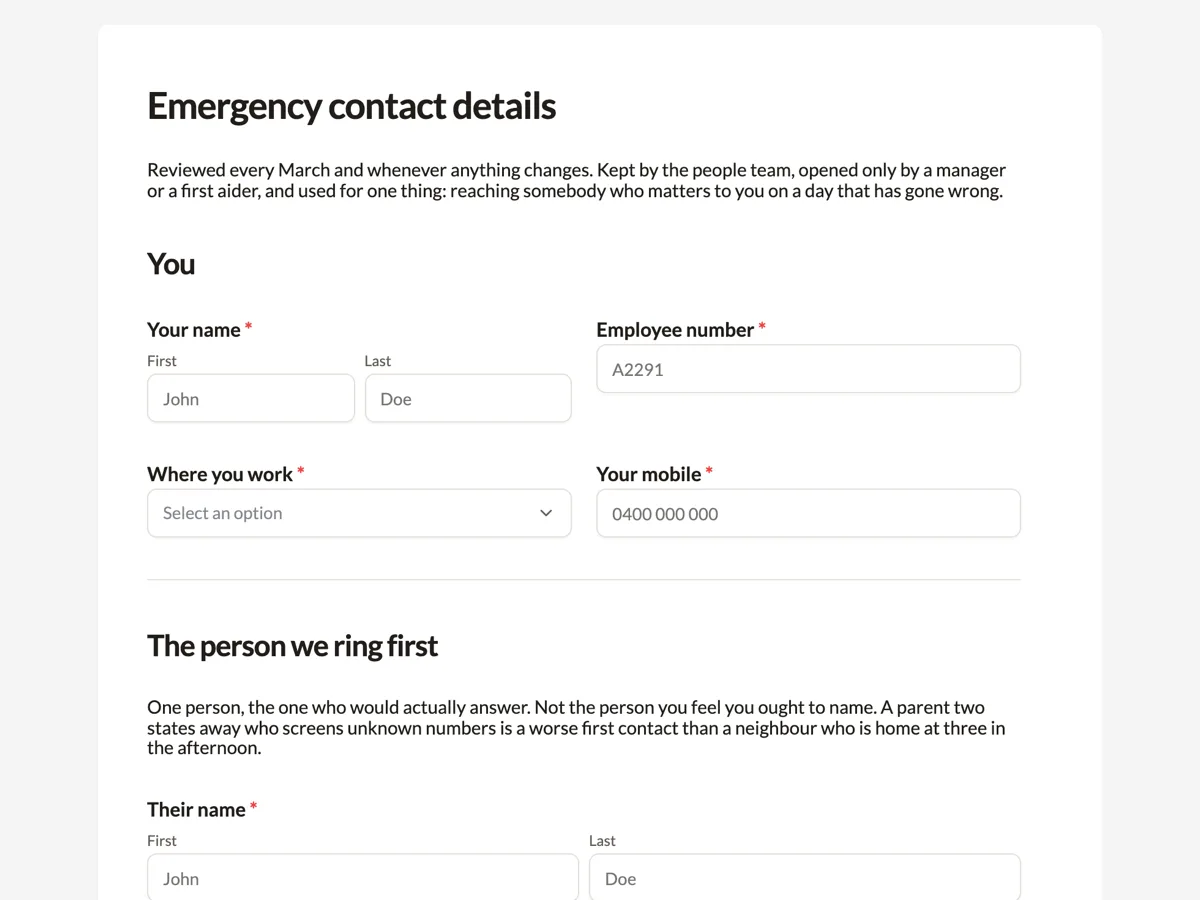
Emergency contact form
The emergency contact on file is usually the one somebody typed on their first day, three phone numbers ago. This form exists to be resent every year without asking anybody to confirm their bank details again, and it asks two questions most versions leave out: how much may be disclosed, and whether anybody must not be contacted. It is a classic form, because a first aider reading it needs the whole record on one page.
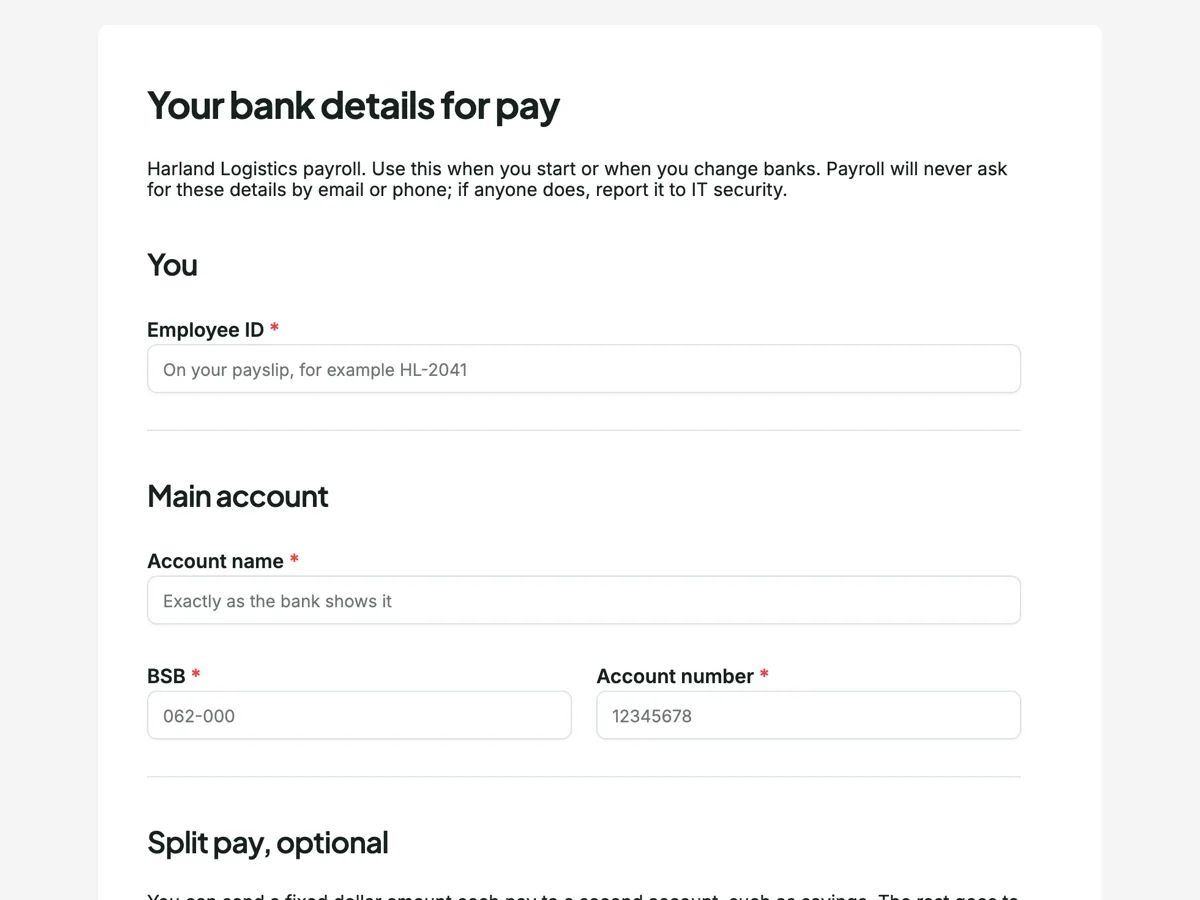
Employee bank details form with split pay
An employee bank details form collects the account name, BSB and account number that wages are paid into, the pay date the change starts from and the employee's signature. This Australian payroll version adds an optional fixed amount to a second account and warns staff about payment redirection scams.
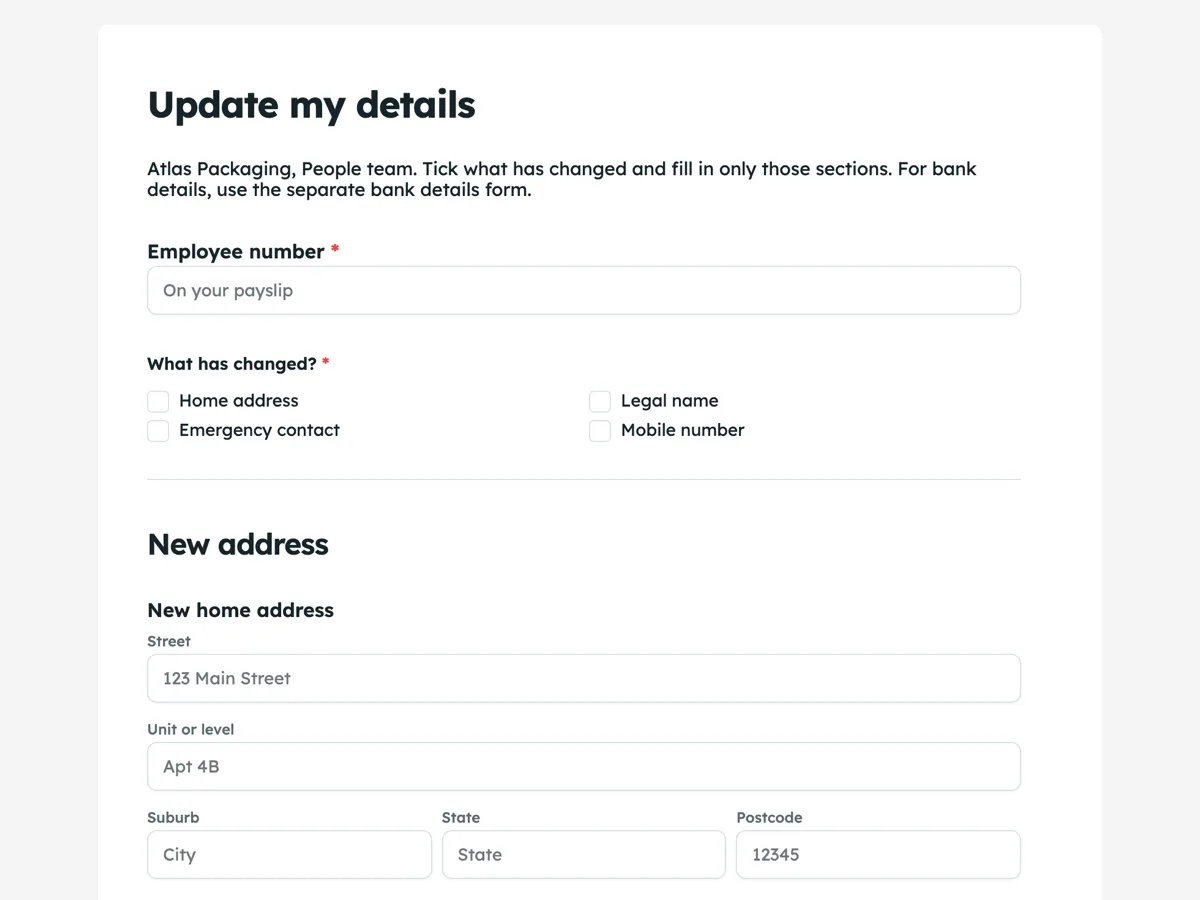
Employee details change form for address, name and contacts
An employee details change form lets staff tell HR what has changed in one place: their address, legal name, emergency contact or mobile, with evidence for a name change and the date it applies from. This version asks staff to tick what changed first, so they fill in only the sections they need.
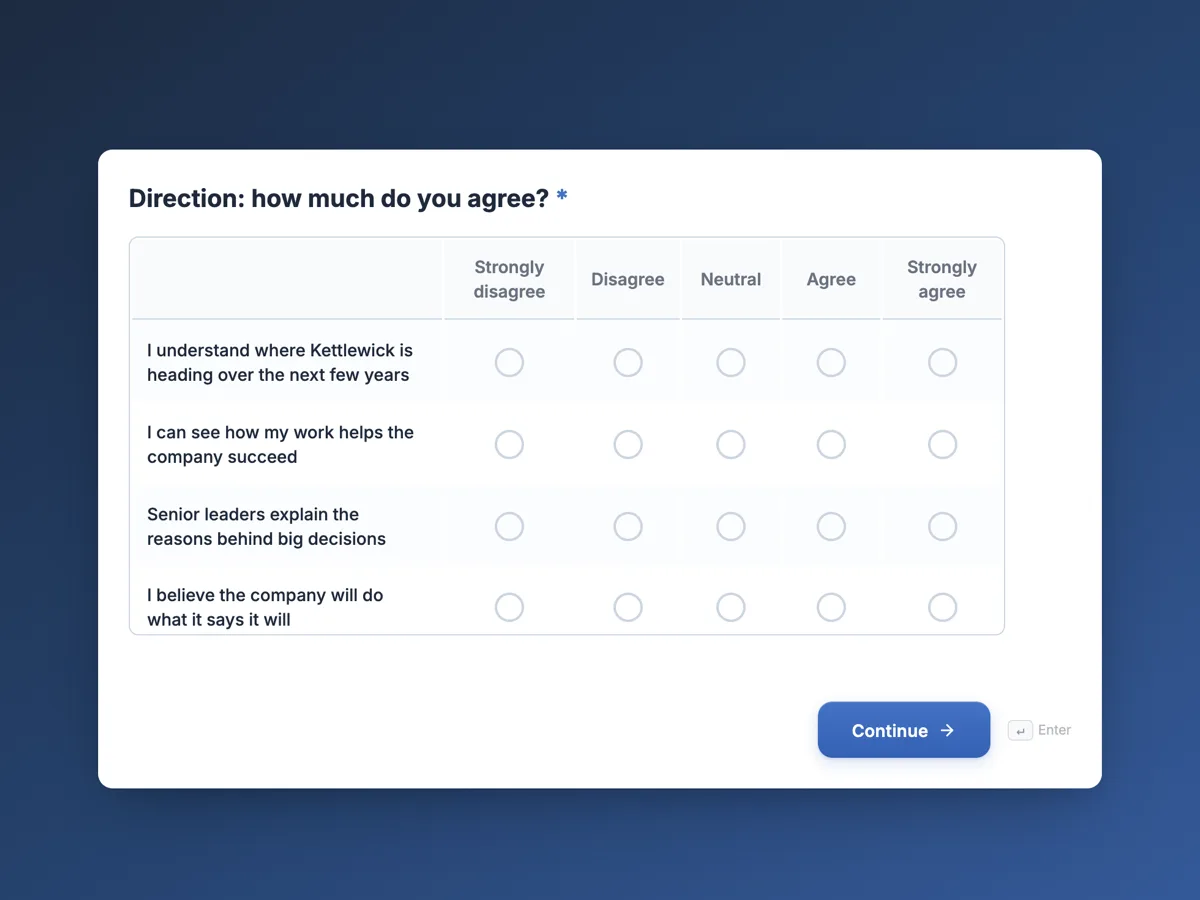
Employee engagement survey template: 20 statements in five themes
An employee engagement survey measures how committed and supported people feel at work, across enough themes to show where to act and anonymously enough that people answer honestly. This template groups twenty agreement statements into five grids, direction, manager, growth, recognition and team, then asks the employer recommendation question.
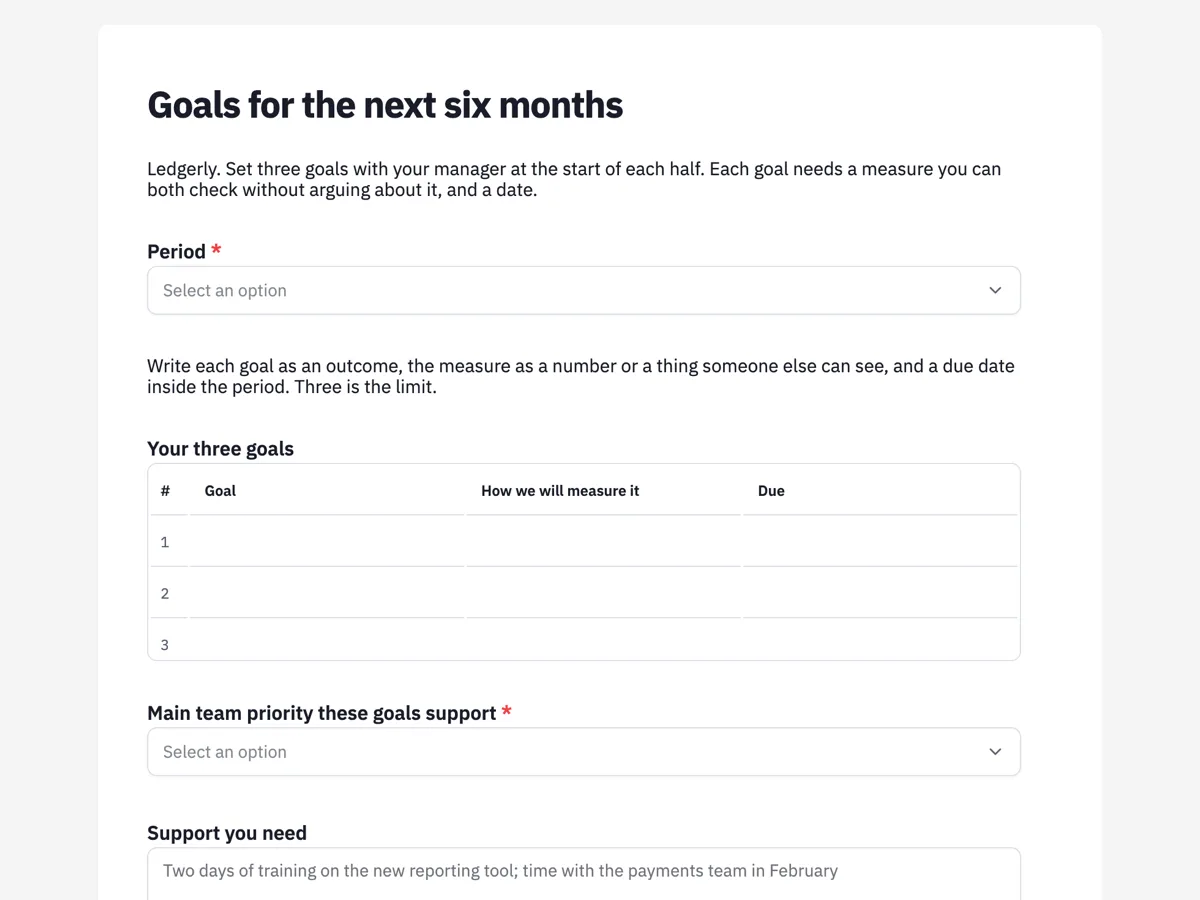
Employee goal setting form with three measured goals
An employee goal setting form records a small number of goals for a set period, how each will be measured, when it is due, how the goals connect to team priorities, what support is needed and when progress will be checked. This version limits each employee to three goals and asks both employee and manager to sign.
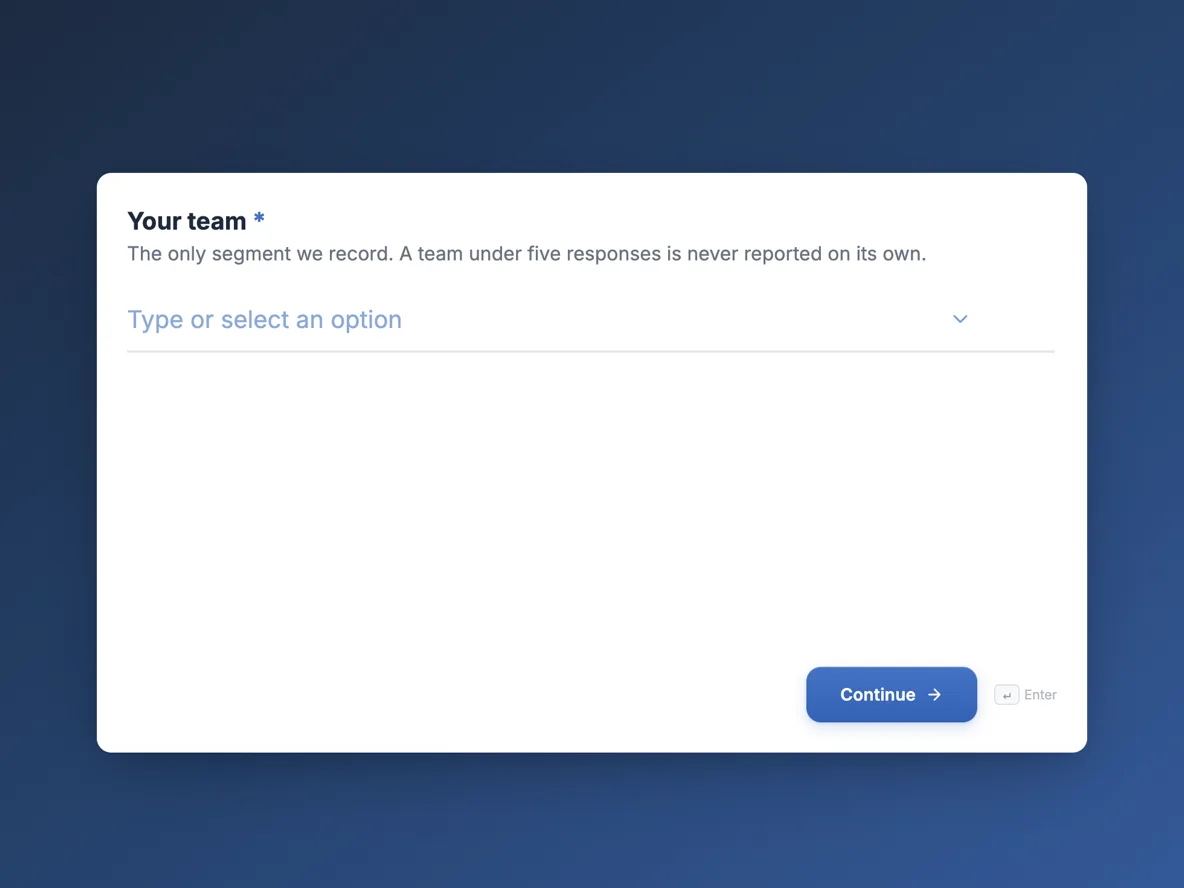
Employee pulse survey that can be trended month to month
A pulse survey only works if the questions never change, because the point is the line on the chart, not the answer this month. These six statements are the whole instrument, the team question is the only segment, and the open questions are optional so the six always get answered.
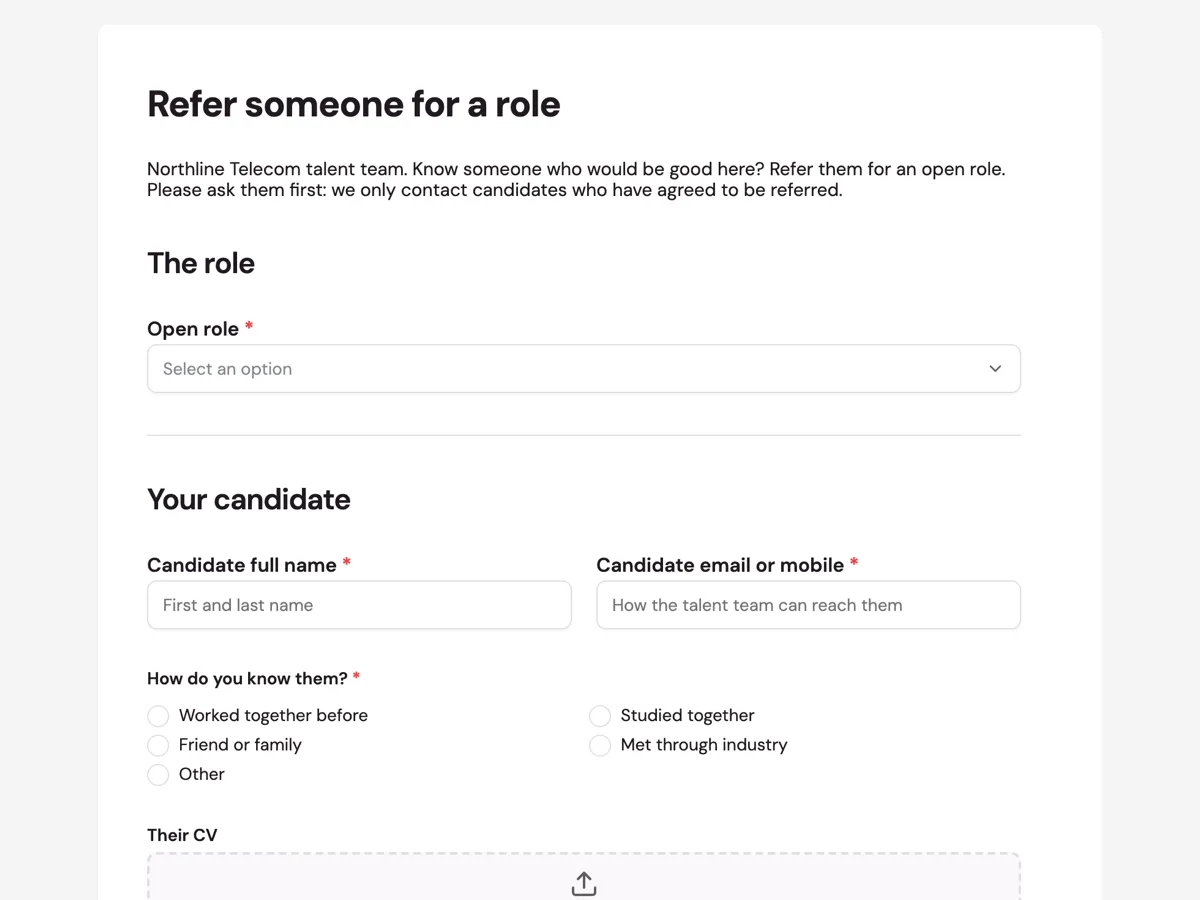
Employee referral form with candidate consent
An employee referral form lets staff put forward someone they know for an open role: which role, the candidate's details, how they know each other, a CV, why the candidate fits and whether they have agreed. This version will not contact a candidate who has not agreed, which protects both the candidate and the referrer.
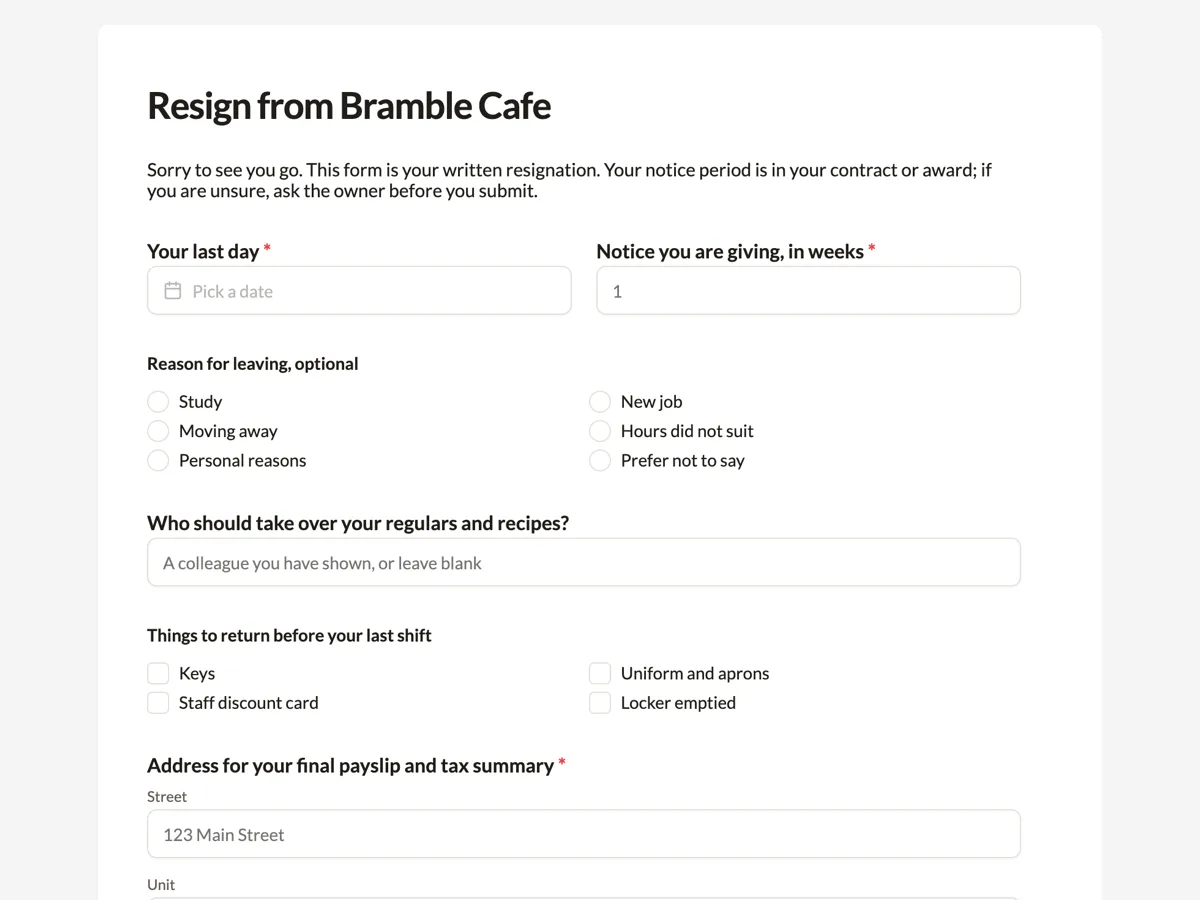
Employee resignation form with notice and last day
An employee resignation form is a written resignation: the last day, how much notice is being given, a handover contact, the property to return and where to send final documents. This small cafe version keeps the reason for leaving optional and thanks the employee rather than asking them to justify leaving.
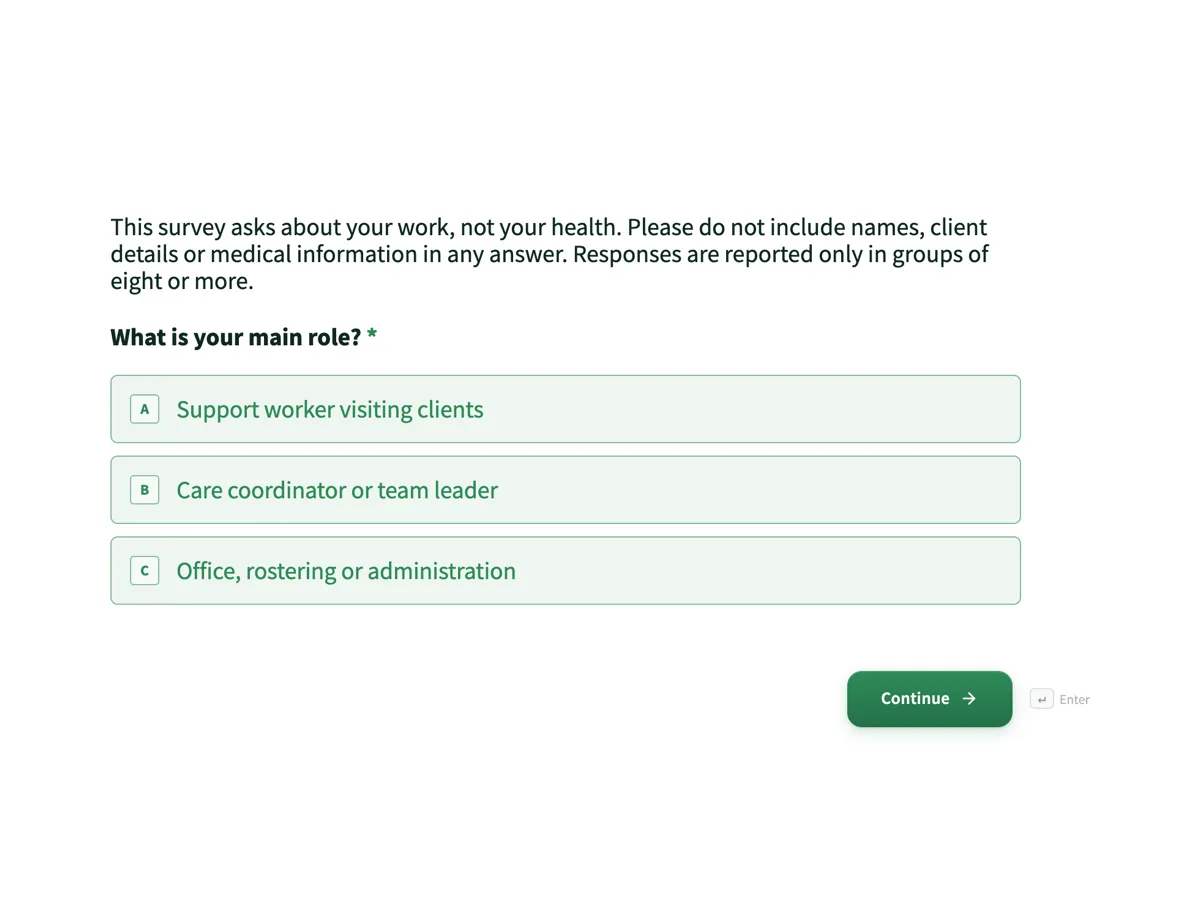
Employee wellbeing survey template with workload and support items
An employee wellbeing survey has to find the work conditions that wear people down, workload, isolation, aggression and poor support, without asking anyone about their health. This anonymous template for an Australian home care provider rates six psychosocial hazards by frequency and checks whether staff know where to get help.
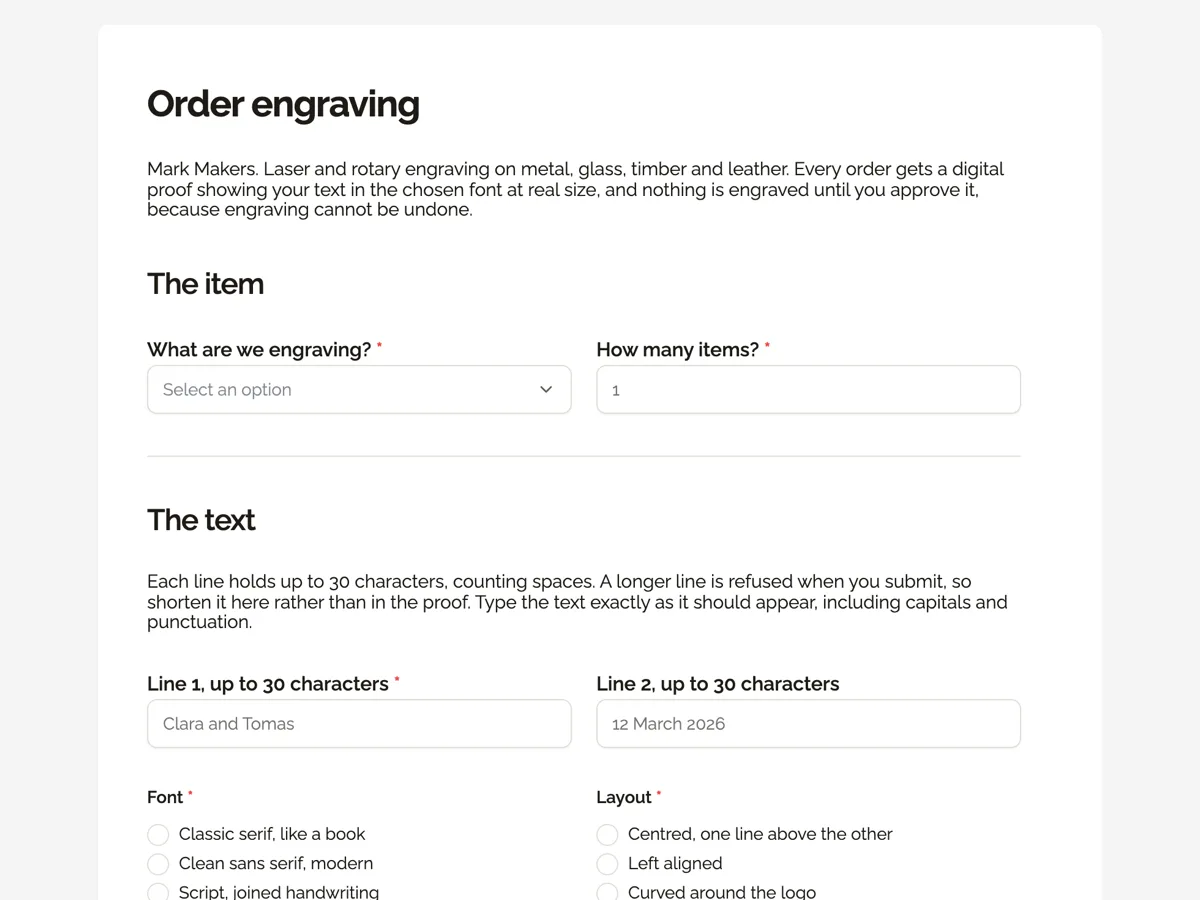
Engraving order form with a text proof and font choice
An engraving order form has to get the exact words, spelled and spaced as they should be cut, because an engraved mistake cannot be fixed. This one limits each of two lines to 30 characters, asks the font and layout as named styles, and sends a proof for approval before any item is engraved.
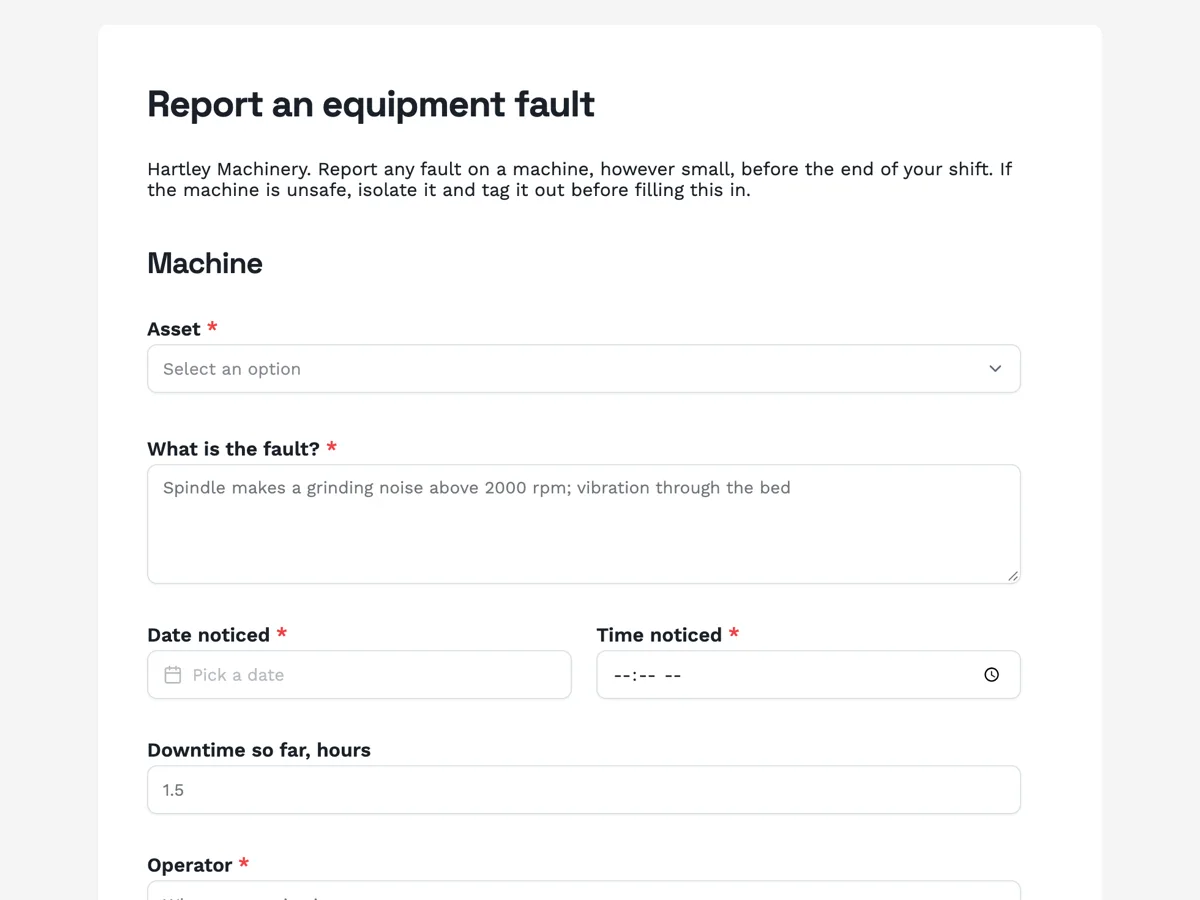
Equipment fault report form for a machine shop
An equipment fault report form tells maintenance which machine is faulty, what is wrong, when it was noticed, how long it has been down, who was running it, whether it is isolated and how urgent it is. This machine shop version adds a photo and sends each report on to the maintenance system.
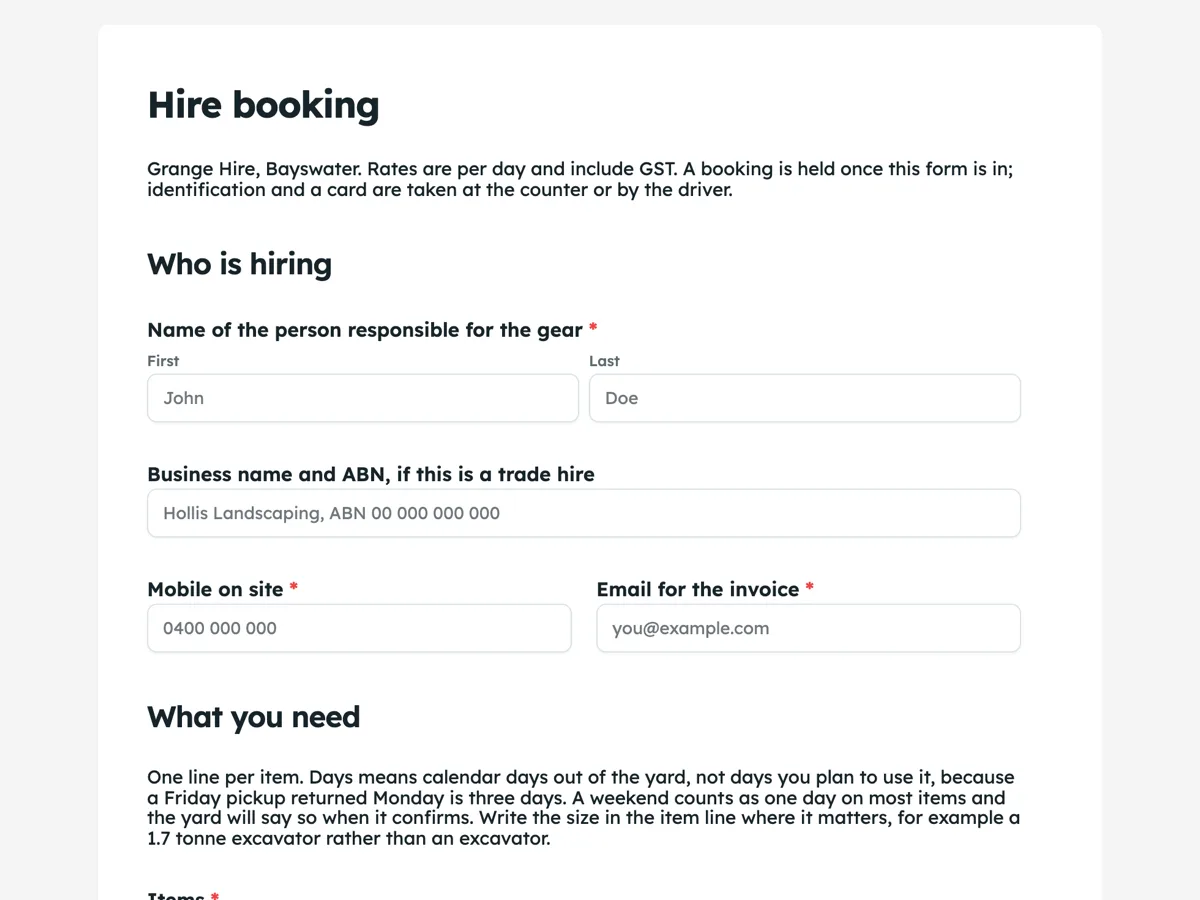
Equipment hire booking form with the items as a table
A hire yard prices a booking from three columns, which are the item, how many and for how many days, and everything else on a hire form is about getting the gear to a site and back. This booking form takes those three as a table, asks what the truck will find when it arrives, and closes with the waiver and the terms signed.
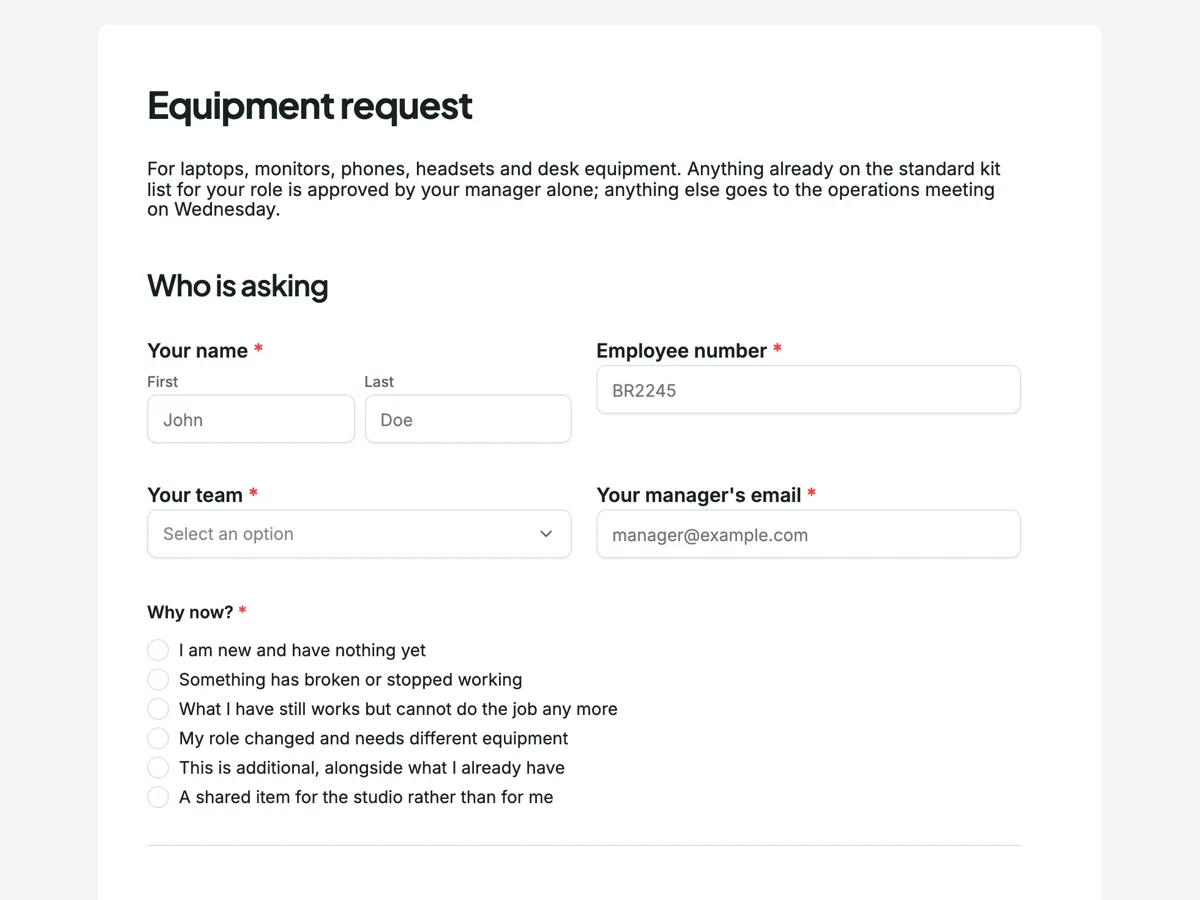
Equipment request form
An equipment request that only says "I need a new laptop" costs two more emails before anybody can act on it. This one asks for a rough price per line so the approver knows whether it is theirs to sign, takes a photo of the fault when something is being replaced, and puts the asset return terms on the page before the request is sent rather than in a policy nobody opened. It is a classic form, because the photo field and the item table have to sit beside each other.
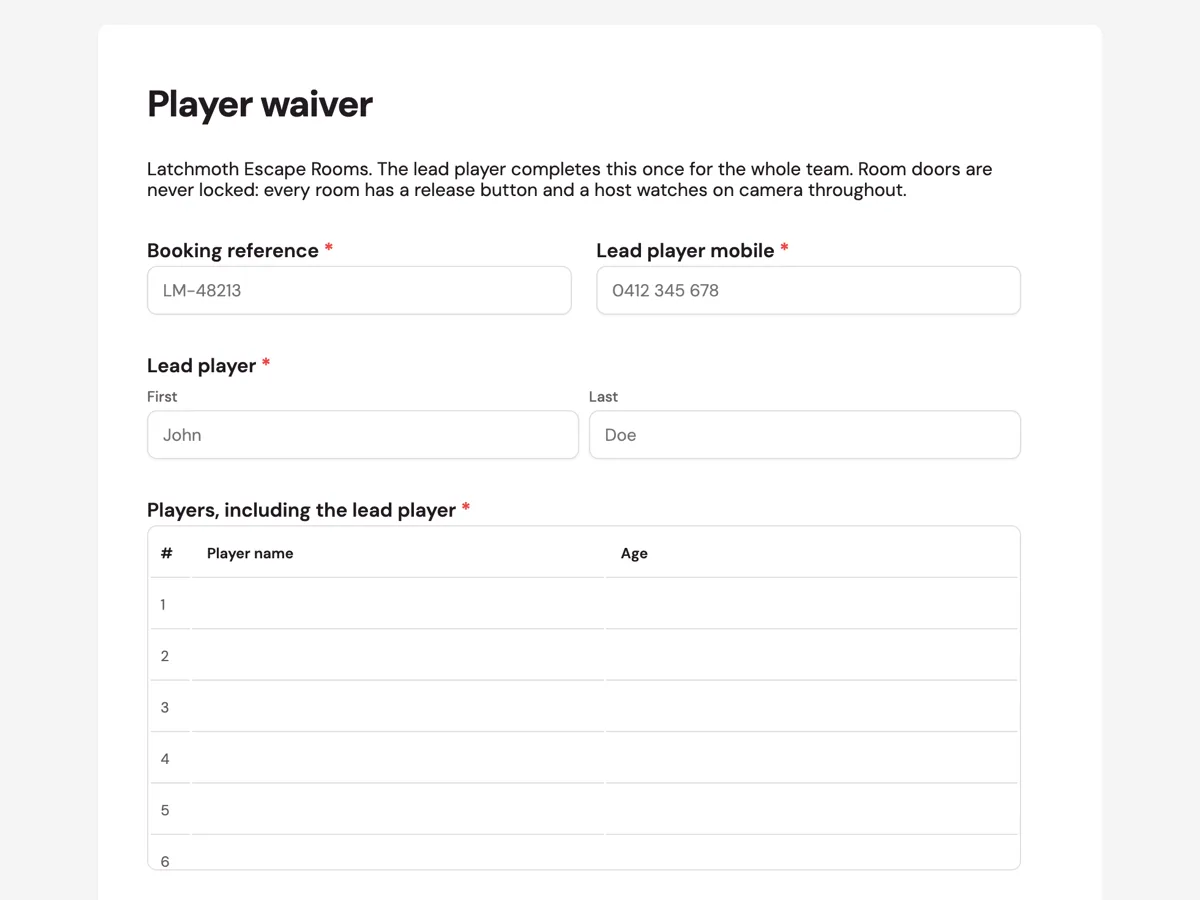
Escape room waiver with a player table and a claustrophobia check
An escape room waiver records that the team has read the room rules and told the host about anything that could make a dark, enclosed room unsafe. This one is signed once by the lead player, with a six player table, a conditions checklist and the promise that doors are never locked.
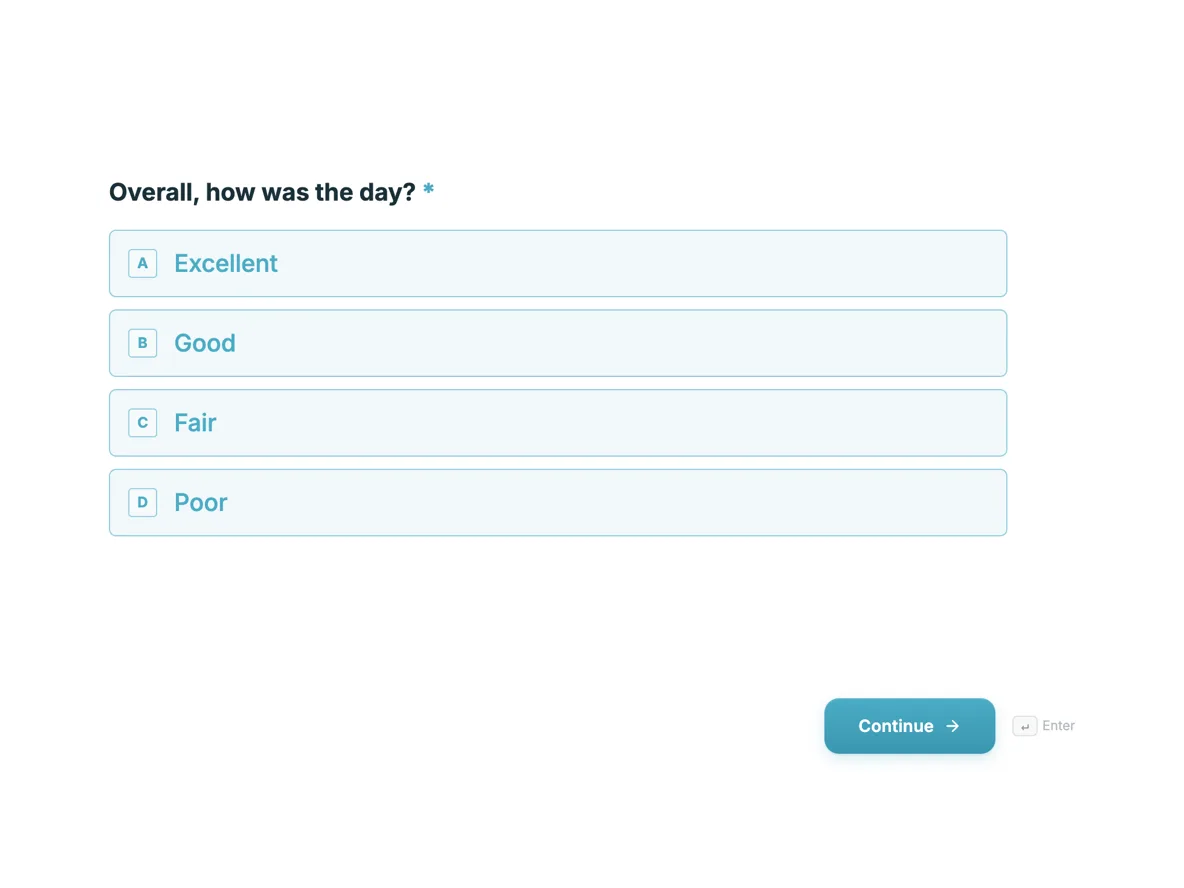
Event feedback form that asks what to change
Feedback collected a week later is memory; collected the next morning it is evidence. This survey is eight screens, two of them free text, built so the organiser gets a ranked list of sessions and two sentences per person about what to keep and what to drop.
Event sponsorship enquiry form
A sponsorship enquiry is not a booking, it is the two minutes that decide which pack gets sent. This one asks the three things a partnerships team has to guess at otherwise: roughly what the budget is, what the sponsor actually wants, and when they have to decide. It is conversational, one question per screen, because an enquiry is a conversation and nine boxes at once reads as a credit check.
EWP pre start checklist for boom lifts
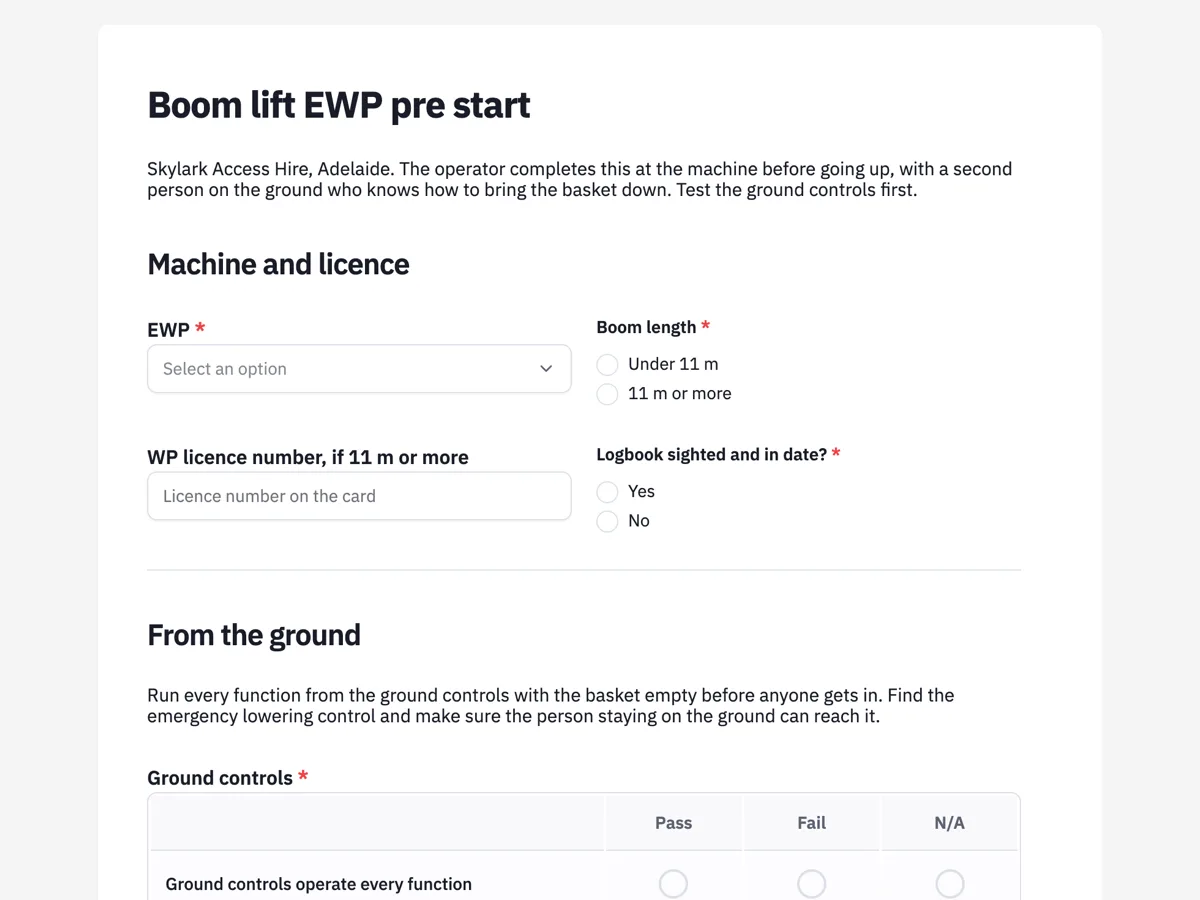
An EWP pre start checklist runs every function from the ground controls, tests the emergency stop and emergency lowering, then checks the basket gate, anchor, platform controls and harness before anyone goes up. This boom lift version also records the WP licence line at 11 metres and makes the operator write a rescue plan.
Excavator pre start checklist with quick hitch checks
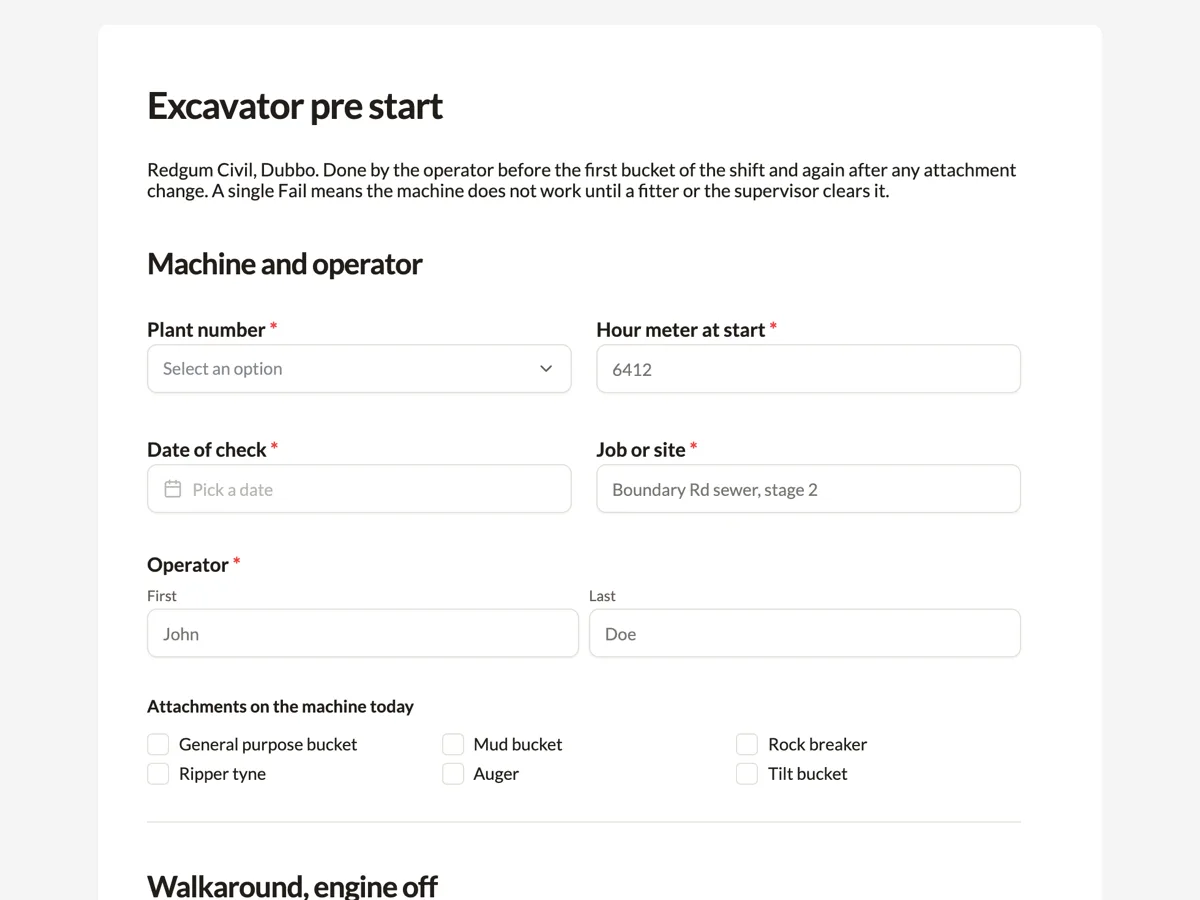
An excavator pre start checklist is the operator's walkaround before the first bucket: tracks, hoses, fluids, the rollover cab, the alarm and the quick hitch, each marked Pass, Fail or N/A. This one adds the three hitch checks that stop a bucket falling off and a tag out question that keeps a faulty machine parked.
Exchange program application form with host preferences and unit mapping
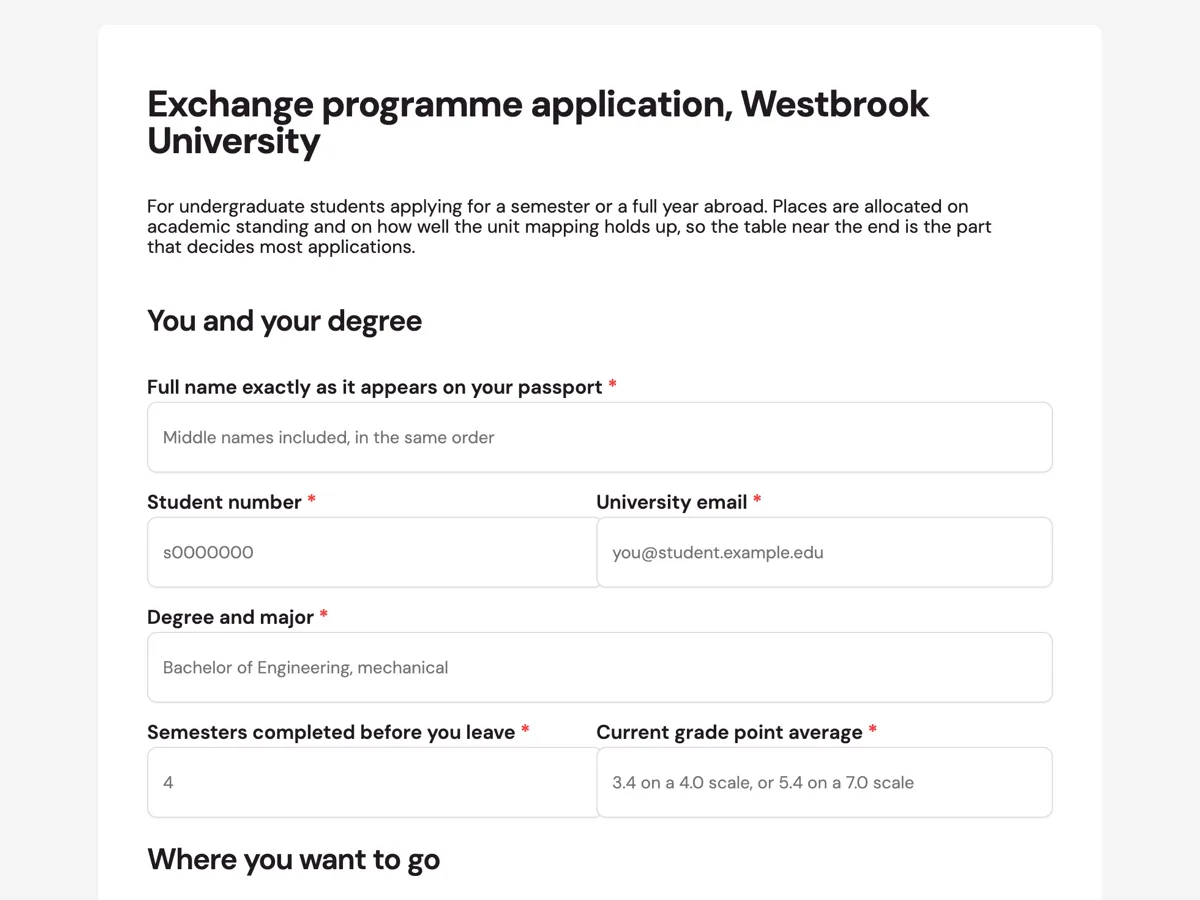
An exchange place is only useful if the units taken abroad come back as credit, and that mapping is the part most applications get wrong. This fifteen field form ranks three host universities, records the language of instruction honestly, and puts a four row unit mapping table at the centre of the decision.
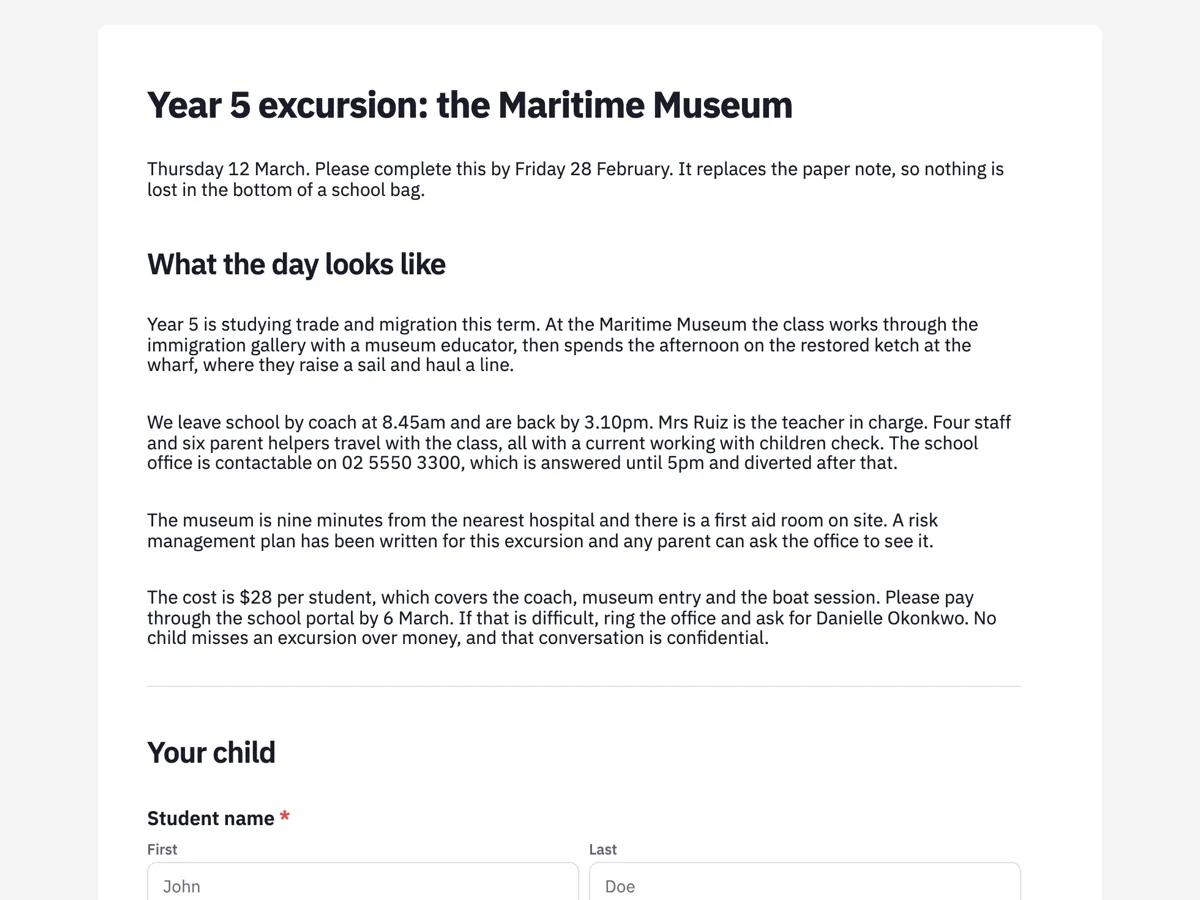
Excursion permission form
Consent only counts if the parent had enough information to give it, which is why half of this form is the school telling you about the day before it asks you for anything. The rest is the health picture for one Thursday and the four things parents most often say nobody told them. It is a classic form, because a page of information reads better as a page than as a series of questions.
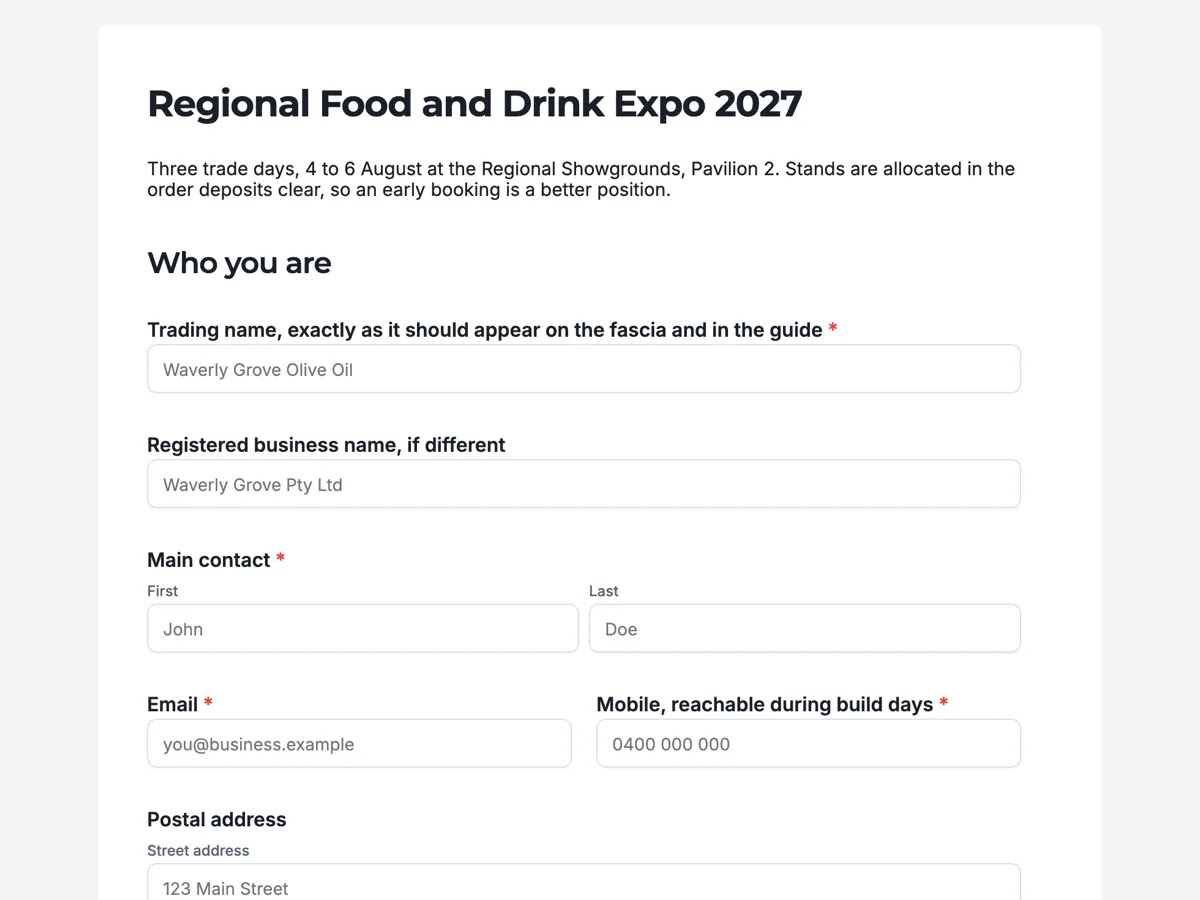
Exhibitor stand booking form
A stand booking is a contract, an order for services and a safety record all at once, which is why it ends in a signature and a position in the business. This one takes the floor plan detail, the add ons that get forgotten until build day, and the insurance evidence as structured fields rather than a promise. It is a classic form, because it is a contract, and a contract revealed one question at a time is not one anybody would sign.
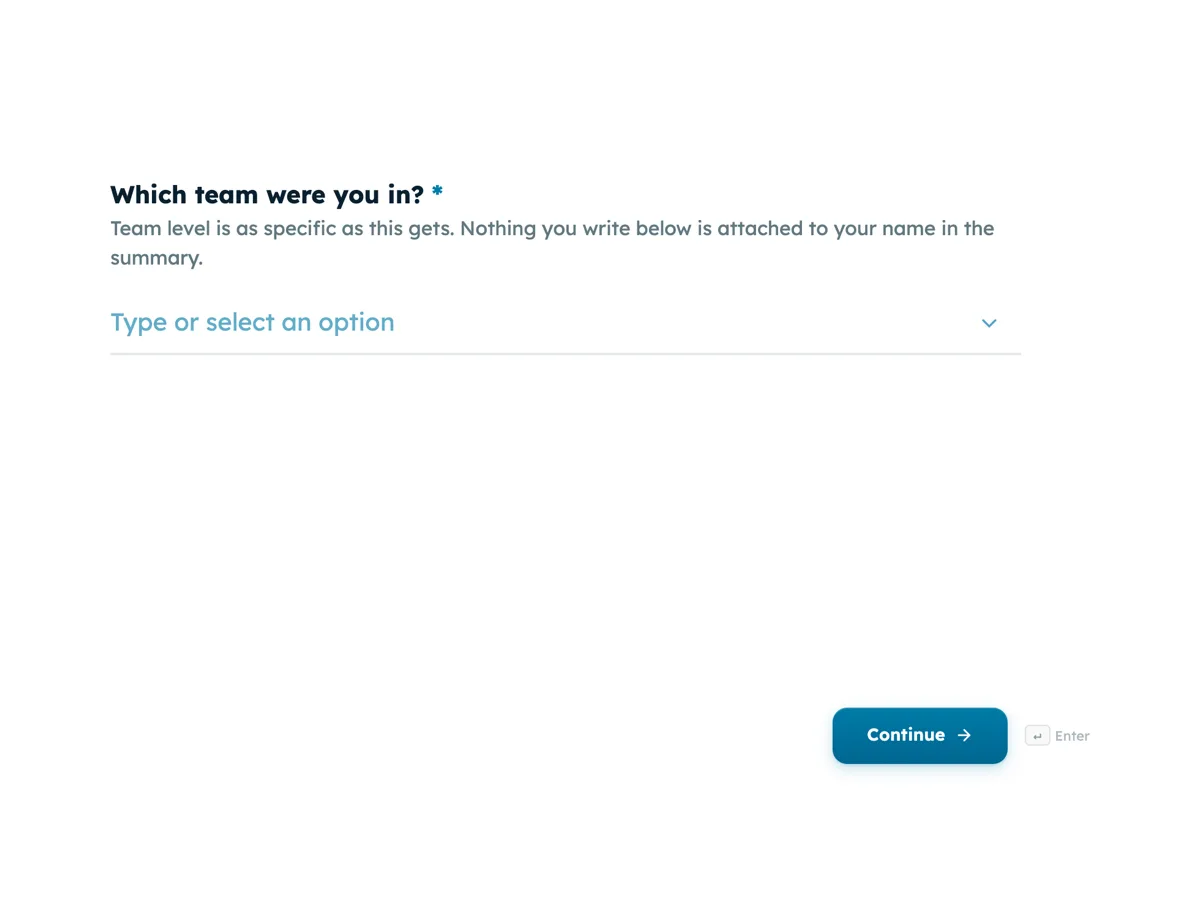
Exit interview form
Exit interviews collect polite nothing when the leaver cannot tell who will read the answers. This one settles that in the first screen, separates the thing that started the search from the thing that finished it, and ends by asking what may be shared and with whom. It is conversational, because fourteen questions asked one at a time get longer written answers than the same fourteen stacked on a page.
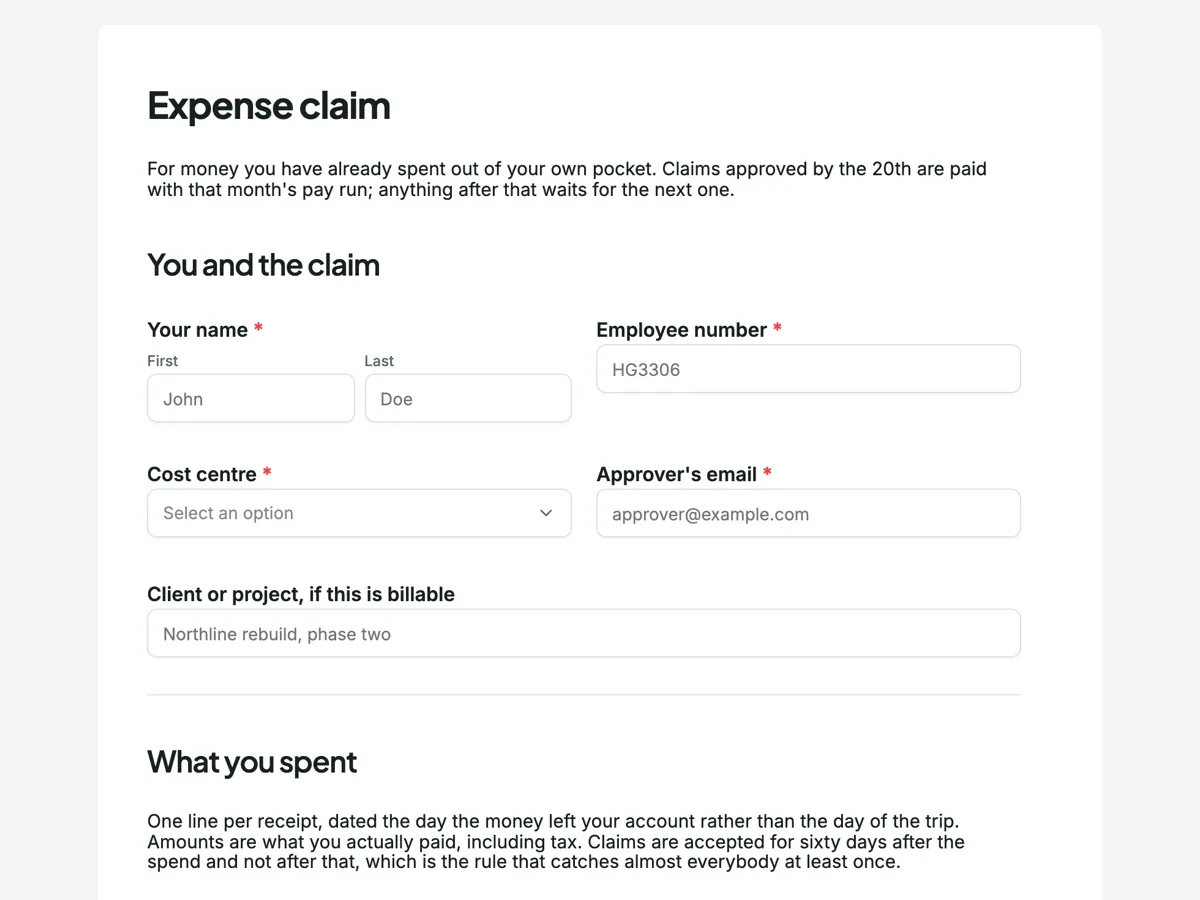
Expense claim form
Expense claims come back for boring reasons: a missing receipt, a date outside the window, or fuel claimed on top of a kilometre rate. This claim states each of those rules in the block where it applies, and gives the line items a table with six rows so a normal trip fits without an attachment. It is a classic form, because a claim is checked as a whole and a receipt upload has to sit beside the lines it belongs to.
Start from a description instead
You do not have to start from an example. Describe the form you need in a sentence and the generator writes the fields for you, in your language and your colours.
Build a form